





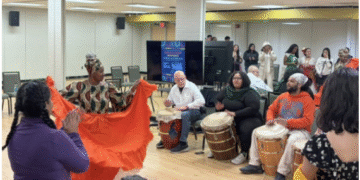














Smoke from the sacred fire curled between the dry leaves as Mary Lee, 55, an Anishinaabe woman from the Little River Band of Odawa nation, placed trays of fry bread and wild rice soup to honor her ancestors at the Ghost Supper at the Fenner Nature Center in Lansing on November 6th, where dozens gathered.
“This is what our ancestors always ate, and this is how we remember them. I try to teach my granddaughters how to cook it,” Lee said.
The Ghost Supper is a drop-in feast that celebrates those who are in the spirit world. Across the Great Lakes region, when autumn reaches its midpoint and the leaves begin to fall, the Anishinaabe nations, Ojibwe, Odawa, and Potawatomi honor their loved ones who no longer live among us by sharing dishes in communal suppers.
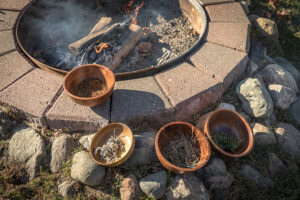
This celebration is taking place in the first 3 weeks of November at several locations across Michigan. At the Nokomis Learning Center, a museum of the Anishinaabe people located in Okemos, dozens of community members of all ages brought dishes and drinks to share and celebrate in memory of their ancestors on Sunday, November 2nd in the afternoon.
“Generous spirit, we are giving our hearts to this tobacco and prayer,” began a prayer recited in Anishinaabemowin, the Anishinaabe language, to those present before the elders went to serve their dishes before the youngest ones; while outside, the sacred fire would be kept alive until the end of the meeting, as in every gathering.
Next to the sacred fire, which was set before the feast, was Ramona Henry, 41, an Anishinaabe woman from the Ojibwe nation and a member of the Saginaw Chippewa tribe. She took a handful of medicine: tobacco, cedar, sage, and sweetgrass from their containers before putting them into the fire along with a short prayer; then, she explained the purpose of the celebration.
“You’re here honoring those who came before, but you’re also making a dish they loved, something that represents them. That’s a way of welcoming them,” said Henry who is part of the organizers of the Ghost Supper in Lansing.
Similar to the Day of the Dead concept by indigenous communities in Mesoamerica and South America, for the Odawa people, “the veil to our regular world and our spirit, is open,” explained Henry.
“The creator gives us time with our loved ones,” she added.
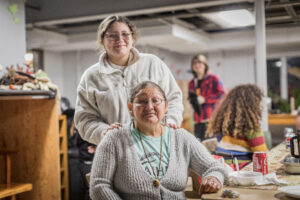
Although this tradition is from the Odawa nation, other Anishinaabe nations also practice it, sharing it among themselves from reservations to urban areas.
On various reservations in Michigan, during the first weeks of November, those who host ghost suppers leave their doors open as an invitation to community members and spirits, while in urban areas, community dinners are organized.
“We are all known as Anishinaabe, but we have different traditions. The Ghost Supper comes from the Odawa people. Even though I’m Anishinaabe, I honor it,” said Henry. “We Ojibwe people offer spirit plates throughout the year. For example, my brother is no longer here, so anytime I think of him, I’ll make his favorite food and then leave it in the woods or into the fire.”
Todd Parker, an attendee at the Nokomis Center, said food is all what is about and it is a way of recognizing the spirit of the creator.
“Among all the gifts you can give, food is the number one because food sustains life,” Parker said while more attendees with full plates in their hands approached his table to sit next to him.
Parker highlighted the importance of maintaining the tradition of these events for the native community living in urban areas far from the reserves. “A lot of people have a hard time doing the supper on their own. Students 2,000 miles from home or older people who sometimes live alone have to do it this way. So, we all share here as a community,” he said.
Many return to this celebration to share and listen to stories, where elders share knowledge with younger people, especially those who want to learn more about their own culture.
Emily Sorroche, 43, director of the Office of Culture, Access, and Belonging at MSU, says that in this way, the youngest learn the values and traditions because they will represent these events in the future. However, there are some challenges among native college students.
“They may not have heard about things like this for whatever reason,” Sorroche said. “Maybe they get too much email, or didn’t read about the event on time, or maybe they aren’t connected to the people who know about these things. So that’s a challenge we often come across.
“There is a lot of stereotype and discrimination. And because a lot of the native people don’t live in their tribal communities, it’s hard to keep those traditions going when you aren’t surrounded with it,” added Henry.
Despite the challenges, both Sorroche and Henry agree on the importance of closing the cultural gap for native youth who wish to maintain and learn about the culture they have inherited. Events like the Ghost Supper in the city are part of that effort.