















Sajama National Park
Bolivia, home to the Salar de Uyuni and one of the countries through which the Andes mountain range passes, boasts more than 10 mountains, peaks, and volcanoes that rise above 6,000 meters above sea level (m.a.s.l.), the highest being the Sajama volcano in the Andes.
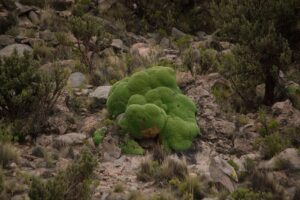
The name Sajama comes from the Aymara language, as the Aymara people are the second largest in Bolivia, after the Quechua. Thus, the name Sajama originates from Aymara words; however, it has not been determined whether it corresponds to the concept of Chak Xaña, meaning “distant,” or Chak-jjaña, meaning “west.”
The snow-capped Sajama volcano is located in the Bolivian Altiplano within Sajama National Park, where other peaks of the mountain range are also found. The community of Sajama, located at the foot of the snow-capped Sajama volcano at an elevation of 4,238 meters above sea level, is surrounded by other mountains that reflect the surrounding landscape like mirrors, as well as geysers from which hot water erupts, transforming this otherwise cold place into a haven of warm surprises. The town of Sajama has fewer than 1,000 inhabitants, yet it is able to accommodate and provide basic necessities to tourists seeking hiking and mountaineering experiences, whether on the Sajama volcano, or on the Cholcani or Pomerape volcanoes.
In Sajama National Park, you can find exceptional animal species, such as chinchillas, a whiskered rabbit-squirrel. You can also see vicuñas, which are smaller than llamas, even smaller than alpacas.

Bolivian Poetry
Melissa Sauma Vaca (Santa Cruz de la Sierra, 1987) is a poet and photographer. She has published Luminiscencia (2017, Editorial 3600 and 2017, Editorial Llamarada Verde), which received the National Prize for New Writers from the Santa Cruz Book Chamber in 2017, and Maneras de parar el mundo (2021, El Ángel Editor and 2022, Editorial Llamarada Verde).
Everything in everything
To think that everything is made of the same thing: of us
that on the ground I walk on the bones of my children
will be dissolved
when I am nothing more than a phrase written
in what was once part of a forest.
That everything that exists is formed
of the same matter in different proportions
and a small exercise of chance is what determines
that the rose is a rose and the lynx is a lynx.
That within each atom of my being is contained
the emptiness contained within the atoms of every other creature
that this is the substance we share
that which separates and unites us.
That in the earth and water and air and fire
lies the record of the past and the future
and everything we build is part of something that already exists
and will continue to exist when we are gone.
That we never truly leave
that we continue to journey through the flow of life
as a fossil, a snow-capped peak, a cloud, or a river.
People in the Rain
Those who run because of the myth accepted in childhood
those who cover their heads with the shopping list
or with a brown paper envelope
those who sense that covering up is useless
those who read poems under plump drops
that slide down, deforming the book
and will say that the figures the ink drips
are also poetry
those who flee from the rain as from anything
that might disturb the order
those who look for the sun on the other side of the clouds
and stare back at the light, waiting for the rainbow
those who always carry an umbrella under their arm
those who sell umbrellas
those who wear a raincoat even when it’s not raining
those with waterproof skin
those who are rain
those who complain about the weather and frown
those who act as if it hasn’t rained
those who dance
before, during, and after the rain
those who sing
for it to rain, for it to stop raining, because it has rained
those who watch it rain From the gallery, they write about the rain:
those who classify the drops by size, speed, and frequency of fall
those who categorize people in rainy situations
those who write treatises on surviving deluges
those who put on music and turn up the volume on melancholy
those who hear music in the rain
those who hope it doesn’t last long because they have so much to do
those who don’t realize it has rained
until the river overflows
and they have to move to another country
and there’s no time left
to pack
or say goodbye
to the neighbors.
Parque Nacional Sajama
Bolivia, casa del Salar de Uyuni y uno de los países por los que pasa la cordillera andina, lo que le ha dado más de 10 montañas, picos y volcanes que se elevan por encima de los 6,000 metros sobre el nivel del mar (m.s.n.m.), siendo el más elevado el volcán de Sajama, en la cordillera andina.
El nombre de Sajama proviene de la lengua aymara, pues, siendo en Bolivia el pueblo Aymara el segundo más importante, detrás del Quéchua. Así, el nombre de Sajama tiene origen en palabras aymaras, no obstante, no se ha logrado definir si responde al concepto Chak Xaña, que significa “distante”, o bien, Chak-jjaña que significa “oeste”.
El volcán nevado de Sajama se encuentra en el altiplano boliviano en el Parque Nacional Sajama, donde también se encuentran otros picos de la cordillera.
La comunidad de Sajama, que se encuentra a las faldas del volcán nevado Sajama, a una elevación de 4,238 m.s.n.m., rodeada de otras montañas que fungen como espejos, así como géisers de donde brota el agua caliente, haciendo de aquel sitio frío, un espacio de sorpresas cálidas. La población Sajama cuenta con menos de 1,000 habitantes, mas es capaz de recibir y proveer de básicos a los turistas de la zona que buscan experiencias de senderismo y alpinismo ya sea hacia el Nevado de Sajama, o bien, al volcán Cholcani o el Pomerape.
En el Parque Nacionala de Sajama se encuentran especies de animales excepcionales, como son los chinchillones, una especie de conejo-ardillas bigotonas. También se ven las vicuñas, que son más pequeñas que las llamas, incluso menores que las alpacas.
Poesía boliviana
Melissa Sauma Vaca (Santa Cruz de la Sierra, 1987) es Poeta y fotógrafa. Ha publicado Luminiscencia (2017, Editorial 3600 y 2017, Editorial Llamarada Verde), que recibió el Premio Nacional Noveles Escritores de la Cámara del Libro de Santa Cruz, 2017, y Maneras de parar el mundo (2021, El Ángel Editor y 2022, Editorial Llamarada Verde).
Todo en todo
Pensar que todo está hecho de lo mismo: de nosotros
que en el suelo que piso estarán disueltos
los huesos de mis hijos
cuando yo no sea más que una frase escrita
en lo que un día fuera parte de un bosque.
Que todo cuanto existe está formado
de una misma materia en distintas proporciones
y un pequeño ejercicio del azar es el que determina
que la rosa sea rosa y el lince sea lince.
Que en cada átomo de mi ser está contenido
el vacío contenido en los átomos de cualquier otra criatura
que es esa la sustancia que compartimos
lo que nos separa y unifica.
Que en la tierra y el agua y el aire y el fuego
está la bitácora del pasado y del futuro
y todo lo que construimos es parte de algo que ya existe
y seguirá existiendo cuando nos hayamos ido.
Que no nos vamos nunca
que seguimos transitando el fluir de la vida
como fósil, nevado, nube o río.
Personas bajo la lluvia
Los que corren por el mito aceptado en la infancia
los que se cubren la cabeza con la lista del mercado
o con un sobre de papel madera tamaño oficio
los que intuyen que cubrirse es inútil
los que leen poemas bajo orondas gotas
que resbalan deformando el libro
y dirán que las figuras que la tinta escurre
son también poesía
los que huyen de la lluvia como de cualquier cosa
que acaso pudiera alterar el orden
los que buscan el sol en el reverso de las nubes
y miran a contraluz esperando el arcoíris
los que siempre llevan un paraguas bajo el brazo
los que venden paraguas
los que usan impermeable aunque no llueva
los que tienen la piel impermeable
los que son lluvia
los que se quejan del clima y ponen mala cara
los que hacen como si no hubiera llovido
los que bailan
antes, durante y después de la lluvia
los que cantan
para que llueva, para que deje de llover, porque ha llovido
los que ven llover desde la galería y escriben sobre la lluvia
los que clasifican las gotas en tamaño, velocidad y frecuencia de caída
los que catalogan a las personas en situaciones de lluvia
los que escriben tratados de supervivencia a diluvios
los que ponen música y suben el volumen a la melancolía
los que escuchan en la lluvia una música
los que esperan que dure poco porque tienen que hacer mucho
los que no perciben que ha llovido
hasta que el río desborda
y hay que mudarse de país
y ya no hay tiempo
para hacer maletas
o despedirse
de los vecinos.