


















Guarani Myth About The Origin Of Language
The true Father Ñamandú, the First One, from a small portion of his own divinity, from the wisdom contained within his own divinity, and by virtue of his creative wisdom, caused flames and a faint mist to come into being.
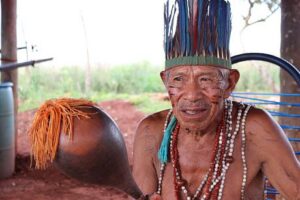
Having risen up (assuming human form), from the wisdom contained within his own divinity, and by virtue of his creative wisdom, he conceived the origin of human language. Our Father created the foundation of human language and made it part of his own divinity.
Before the earth existed, in the midst of the primordial darkness, before there was any knowledge of things, he created that which would be the foundation of human language (or the foundation of the future human language), and Ñamandú made it part of his own divinity as the true First Father.
Having conceived the origin of future human language, from the wisdom contained within his own divinity, and by virtue of his creative wisdom, he conceived the foundation of love for one’s fellow human beings.
Before the earth existed, in the midst of the primordial darkness, before there was any knowledge of things, and by virtue of his creative wisdom, he conceived the origin of love for one’s fellow human beings.
Having created the foundation of human language, having created a small portion of love, from the wisdom contained within his own divinity, and by virtue of his creative wisdom, he created, in his solitude, the origin of a single sacred hymn.
Before the earth existed, in the midst of the primordial darkness, before things were known, he created the origin of a sacred hymn in his solitude and for himself.
Having created, in his solitude, the foundation of human language; having created, in his solitude, a small portion of love; having created, in his solitude, a short sacred hymn, he reflected deeply upon whom he should make a participant in the foundation of human language; upon whom he should make a participant in that small love (for one’s fellow human beings); upon whom he should make a participant in the series of words that composed the sacred hymn.
Having reflected deeply, from the wisdom contained within his own divinity, and by virtue of his creative wisdom, he created those who would be companions of his divinity.
Having reflected deeply, from the wisdom contained within his own divinity, and by virtue of his creative wisdom, he created Ñamandú of the Great Heart.
He created him simultaneously with the reflection of his wisdom (the sun).
Before the earth existed, in the midst of the primordial darkness, he created Ñamandú of the Great Heart.
As the father of his future numerous children, as the true father of the souls of his future numerous children, he created Ñamandú of the Great Heart.
The Paraguayan Pantanal
The Pantanal is one of the largest freshwater wetlands in the world, covering approximately 150,000 km² in the upper basin of the Paraguay River. It extends across parts of three countries: Bolivia, Brazil, and Paraguay. In Paraguay, it is located in the northeasternmost part of the Western Region and extends southward along the Paraguay River to the area of the Apa River.
The Paraguayan Pantanal forms a large inland delta where, every year, the waters rise several meters, flooding an extensive territory and then receding, creating a naturally beautiful landscape that provides refuge for birds, fish, amphibians, reptiles, and mammals. It covers approximately 15,000 km² in the upper basin of the Paraguay River.
The Paraguayan Pantanal is considered one of the most interesting wetlands in the Americas because of its natural and cultural surroundings. In addition, the Paraguayan Pantanal is of great importance for bird conservation. Tuyuyus, herons, ducks, storks, cormorants, and common kingfishers can be found here. A total of 354 species are currently recorded in this wetland area, which includes rivers, forests, and palm groves.
El Pantanal paraguayo
El Pantanal es uno de los humedales de agua dulce más grande del mundo, cubriendo aproximadamente 150 mil km2 en la cuenca alta del Río Paraguay. Ocupa parte del territorio de tres países, Bolivia, Brasil, y Paraguay. En nuestro país está situado en el extremo noreste de la región occidental y se extiende hacia el sur a lo largo del Río Paraguay hasta la zona del Río Apa.
El Pantanal paraguayo constituye un gran delta interior donde anualmente las aguas suben varios metros, inundando un extenso territorio, y luego retroceden creando un escenario natural de gran belleza, refugio de aves, peces, anfibios, reptiles y mamíferos. Cubre aproximadamente 15. 000 km2 en la cuenca alta del río Paraguay.
El Pantanal paraguayo es considerado como uno de los más interesantes de América por su entorno natural y cultural. Además, el pantanal paraguayo es de gran importancia para la conservación de aves. Tuyuyues, garzas, patos, cigueñas, mbiguaes y martín pescador común. Se registran ahora 354 especies en este sitio de humedales ríos, bosques, palmares.
Mito Guaraní sobre el origen del lenguaje
El verdadero Padre Ñamandú, el Primero, de una pequeña porción de su propia divinidad, de la sabiduría contenida en su propia divinidad, y en virtud de su sabiduría creadora, hizo que se engendrasen llamas y tenue neblina. Habiéndose erguido (asumido la forma humana), de la sabiduría contenida en su propia divinidad, y en virtud de su sabiduría creadora, concibió el origen del lenguaje humano. Creó nuestro Padre el fundamento del lenguaje humano e hizo que formara parte de su propia divinidad. Antes de existir la tierra, en medio de las tinieblas primigenias, antes de tenerse conocimiento de las cosas, creó aquello que sería el fundamento del lenguaje humano (o el fundamento del futuro lenguaje humano) e hizo Ñamandú que formara parte de su propia divinidad de verdadero Primer Padre. Habiendo concebido el origen del futuro lenguaje humano, de la sabiduría contenida en su propia divinidad, y en virtud de su sabiduría creadora concibió el fundamento del amor (al prójimo). Antes de existir la tierra, en medio de las tinieblas primigenias, antes de tenerse conocimiento de las cosas, y en virtud de su sabiduría creadora concibió el origen del amor al prójimo. Habiendo creado el fundamento del lenguaje humano, habiendo creado una pequeña porción del amor, de la sabiduría contenida en su propia divinidad, y en virtud de su sabiduría creadora, el origen de un solo himno sagrado creó en su soledad.
Antes de existir la tierra en medio de las tinieblas originarias, antes de conocerse las cosas, el origen de un himno sagrado lo creó en su soledad y para sí mismo. Habiendo creado, en su soledad, el fundamento del lenguaje humano; habiendo creado, en su soledad, una pequeña porción de amor; habiendo creado, en su soledad, un corto himno sagrado, reflexionó profundamente sobre a quién hacer partícipe del fundamento del lenguaje humano; sobre a quién hacer partícipe del pequeño amor (al prójimo) sobre a quién hacer partícipe de las series de palabras que componían el himno sagrado. Habiendo reflexionado profundamente, de la sabiduría contenida en su propia divinidad, y en virtud de su sabiduría creadora creó a quienes serían compañeros de su divinidad.
Habiendo reflexionado profundamente, de la sabiduría contenida en su propia divinidad, y en virtud de su sabiduría creadora creó al Ñamandú de corazón grande. Lo creó simultáneamente con el reflejo de su sabiduría (el sol).
Antes de existir la tierra, en medio de las tinieblas originarias, creó al Ñamadú de corazón grande. Para padre de sus futuros numerosos hijos, para verdadero padre de las almas de sus futuros numerosos hijos creó al Ñamandu de corazón grande.