
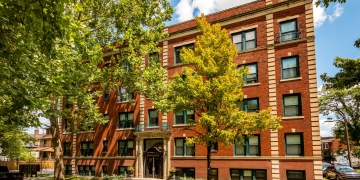



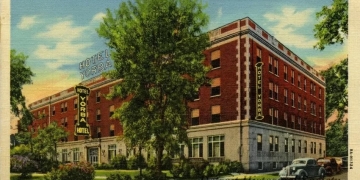










For generations, Hotel Yorba has been hard to miss. Its rooftop sign has towered over Lafayette Boulevard and is visible from Interstate 75, making it a familiar landmark in Southwest Detroit. Built in 1926, the four-story, 250-room building operated for decades as a low-cost rooming house, serving people in need of temporary housing. In 2001, it became part of Detroit’s musical history through its connection to The White Stripes.

Now, after years of deterioration and a city-ordered closure, Hotel Yorba is facing another turning point. Kahlil Assad, a longtime construction-industry executive and mechanical contractor who owns the family-run HVAC and refrigeration company The Air King, acquired Hotel Yorba after years of involvement in Detroit property ownership and redevelopment.
Unlike a conventional redevelopment project with a finished concept, Assad says he does not yet know exactly what the building will become. Instead, he is asking the neighborhood to help decide.
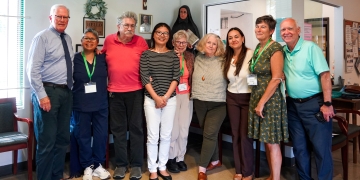
That conversation took place Aug. 20, when Assad and his team hosted a community barbecue outside Hotel Yorba to hear residents’ ideas for the property’s future. The gathering also gave Assad an opportunity to explain why his initial plan for low-income housing is being reconsidered after conversations with neighbors. “After we had closed on the property, we met the neighbors and immediately realized that that’s not what the neighborhood wanted,” Assad said.
The possibilities now range from retail and a restaurant to apartments, high-end condominiums, low-income housing, a hostel or another hotel. Rather than commit to one use, Assad said the team wants residents’ input. “We’re really looking for ideas of what the community is looking for,” he said, adding that the goal is to determine “what is going to work here” and what the neighborhood wants to see.
For some residents, seeing activity around the long-vacant building was encouraging. Emily Reyst, a Hubbard Farms resident who has lived in Detroit for six years and works in community development and affordable housing, attended to hear what neighbors wanted for the property. “I would just be really excited to see it revitalized and come to life in a new way,” Reyst said.
Adriana Zuniga, a longtime Southwest Detroit resident, welcomed the opportunity to offer her opinion. “I am grateful that someone did buy the building” she said. She favors a return to a hotel but also suggested affordable senior housing.
For longtime residents, however, the question is not only what the building becomes, but whether redevelopment preserves the role the Yorba has played in the community. Joseph Sarasua, a Hubbard Farms resident since 1991, remembers the Yorba as a transient hotel rather than a luxury destination. He said it housed displaced people and residents living from week to week, and sometimes refugees when other facilities were full.
“As long as I’ve been here, it’s been a transient hotel that houses a lot of people that were displaced or living from week to week,” Sarasua said. “It never really was, as long as I’ve lived here, a luxury hotel.”
Sarasua remembers the building before its condition worsened. When he moved to the neighborhood, he said, the main entrance had recently been restored and the windows repaired. “It needed work. It always needed work,” he said. “But it wasn’t like this. It wasn’t as bad.”

The deterioration eventually led to the city’s intervention. According to the Detroit Free Press, in September 2025, Detroit officials ordered Hotel Yorba vacated after inspectors found unsafe conditions, including a leaking roof, collapsing ceilings on the third and fourth floors, an infestation of insects and vermin, missing and defective smoke detectors and a nonfunctional fire alarm panel.
That history is part of what Sarasua wants developers to consider. He supports renovating the hotel but worries redevelopment could make the neighborhood less accessible to existing residents. He added that higher prices could contribute to the gentrification he has seen in the neighborhood.
The Yorba’s history extends beyond housing. Built as a residential hotel, it was associated with Detroit’s working-class history and workers involved in construction of the nearby Ambassador Bridge. Decades later, it became part of the city’s rock-and-roll mythology.
In 2001, The White Stripes released “Hotel Yorba” on their album White Blood Cells, and the building appeared in the song’s music video. Assad said that connection remains important. White Stripes fans have visited the property, he said, and the development team plans to include a dedication to the band, which has no direct involvement in the redevelopment.
Preserving the building’s history will be complicated by its condition. Assad said much of the interior has been stripped, including doors, brass fixtures, electrical wiring and phone cable. Still, he said the team intends to preserve as much of the remaining structure as possible.
“We want to keep this as historical as possible; we’re not looking to change everything. The priority is stabilization,” Assad said, adding that his team has installed a new roof to prevent further water damage. The project remains in its financial and design-planning stages, with permitting expected before substantial construction begins. Assad estimates the redevelopment will take 24 to 36 months, with the immediate focus on preparing the property, design, permitting, financial planning and community outreach.
For now, Hotel Yorba remains caught between its past and its future. The building has a new owner working to restore it and a neighborhood being asked to imagine what comes next. “We welcome the community involvement,” Assad said. “We welcome anybody to come out and share their opinion.”
Residents who want to offer suggestions can follow Hotel Yorba Detroit on Instagram (@hotelyorbadetroit) or contact Assad at Kahlilassad@theairking.com.
Durante generaciones, el Hotel Yorba no ha pasado desapercibido. El letrero de su azotea se ha alzado sobre el bulevar Lafayette y es visible desde la autopista I-75, convirtiéndolo en un ícono familiar del suroeste de Detroit. Construido en 1926, el edificio de cuatro plantas y 250 habitaciones funcionó durante décadas como una casa de huéspedes de bajo costo, atendiendo a personas que necesitaban un alojamiento temporal. En 2001, pasó a formar parte de la historia musical de la ciudad a través de su vínculo con la banda The White Stripes.
Ahora, tras años de deterioro y un cierre ordenado por la ciudad, el Hotel Yorba se encuentra ante un nuevo punto de inflexión. Kahlil Assad, un veterano ejecutivo de la construcción y contratista mecánico, dueño de la empresa familiar de climatización y refrigeración The Air King, adquirió la propiedad tras años de trayectoria en el sector inmobiliario y de reurbanización en Detroit.
A diferencia de un proyecto de remodelación convencional que parte de un concepto definitivo, Assad asegura que aún no sabe con certeza en qué se convertirá el inmueble. En su lugar, está pidiendo la colaboración del vecindario para decidirlo.
Ese intercambio tuvo lugar el 20 de agosto, cuando Assad y su equipo organizaron una barbacoa comunitaria frente al Hotel Yorba para escuchar las propuestas de los residentes. El encuentro también sirvió para que el empresario explicara por qué reconsideró su plan inicial de construir viviendas de interés social tras conversar con los vecinos. “Una vez que cerramos la compra del inmueble, nos reunimos con la gente del barrio e inmediatamente nos dimos cuenta de que eso no era lo que buscaban”, señaló Assad.
Las alternativas actuales van desde locales comerciales y un restaurante hasta departamentos, condominios de alta gama, viviendas asequibles, un hostal o un nuevo hotel. En lugar de comprometerse con un solo uso, Assad enfatizó que el equipo busca la opinión de la gente. “Buscamos ideas sobre lo que la comunidad realmente necesita”, afirmó, añadiendo que el objetivo es determinar “qué va a funcionar aquí” y qué quiere ver el vecindario.
Para algunos residentes, ver movimiento alrededor de un edificio que estuvo abandonado tanto tiempo resulta alentador. Emily Reyst, vecina de Hubbard Farms que vive en Detroit desde hace seis años y trabaja en desarrollo comunitario y vivienda asequible, asistió para escuchar las inquietudes locales. “Me entusiasmaría mucho verlo revitalizado y cobrando vida de una forma nueva”, comentó Reyst.
Adriana Zuniga, residente de toda la vida del suroeste de Detroit, celebró la oportunidad de dar su punto de vista. “Agradezco que alguien haya comprado el edificio”, expresó. Zuniga se inclina por que vuelva a funcionar como hotel, aunque también sugirió viviendas asequibles para adultos mayores.
Sin embargo, para los residentes más antiguos la cuestión no es solo en qué se transformará el edificio, sino si la remodelación preservará el papel que el Yorba ha desempeñado históricamente en la comunidad. Joseph Sarasua, vecino de Hubbard Farms desde 1991, recuerda el inmueble como un hospedaje de paso más que como un destino de lujo. Explicó que allí se albergaba a personas desplazadas, a residentes que vivían al día y, en ocasiones, a refugiados cuando otros centros estaban llenos.
“Desde que vivo aquí, siempre ha sido un hotel de tránsito que acogía a mucha gente desplazada o que pagaba semana a semana”, recordó Sarasua. “Nunca fue, en todo el tiempo que llevo aquí, un hotel de lujo”.
Sarasua recuerda la propiedad antes de que su estado empeorara. Cuando se mudó al barrio, la entrada principal acababa de ser restaurada y las ventanas reparadas. “Necesitaba mantenimiento, siempre hizo falta”, comentó. “Pero no estaba así, no estaba tan mal”.
El deterioro progresivo derivó finalmente en la intervención municipal. Según reportó el Detroit Free Press, en septiembre de 2025 las autoridades de Detroit ordenaron el desalojo del Hotel Yorba después de que los inspectores detectaran condiciones inseguras, como filtraciones en el techo, derrumbes de cielo raso en el tercer y cuarto piso, plagas de insectos y roedores, detectores de humo faltantes o averiados y un panel de alarma contra incendios inoperativo.
Esa trayectoria es parte de lo que Sarasua pide que los desarrolladores tengan en cuenta. Aunque apoya la renovación del inmueble, le preocupa que el proyecto vuelva el barrio inaccesible para los residentes actuales, y advierte que el aumento de precios podría acelerar el proceso de gentrificación que ya se observa en la zona.
La historia del Yorba va más allá de lo habitacional. Edificado como un hotel residencial, estuvo ligado a la historia de la clase trabajadora de Detroit y a los obreros que participaron en la construcción del cercano puente Ambassador. Décadas después, se integró a la mitología del rock and roll local.
En 2001, The White Stripes lanzó el sencillo “Hotel Yorba” como parte de su álbum White Blood Cells, y el edificio apareció en el video musical del tema. Assad afirmó que esa conexión sigue siendo importante. Fans del grupo han acudido a visitar el lugar, por lo que el equipo de desarrollo planea incluir un espacio dedicado a la banda, la cual no tiene participación directa en la obra.
Preservar el legado histórico del edificio será complejo debido a su estado actual. Assad detalló que gran parte del interior fue desmantelado, incluidos marcos de puertas, accesorios de latón, cableado eléctrico y líneas telefónicas. Aun así, aseguró que la intención es conservar la mayor parte posible de la estructura remanente.
“Queremos mantener esto tan fiel a su historia como sea posible; no buscamos cambiarlo todo. La prioridad es la estabilización”, explicó Assad, destacando que ya instalaron un techo nuevo para frenar los daños por agua. El proyecto se encuentra en fase de planificación financiera y de diseño, y se prevé la tramitación de permisos antes de iniciar las obras mayores. El desarrollador estima que la remodelación tomará entre 24 y 36 meses, enfocándose por ahora en la preparación del inmueble, el diseño, la gestión de permisos, el esquema financiero y el acercamiento comunitario.
Por lo pronto, el Hotel Yorba permanece entre su pasado y su futuro: una edificación con un nuevo propietario que busca restaurarla y un vecindario al que se le invita a imaginar lo que vendrá. “Agradecemos la participación de la comunidad”, concluyó Assad. “Cualquiera es bienvenido a acercarse y compartir su opinión”.
Los residentes interesados en enviar sugerencias pueden seguir la cuenta de Instagram del Hotel Yorba Detroit (@hotelyorbadetroit) o escribir a Assad al correo Kahlilassad@theairking.com.