















The Ruins of Copán are one of the most important archaeological sites of the ancient Maya civilization in Honduras, and we should not forget that Maya culture is still very much alive today.

The Ruins of Copán are located in the Copán Valley in western Honduras, near the border with Guatemala. During the Classic Period, Copán became an important political, civic, and religious center, as well as one of the main cultural centers in the southeastern Maya region. Its importance goes beyond its impressive structures, as research conducted at the site has provided valuable insight into many aspects of the political organization, religion, art, writing, mathematics, and astronomy of the ancient Maya.
The Copán Valley has a much longer history than the period when the city reached its greatest splendor. There is evidence of human settlement in the valley dating back to around 1500 BC, while Maya presence has been documented from around 100 AD. However, Copán reached its greatest development during the Classic Maya period, between the 3rd and 9th centuries AD. In 427, Yax K’uk’ Mo’ arrived in the valley and established a dynasty of 16 rulers that transformed Copán into one of the great Maya cities of its time. The city was eventually abandoned in the early 10th century.
The Copán Archaeological Park includes an important collection of plazas, temples, terraces, and other architectural structures. Among its most notable areas are the Great Plaza and the Acropolis, which formed the political and religious heart of the city. The Hieroglyphic Stairway is another remarkable feature and one of the most extraordinary structures in Maya architecture. Its steps contain more than 1,800 glyphs, making it the longest known Maya inscription. This record has been fundamental to researchers because it provides historical information about the rulers and events of Copán.
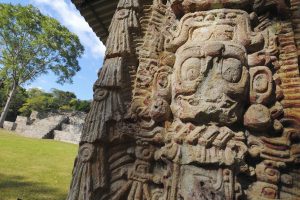
The monumental complex that visitors can see today represents only part of the ancient city. Archaeological studies have identified more than 4,500 structures or mounds throughout the Copán Valley, as well as different residential areas surrounding the monumental center. The architecture, stelae, altars, and sculptures found at the site demonstrate the high level of artistic achievement reached by its inhabitants. Copán’s sculpture is particularly well known for the quality and complexity of its representations.
For all these reasons, Copán is a fundamental source for the study of Maya civilization. Research carried out on its buildings, sculptures, and inscriptions has helped reconstruct aspects of the city’s political and cultural history, as well as that of an important part of the Maya world. UNESCO added the Maya Site of Copán to the World Heritage List in 1980, recognizing its exceptional architectural, artistic, and historical value. In 1982, a presidential decree also established the Copán National Monument, which covers a larger area of the valley and provides protection for its archaeological remains.
However, it would be inaccurate to think of the Maya solely as a civilization of the past. Maya peoples are still very much alive today and are an important part of Mesoamerica’s cultural diversity. Today, Maya communities and peoples live in Mexico, Guatemala, and Belize, and there are also Indigenous peoples of Maya affiliation in Honduras. Over the centuries, these communities have preserved and adapted their traditions, knowledge, forms of organization, and cultural expressions. For this reason, it is not accurate to speak of a single, homogeneous Maya culture, but rather of a great diversity of peoples and communities, each with their own histories and characteristics.
This continuity can also be seen in their languages. The Maya language family consists of numerous languages and linguistic groups, including Yucatec Maya, or Maayat’aan, K’iche’, Kaqchikel, Q’eqchi’, Mam, Tseltal, Tsotsil, and others. The National Institute of Indigenous Languages indicates that the Maya language family is found mainly across southern Mexico, Guatemala, and Belize, and that Mexico is home to numerous linguistic groups belonging to this family. Maayat’aan, for example, is still spoken in the states of Yucatán, Campeche, and Quintana Roo, as well as in northern Belize.
Las Ruinas de Copán son uno de los sitios arqueológicos más importantes de la antigua civilización maya en Honduras, no debemos olvidar que la cultura maya sigue viva hasta la actualidad.
Las Ruinas de Copán se encuentran en el Valle de Copán, al occidente de Honduras, cerca de la frontera con Guatemala. Copán fue un importante centro político, civil y religioso que durante el período Clásico, se convirtió en uno de los principales centros culturales de la región sureste del área maya. Su importancia no se limita a sus impresionantes construcciones, ya que las investigaciones realizadas en el sitio han permitido conocer numerosos aspectos de la organización política, la religión, el arte, la escritura, las matemáticas y la astronomía de los antiguos mayas.
El asentamiento del Valle de Copán tiene una historia mucho más antigua que la época de mayor esplendor de la ciudad. Existen evidencias de población en el valle desde aproximadamente el año 1500 a. C., mientras que la presencia maya se documenta desde alrededor del año 100 d. C. Sin embargo, el período de mayor desarrollo de Copán ocurrió durante la época maya Clásica, entre los siglos III y IX de nuestra era. En el año 427 llegó al valle Yax K’uk’ Mo’, quien inició una dinastía de 16 gobernantes que transformó a Copán en una de las grandes ciudades mayas de su época. La ciudad fue finalmente abandonada a comienzos del siglo X.
El Parque Arqueológico de Copán comprende un importante conjunto de plazas, templos, terrazas y otras estructuras arquitectónicas. Entre sus espacios más destacados se encuentran la Gran Plaza y la Acrópolis, que constituían el núcleo político y religioso de la ciudad. También sobresale la Escalinata de los Jeroglíficos, una de las estructuras más extraordinarias de la arquitectura maya. Sus escalones contienen más de 1,800 glifos, formando la inscripción maya conocida más extensa. Este registro ha sido fundamental para los investigadores, ya que proporciona información histórica sobre los gobernantes y acontecimientos de Copán.
El conjunto monumental que actualmente puede visitarse representa solamente una parte de la antigua ciudad. Los estudios arqueológicos han identificado más de 4,500 estructuras o montículos en el Valle de Copán, además de diferentes zonas residenciales que rodeaban el núcleo monumental. La arquitectura, las estelas, los altares y las esculturas encontradas en el lugar muestran el alto nivel artístico alcanzado por sus habitantes. La escultura de Copán es particularmente reconocida por la calidad y complejidad de sus representaciones.
Por todo ello, Copán constituye una fuente fundamental para el estudio de la civilización maya. Las investigaciones realizadas en sus edificios, esculturas e inscripciones han contribuido a reconstruir aspectos de la historia política y cultural de la ciudad y de una parte importante del mundo maya. La UNESCO incorporó el Sitio Maya de Copán a la Lista del Patrimonio Mundial en 1980, reconociendo su excepcional valor arquitectónico, artístico e histórico. En 1982, mediante un decreto presidencial, se creó además el Monumento Nacional de Copán, que comprende un territorio más amplio del valle y establece medidas de protección para sus vestigios arqueológicos.
Sin embargo, hablar de los mayas únicamente como una civilización del pasado sería impreciso. Los pueblos mayas continúan vivos y forman parte de la diversidad cultural de Mesoamérica. Actualmente existen comunidades y pueblos mayas en México, Guatemala y Belice, y también existen pueblos indígenas de filiación maya en Honduras. A lo largo de los siglos, estas comunidades han conservado y transformado sus tradiciones, conocimientos, formas de organización y expresiones culturales, por lo que no puede hablarse de una sola cultura maya homogénea, sino de una gran diversidad de pueblos y comunidades con historias y características propias.
Esta continuidad también se manifiesta en las lenguas. La familia lingüística maya está formada por numerosas lenguas y agrupaciones lingüísticas, entre ellas el maya yucateco o Maayat’aan, el k’iche’, el kaqchikel, el q’eqchi’, el mam, el tseltal, el tsotsil y otras. El Instituto Nacional de Lenguas Indígenas señala que la familia maya se extiende principalmente por el sur de México, Guatemala y Belice, y que en México existen numerosas agrupaciones pertenecientes a esta familia. El Maayat’aan, por ejemplo, continúa hablándose en los estados de Yucatán, Campeche y Quintana Roo, así como en el norte de Belice.