




















Three panelists walked onto the stage the evening of October 14th at Tech Town to an audience of eager, tech-forward, tech-curious students and spoke about their fields from three completely different directions. One writes software for one of the world’s biggest car companies. One builds electric off-road vehicles in Detroit. One runs a university center that has fought for Latino students for more than five decades. Put together, their stories answered the question the night was built around: how do our people get into the tech ecosystem, and once inside, how do they create opportunities for the next person?
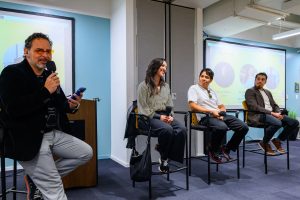
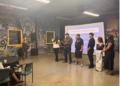
(l to r) Dr. Nathalia Jaramillo, David Medina and Enrique Sancen.
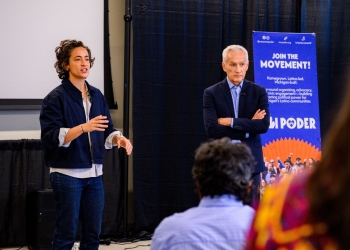
Moderator Luis Antonio Uribegan, CEO of Design Think Tank, kept the conversation engaging and bilingual, in English with Spanish offered to anyone who needed it, and a full house of students, professionals from tech to education, and families leaned in.
Enrique Sancen, a software engineer at General Motors working in virtual automation, spoke first and started close to home. He is a Detroit native from the 48210 on the westside, a Wayne State graduate, and a first-generation college student who worked his way through school.
“I wasn’t necessarily prepared for university, so I always felt like I had to work twice as hard to even be a step behind everyone else,” he said.
He told a story about a summer when he took classes and washed dishes at a popular Southwest Detroit restaurant. The night before a physics exam, his boss told him he needed to work the evening shift. He chose to skip the shift, miss out on a few extra dollars, and took the exam. He told that story to make a point our community does not always like to hear: Sometimes you have to put yourself first.
“In order for you to help someone else, you need to first help yourself,” he said. “You need to be a little selfish sometimes.”
Sancen was blunt about “imposter syndrome”, the sense that you don’t belong or don’t deserve a seat at the table you earned your way to and you still count yourself as a fraud. He highlighted how rarely he saw Latinos in tech when he started school in 2010, and about mentors carrying him through. But his most urgent advice was about the present. He told the students that they can learn AI agents, the software tools now reshaping his field, online immediately.
“Agents are the future,” Santan said. “You can do this right now. That will put you forward against any other candidates when you start applying for jobs.”
David Medina, founder and CEO of LIVAQ, an electric off-road vehicle company based in Detroit, got his start in tech at nine years old. Growing up in Mexico, he read about Horacio Pagani, the Argentine who went from working at Lamborghini to building supercars that sell for millions, and he decided on the spot: That would be his life. That same night, he and his parents mapped out a 14-year plan by discussing which high school he would attend. Which projects? Which college? When would he build his first prototype, and when would he start the company.

“You are going to be told that you’re wrong so many times,” Medina said. “Having no fear to fail, I think that’s key. We overestimate the repercussions of failing, and that stops us from making the jump.”
Before he left Mexico, his grandfather, an entrepreneur from Guerrero, sat him down with his parents and uncle and gave him his marching orders: You are going there to create jobs and opportunities, not just to work for somebody else. And a saying he still repeats: “Quien mira hacia adelante, atrás no se queda.” Whoever looks forward does not stay behind.
Dr. Nathalia Jaramillo, the new director of Wayne State University’s Center for Latino/a and Latin American Studies (CLLAS), expanded the conversation to education. Eight weeks into the job and new to Detroit, she introduced herself as a Los Angeles native, the daughter of Colombian immigrants, and the first woman in her family to go to college. She started as a classroom teacher, fell in love with education and, in her words, fell into rage at the inequities she saw in the communities she served. That pushed her to a master’s, a PhD, and a seat at the table.
She reminded the audience that CLLAS was born of activism, founded by students who wrote a charter on three principles: Know your heritage and your language; understand the economic and social realities facing Latino communities in Detroit; and apply that knowledge to transform those conditions. That origin shapes how the center does research now, with the community leading and asking the questions, not just answering them.
“Too often we’ve been the subjects of research,” Jaramillo said. The center’s answer is participatory research, projects built with the community so the results mean something in the community.
On artificial intelligence, the panel did not speak with one voice, and that was the point. Sancen urged students to seize the tools early. Jaramillo cautioned that in education, AI can feed the pressure students feel to perform like somebody else, instead of learning who they are.
Medina landed somewhere in between: Learn the tools and use them to get ahead.
“The one who does it first gets an advantage against everybody else,” Medina said. “That’s what we need, an unfair advantage, so we can catch up and have a louder voice in the tech ecosystem.”

The evening ended with a challenge from moderator Uribegan. Each panelist was asked to offer the attendees something real, right there. Coffee and mentorship. A visit to their workspace to see how they create the vehicles. Help finding a mentor. Jaramillo opened the center’s doors: CLLAS hosts cafecito on Mondays from 3 to 5 p.m., and everyone is welcome. Moderator Uribegan also gave the audience a light homework assignment, “Before asking anyone for anything, offer something first.”
La noche del 14 de octubre, tres panelistas subieron al escenario en TechTown ante un público de estudiantes ansiosos, entusiastas de la tecnología y otros que apenas se acercaban a ella. Hablaron de sus campos desde tres direcciones completamente distintas. Uno escribe software para una de las compañías automotrices más grandes del mundo. Otro construye vehículos eléctricos todoterreno en Detroit. Y el tercero dirige un centro universitario que lleva más de cinco décadas luchando por los estudiantes latinos. Juntas, sus historias respondieron a la pregunta alrededor de la cual se construyó la noche: ¿cómo entra nuestra gente al ecosistema tecnológico y, una vez adentro, cómo crea oportunidades para la siguiente persona?
(l to r) Dr. Nathalia Jaramillo, David Medina and Enrique Sancen.
El moderador, Luis Antonio Uribegan, CEO de Design Think Tank, mantuvo la conversación animada y bilingüe. Se habló en inglés, con traducción al español para quien la necesitara. El auditorio lleno de estudiantes, profesionales de la tecnología y la educación, y familias, escuchó con atención.
Enrique Sancen, ingeniero de software en General Motors que trabaja en automatización virtual, habló primero y comenzó cerca de casa. Es originario de Detroit, del código postal 48210 en el lado oeste, egresado de Wayne State University, y es estudiante de primera generación que se pagó sus estudios trabajando.
“No estaba necesariamente preparado para la universidad, así que siempre sentí que tenía que trabajar el doble para no quedarme atrás de los demás,” dijo.
Contó la historia de un verano en que tomaba clases y lavaba platos en un restaurante popular del suroeste de Detroit. La noche antes de un examen de física, su jefe le dijo que tenía que cubrir el turno de la tarde. Él decidió no ir al turno, perderse unos dólares extra y presentar el examen. Contó esa historia para hacer un punto que nuestra comunidad no siempre quiere escuchar: a veces tienes que ponerte a ti primero.
“Para poder ayudar a alguien más, primero tienes que ayudarte a ti mismo,” dijo. “A veces tienes que ser un poco egoísta.”
Sancen habló con franqueza sobre el “síndrome del impostor”, la sensación de no pertenecer o de no merecer un lugar en la mesa que te ganaste, y de seguir sintiéndote un fraude. Destacó lo poco que veía a latinos en tecnología cuando comenzó la escuela en 2010, y habló de los mentores que lo sostuvieron. Pero su consejo más urgente era sobre el presente. Les dijo a los estudiantes que pueden aprender en línea, desde ya, sobre agentes de inteligencia artificial, las herramientas de software que hoy están transformando su campo.
“Los agentes son el futuro,” dijo Sancen. “Pueden empezar a hacerlo ahora mismo. Eso los pondrá por delante de cualquier otro candidato cuando empiecen a solicitar empleo.”
David Medina, fundador y CEO de LIVAQ, una empresa de vehículos eléctricos todoterreno con sede en Detroit, empezó en la tecnología a los nueve años. Creciendo en México, leyó sobre Horacio Pagani, el argentino que pasó de trabajar en Lamborghini a construir superdeportivos que se venden por millones de dólares, y decidió en ese momento que esa sería su vida. Esa misma noche, él y sus padres diseñaron un plan de 14 años, hablando sobre en qué preparatoria estudiaría. ¿Qué proyectos? ¿Qué universidad? ¿Cuándo construiría su primer prototipo y cuándo fundaría la empresa?
“Te van a decir que estás equivocado tantas veces,” dijo Medina. “No tener miedo a fracasar, creo que eso es clave. Sobreestimamos las consecuencias de fracasar, y eso nos impide dar el salto.”
Antes de salir de México, su abuelo, un emprendedor de Guerrero, lo sentó con sus padres y su tío y le dio sus instrucciones: vas allá a crear empleos y oportunidades, no solo a trabajar para alguien más. Y una frase que todavía repite: “Quien mira hacia adelante, atrás no se queda.”
La Dra. Nathalia Jaramillo, nueva directora del Center for Latino/a and Latin American Studies (CLLAS) de Wayne State University, amplió la conversación hacia la educación. Con ocho semanas en el cargo y recién llegada a Detroit, se presentó como originaria de Los Ángeles, hija de inmigrantes colombianos y la primera mujer de su familia en ir a la universidad. Comenzó como maestra de salón, se enamoró de la educación y, en sus palabras, se llenó de indignación ante las desigualdades que veía en las comunidades a las que servía. Eso la llevó a una maestría, a un doctorado y a un lugar en la mesa.
Recordó al público que CLLAS nació del activismo, fundado por estudiantes que redactaron una carta con tres principios: conocer tu herencia y tu idioma; entender las realidades económicas y sociales que enfrentan las comunidades latinas en Detroit; y aplicar ese conocimiento para transformar esas condiciones. Ese origen define cómo el centro hace investigación hoy, con la comunidad liderando y haciendo las preguntas, no solo respondiéndolas.
“Con demasiada frecuencia hemos sido objeto de investigación,” dijo Jaramillo. La respuesta del centro es la investigación participativa, proyectos construidos con la comunidad para que los resultados signifiquen algo para ella.
Sobre la inteligencia artificial, el panel no habló con una sola voz, y ese era el punto. Sancen instó a los estudiantes a aprovechar las herramientas desde temprano. Jaramillo advirtió que, en la educación, la IA puede alimentar la presión que sienten los estudiantes de actuar como si fueran otra persona, en lugar de aprender quiénes son.
Medina se ubicó en un punto intermedio: aprende las herramientas y úsalas para avanzar.
“El que lo hace primero tiene una ventaja sobre todos los demás,” dijo Medina. “Eso es lo que necesitamos, una ventaja injusta, para poder alcanzar y tener una voz más fuerte en el ecosistema tecnológico.”
La noche terminó con un reto de la moderadora Uribegan. Cada panelista debía ofrecer al público algo real, ahí mismo. Un café y mentoría. Una visita a su espacio de trabajo para ver cómo construyen los vehículos. Ayuda para encontrar un mentor. Jaramillo abrió las puertas del centro: CLLAS organiza un cafecito los lunes de 3 a 5 p.m., y todos son bienvenidos. La moderadora Uribegan también dejó al público una tarea ligera: “Antes de pedirle algo a alguien, ofrece algo primero.”