












Linguist Bethany Cox understands the hesitation that many people encounter when learning Spanish.
“One of the common concerns that I hear from people when it comes to language learning is not feeling like they have a safe space to practice,” she said.
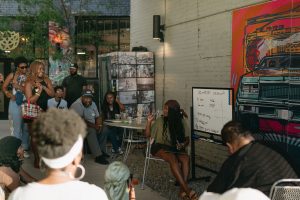
Eager to establish a no-judgment event for Spanish learners of all levels to gather, Cox launched Habla Detroit in early September. The first event, which sold out in just 3 days and welcomed 90 people, focused on building confidence and connection between language learners.
Cox, who is African-American but often gets mistaken for Latina, has a bachelor’s degree in Linguistics and studied Spanish for over a decade. She first started teaching Spanish on TikTok (@blackgirlpolyglot) in 2023 and covers several language-learning topics, such as pronunciation, grammar and translation. Her content has garnered over 150,000 followers across her social media platforms.
One of Cox’s popular teaching videos is her bilingual sing-alongs, where she provides color-coded, lyric-by-lyric, Spanish to English translations. In her livestreams, which sometimes brings 400-500 viewers, Cox also explains the linguistics of popular Latin songs.
“I’ll go line-by-line and I’ll break down the phonetics, the morphology, the syntax,” Cox said, “I break down the structure of it and why everything is what it is.”
But immersing yourself in the culture, Cox believes, is just as important as understanding the linguistics of Spanish. “You can’t learn the language without learning the culture,” she said.
Aside from engaging with Spanish media and courses in high school and college, Cox deepened her immersion in the culture when she worked at Southwest Detroit Immigration and Refugee Center for six months. Her job entailed reception as well as conducting interviews with asylum seekers from different parts of Latin America about their reasons for fleeing their native countries.
“It was such a huge shift going from not growing up around any native speakers,” Cox said. “I’m getting connected and seeing a part of the culture and the people because I feel like they’re very interconnected.”
Cox’s use of Tandem, a language exchange application, furthered her immersion in Spanish. She recalled conversing with different native speakers about various topics. “It’s a space for language learning,” she said, “so it takes away that pressure of feeling like you have to get it correct every single time.”
One of the best ways learners can engage in the culture is by practicing Spanish at Hispanic-owned businesses, Cox said. But she also understands the fear of judgment or making mistakes that often discourages learners from doing so.
“It’s in your human nature to feel nervous to make mistakes,” said Cox, who also struggled with similar concerns when she first started learning Spanish.
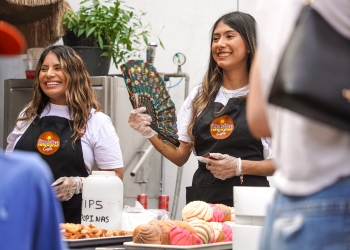
Hoping to ease the familiar discomfort and boost confidence in language learners, Cox decided to host her first Habla Detroit event at La Ventana Cafe near the Eastern Market. “I reiterated amongst the group that this is a safe space,” she said. “When I say no judgment, I mean that to the highest degree.”
Cox invested over $1,200 of her own money to obtain custom bracelets, conversation cards, teaching materials and other expenses for her lessons. “It was definitely an investment, but it’s worthwhile,” she said.

Cox first taught Spanish lessons to each group and then encouraged them to apply what they learned in their own conversations. Color-coded bracelets were provided to distinguish learners of different fluency levels: green (beginner), blue (elementary), yellow (intermediate), and red (advanced). Cox hoped the inclusion of the bracelets would help participants feel more comfortable with practicing Spanish with others at their same level.
Kelly White, an intermediate Spanish learner, found that the bracelets eased her initial anxiety. “As soon as I learned that your speaking level would be color coded, I instantly knew that I would be okay.” White, who mostly practiced Spanish with her former co-worker, plans to attend Cox’s next event.
Lorrie Shepley, a former bank assistant manager who spent 2-3 years learning Spanish to speak with Hispanic clients, enjoyed Cox’s practical lessons and networking with fellow students. She’s eager to improve her Spanish for her next trip.
“I went to vacation in Puerto Rico and just absolutely fell in love with the island,” Shepley said. “I want to go back and visit, and I want to be able to speak to people.”
Cox will host her next Habla Detroit at Tulum from 6-9 p.m. on October 17th in Southwest Detroit. The second event will give participants a chance to practice with native speakers, engage in guided lessons and games, and network with fellow learners.
For more information about future Habla Detroit events, please visit Bethany Cox’s Instagram and TikTok (@blackgirlpolyglot_ and @thelanguagelounge_).

La lingüista Bethany Cox entiende la hesitación que muchas personas encuentran cuando aprenden español.
“Una de las preocupaciones comunes que escucho de la gente cuando se trata de aprendizaje de idioma es no sentir que tienen un espacio seguro para practicar,” dijo.
Ansiosa por establecer un evento sin crítica para aprendices de español de todos los niveles para reunirse, Cox lanzó Habla Detroit a principios de septiembre. El primer evento, que se agotó en solo 3 días y recibió a 90 personas, se enfocó en construir confianza y conexión entre aprendices de idioma.
Cox, quien es africanoamericana pero frecuentemente se confunde como Latina, tiene un título de licenciatura en Lingüística y estudió español durante más de una década. Primero comenzó a enseñar español en TikTok (@blackgirlpolyglot) en 2023 y cubre varios temas de aprendizaje de idioma, como pronunciación, gramática y traducción. Su contenido ha ganado más de 150,000 seguidores a lo largo de sus plataformas de redes sociales.
Uno de los videos de enseñanza populares de Cox son sus singalongos bilingües, donde proporciona traducciones de letra por letra, español a inglés, codificadas por color. En sus transmisiones en vivo, que a veces traen 400-500 espectadores, Cox también explica la lingüística de canciones latinas populares.
“Iré línea por línea y desglosaremos la fonética, la morfología, la sintaxis,” dijo Cox, “Desglosaremos la estructura de ello y por qué todo es lo que es.”
Pero sumergirse en la cultura, cree Cox, es igual de importante que entender la lingüística del español. “No puedes aprender el idioma sin aprender la cultura,” dijo.
Aparte de participar con medios españoles y cursos en secundaria y universidad, Cox profundizó su inmersión en la cultura cuando trabajó en Southwest Detroit Immigration and Refugee Center durante seis meses. Su trabajo implicaba recepción así como conducir entrevistas con solicitantes de asilo de diferentes partes de Latinoamérica sobre sus razones para huir de sus países natales.
“Fue un cambio tan enorme pasar de no crecer alrededor de ningún hablante nativo,” dijo Cox. “Me estoy conectando y viendo una parte de la cultura y la gente porque siento que están muy interconectadas.”
El uso de Cox de Tandem, una aplicación de intercambio de idioma, profundizó su inmersión en español. Recuerda conversar con diferentes hablantes nativos sobre varios temas. “Es un espacio para aprendizaje de idioma,” dijo, “así que quita esa presión de sentir que tienes que acertarlo cada vez.”
Una de las mejores maneras en que los aprendices pueden participar en la cultura es practicando español en negocios propiedad de hispanos, dijo Cox. Pero también entiende el miedo al crítica o cometer errores que frecuentemente desanima a aprendices de hacer eso.
“Es en tu naturaleza humana sentir nervios de cometer errores,” dijo Cox, quien también lucho con preocupaciones similares cuando primero comenzó a aprender español.
Esperando aliviar la incomodidad familiar y reforzar confianza en aprendices de idioma, Cox decidió organizar su primer evento Habla Detroit en La Ventana Cafe cerca de Eastern Market. “Reitere entre el grupo que este es un espacio seguro,” dijo. “Cuando digo sin crítica, quiero decir eso al grado más alto.”
Cox invirtió más de $1,200 de su propio dinero para obtener pulseras personalizadas, tarjetas de conversación, materiales de enseñanza y otros gastos para sus lecciones. “Definitivamente fue una inversión, pero vale la pena,” dijo.
Cox primero enseñó lecciones de español a cada grupo y luego los alentó a aplicar lo que aprendieron en sus propias conversaciones. Pulseras codificadas por color fueron proporcionadas para distinguir aprendices de diferentes niveles de fluidez: verde (principiante), azul (elemental), amarillo (intermedio), y rojo (avanzado). Cox esperó que la inclusión de las pulseras ayudaría a participantes a sentirse más cómodos practicando español con otros a su mismo nivel.
Kelly White, una aprendiz intermedia de español, encontró que las pulseras aliviaron su ansiedad inicial. “En el momento en que aprendí que tu nivel de habla sería codificado por color, al instante supe que estaría bien.” White, quien principalmente practicó español con su excompañera de trabajo, planea asistir al próximo evento de Cox.
Lorrie Shepley, una anterior asistente de gerente de banco que pasó 2-3 años aprendiendo español para hablar con clientes hispanos, disfrutó de las lecciones prácticas de Cox y networking con compañeros estudiantes. Está ansiosa de mejorar su español para su próximo viaje.
“Fui a vacaciones a Puerto Rico y absolutamente me enamoré de la isla,” dijo Shepley. “Quiero regresar y visitar, y quiero ser capaz de hablar con la gente.”
Cox organizará su próximo Habla Detroit en Tulum de 6-9 p.m. el 17 de octubre en Southwest Detroit. El segundo evento dará a participantes una oportunidad de practicar con hablantes nativos, participar en lecciones guiadas y juegos, y networking con compañeros aprendices.
Para más información sobre futuros eventos Habla Detroit, por favor visita el Instagram y TikTok de Bethany Cox (@blackgirlpolyglot_ y @thelanguagelounge_).