













The Sagrada Familia in Barcelona, also known as the Basilica of the Sagrada Familia, is the tallest temple on Earth, reaching 172.5 meters at its highest point, the Tower of Jesus Christ. This tower was recently topped with a cross and blessed by Pope Leo XIV on June 10th of this year. Antoni Gaudí designed the tower so that it would not exceed the height of Montjuïc, which stands at 173 meters. In this way, he avoided surpassing what he considered God’s creation, as had supposedly been attempted with the Tower of Babel.
The original design, dating back to 1882, was created by architect Francisco de Paula del Villar in the Neo-Gothic style. However, disagreements with the construction committee eventually led to his departure from the project. In 1883, the project was entrusted to Antoni Gaudí, who completely redesigned the church. This is why the Sagrada Familia has been under construction for more than 140 years, beginning with the laying of the first stone in 1882. In 1885, the first chapel, dedicated to Saint Joseph, was inaugurated, and the first masses were celebrated there. A few years later, in 1891, work began on the Nativity façade.
It is important to remember that when Gaudí took over the project in 1883, he completely reimagined the church. Gaudí was one of the leading figures of the Modernist architectural movement, an artistic movement that sought to bring curving forms inspired by nature into architecture. Although the towers and the overall design of the Sagrada Familia are a monumental expression of Modernism, the interior is perhaps one of the clearest examples of Gaudí’s fascination with nature.
This is why the interior is often described as Gaudí’s forest. The columns and ceilings create the sensation of standing inside a vast forest. Instead of following the traditional floor-to-ceiling design, the columns continue upward and, before reaching the ceiling, divide into three extensions at different heights that resemble branches. Besides creating the appearance of trees, this design helps distribute the weight of the structure and provides greater physical stability.
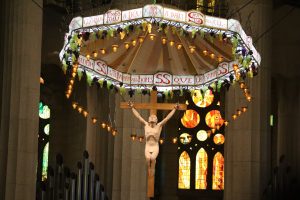
Above the altar stands the imposing sculpture of the crucified Jesus, wearing a crown that symbolizes the moment of his resurrection and ascension into heaven, reaffirming him as the Messiah, the Christ.

The temple is also filled with stained-glass windows and rose windows that allow natural light to filter into the building. As the light passes through the colored glass, it fills the interior with changing shades and creates a progression of colors that allude to the four elements. The side towers are dedicated to the disciples, while the four central towers surrounding the Tower of Jesus Christ are dedicated to the four Evangelists. The star-shaped tower is dedicated to the Virgin Mary.
From many of the higher points around Barcelona, the Sagrada Familia rises above the surrounding buildings, making its presence impossible to miss. This only adds to its significance, not only as one of the city’s great architectural masterpieces, but also as an expression of the idea that beauty can be a way of honoring and praising God.
La Sagrada Familia de Barcelona, también conocida como Basílica de la Sagrada Familia, es el templo más alto sobre la faz de la Tierra, con la altura de 172.5 metros en su torre más alta, la torre de Jesucristo que a la que recién se le colocó una cruz y que fue bendecida el pasado 10 de junio del presente año por el Papa León XIV. La altura de la torre más alta fue diseñada por Antonio Gaudía para que no sobrepasara la altura del Montjuic de 173 metros, para no desafiar a Dios, como lo hicieron con la Torre de Babel.
El diseño inicial de 1882 fue del arquitecto Francisco De Paula Del Villar con estilo Neogótico. Sin embargo, debido a diferencias con la comitiva de construcción de La Sagrada familia lleva más de 140 años en construcción, ya que en 1882 se colocó la primera piedra. Afortunadamente, en 1883 se llevó a cabo un nuevo diseño de la Basílica, quedando el proyecto en las manos Antonio Gaudí. En 1885 se inauguró la primera capilla, la de San José, donde se oficiaron las primeras misas. Y en 1891 se iniciaron las obras de la fachada del Nacimiento.
Es importante destacar que cuando en 1883 se le otorgó el proyecto a Antonio Gaudí, la iglesia fue completamente rediseñada, pues Gaudí era uno de los mayores representantes del movimiento arquitectónico del Modernismo, movimiento artístico que buscaba que la arquitectura tomara formas curvilíneas que remitieran a la naturaleza. Aunque las torres y toda la forma de la Sagrada Familia es una monumental representación del Modernismo, el interior es una magnífica representación de la naturaleza, de ahí que al interior se le llame el bosque de Gaudí, porque tanto las columnas como los techos remiten a la sensación de encontrarse dentro de un bosque, ya que las columnas en lugar de tener el estilo clásico de suelo a techo, se mantienen hasta arriba y antes de llegar al techo tienen tres extensiones a diferente altura que semejan ramas y que permiten repartir así distribuir el peso, dándole mayor estabilidad física.
En el altar se encuentra la escultura elevada de Jesús crucificado con una corona que simboliza el momento en que Jesús resucita y se elevó al cielo reafirmándose como el mesías, el Cristo.
El templo cuenta con vitrales y rosetones que permiten el paso de la luz y que colorean las paredes haciendo una progresión de tonos que remiten a los cuatro elementos. Las torres laterales están dedicadas a los discípulos, las cuatro torres centrales que rodean la torre de Jesucristo a los cuatro evangelistas, la torre de la estrella dedicada a la Virgen María.
Desde cualquier punto elevado de la ciudad de Barcelona, la Sagrada Familia se eleva muy por encima de cualquier otro edificio, dándole aun más importancia, no sólo como la gran obra arquitectónica, sino también dejando claro que para Barcelona para alabar a Dios se necesita la belleza.