






The Bahamas, a coastal paradise in the Atlantic, is one of the North American countries located in the Antilles, a group of islands in the Atlantic Ocean. Its capital is Nassau, on New Providence Island.
The most important Bahamian celebration is Junkanoo Carnival, held on December 26th and January 1st.
The beaches of the Bahamas are characterized by crystal-clear waters and white sand, but they are not part of the Caribbean Sea. However, the country is member of the Caribbean Community (CARICOM), though not part of the Caribbean Single Market and Economy.

The Bahamas’ geographic location, north of Cuba and east of Florida, gives them a privileged position in the geopolitics of the Americas, as they are located on a transit route for various types of vessels supplying the United States with different goods.
Its currency is the Bahamian dollar, which is pegged to the US dollar at a one-to-one rate, meaning 1 USD = 1 BSD.
Currently, the Bahamas comprises a territory of 2000 islets, plus 700 among cays and islands, although only 30 islands are inhabited.
The official language of the Bahamas is English, and it is part of the Commonwealth of Nations of the United Kingdom, which means it is governed by a prime minister under the monarchy of King Charles.
The Bahamas were inhabited by the Lucayans, who descended from the Taíno Arawakan people. The Taíno are the indigenous group that inhabited the Antilles. It is said that the Arawakans migrated from Venezuela and from there moved from island to island until they populated almost all of the Antilles.
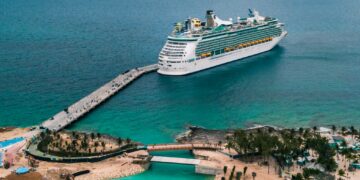
Like all Atlantic islands, it is susceptible to the frequent damage caused by hurricanes. Its permanent population is just over 400,000, who ensure the islands’ sustainability through banking, investment management, and tourism, as the Bahamas receives a large number of cruise ships.
90% of the Bahamian population is of African descent.
Junkanoo Carnival
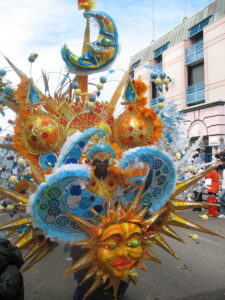
The Junkanoo Carnival is the most important festival in the Bahamas, celebrated on December 26th and January 1st. It includes dances and other festive cultural expressions. Dating back to the 19th century, it is part of the cultural heritage brought by enslaved people from the vast African continent and their descendants.
It is said that the origin of its name comes from the John Canoe, Junkanoo.
As the most important festival in the Bahamian nation, Junkanoo is not only celebrated on Bay Street in Nassau, but also on 16 other islands that are filled with joy and folklore.
The celebration showcases the cultural syncretism of Afro-Bahamians with Christianity, considering that the Bahamas is one of the countries with the largest number of Baptist churches within Protestant Christianity. The celebration includes parades with dances, costumes, and colorful masks that move to the rhythm of percussion, drums, and whistles.
It is said that the dates commemorate the three days of rest granted to enslaved people during the colonial occupation and founding period.
The festivities begin at 2:00 a.m., in the early hours of the morning, and end at 3:00 p.m., in this inexhaustible time of rhythm and joy.
Las Bahamas un paraíso costero en el Atlático, es uno de los países de América del Norte ubicado en las Antillas, un grupo de islas ubicadas en el océano Atlántico, su capital es la ciudad de Nasáu, en la isla de la Nueva Providencia.
La fiesta más importante de los bahameños es el carnaval del Junkanoo, que se festeja el 26 de diciembre y el 1 de enero.
Las playas de las Bahamas se caracterizan por aguas cristalinas y arenas blancas, mas no pertenecen al territorio del Mar Caribe, no obstante, ocupan un lugar en la Comunidad del Caribe, sin por ello pertenecer al Mercado Único y de Economía del Caribe.
La ubicación geográfica de las Bahamas es al norte de Cuba y al este del estado de Florida, lo que les da un lugar privilegiado en la geopolítica del continente americano, pues, se encuentran en el tránsito de diferentes tipos de embarcaciones que proveen a Estados Unidos de diferentes tipos bienes.
Su moneda es el dólar bahameño, que equivale uno a uno con el dólar estadounidense, es decir 1 USD = 1 BSD.
Actualmente, las Bahamas se integra por un territorio de 700 islotes, cayos e islas, aunque tan sólo 30 islas se encuentran habitadas.
La lengua oficial de las Bahamas es el inglés, siendo parte de la Mancomunidad de las Naciones del Reino Unido, lo que les hace ser regido por un primer ministro bajo la monarquía del Rey Carlos.
Las Bahamas eran habitadas por los Lucayos, quienes descendían de la etnia Taína Arahucana, Arawak, recordemos pues que los taínos son el grupo indígena que habitó las Antillas, tanto mayores, como menores. Se dice que partieron los arahucanos desde Venezuela y de ahí se fueron desplazando de isla en isla hasta poblar casi todas las Antillas.
Como todas las islas del Atlántico, se encuentra susceptible a los continuos daños de los huracanes.
Su población estable es de poco más de 400,000 habitantes estables que dan continuidad a la sostenibilidad de las islas, a través del comercio bancario, el manejo de inversiones, así como el comercio turístico, ya que las Bahamas reciben gran cantidad de cruceros de turismo.
El 90% de la población bahameña es afrodescendiente.
Carnaval de Junkanoo
El Carnaval de Junkanoo es la festividad más importante en las Bahamas, se celebra el 26 de diciembre y el 1 de enero, incluye bailes y otro tipo de expresiones festivo culturales. Data del siglo XIX y es parte de la herencia cultural que trajeron las personas esclavizadas tanto del vasto continente africano, como sus descendientes.
Se dice que el origen de su nombre proviene del John Canoe, Junkanoo.
Siendo el Junkanoo la festividad más importante de la nación bahameña, no sólo se deja ver en la Bay Street de Nasáu, sino en otras 16 islas que también se llenan de alegría y folclor.
La celebración muestra el sincretismo cultural afrodescendiente con el cristianismo, considerando que las Bahamas es uno de los países con mayor cantidad de iglesias bautistas del cristianismo protestante.
El festejo incluye desfiles con bailes, vestuarios, máscaras coloridas que se mueven al ritmo de percusiones, tambores, silbatos,
Se dice que las fechas remiten a los tres días que se les concedían a los esclavizados de descanso durante la época de ocupación y fundación colonial.
La festividad comienza a las 2:00 de la mañana, a plena madrugada y termina a las 3:00 de la tarde, en este tiempo inagotable de ritmo y alegría.