






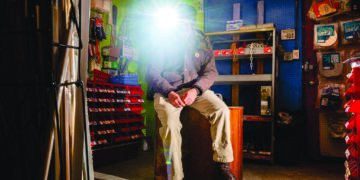



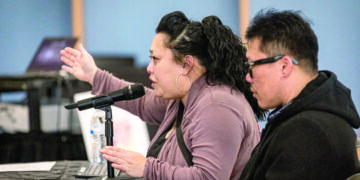

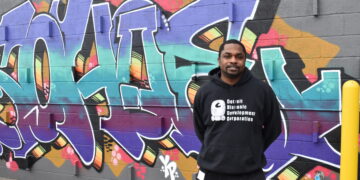




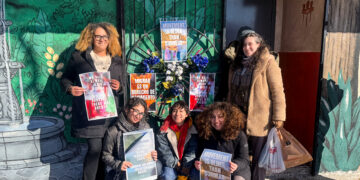



Ron Ellis never got the chance to meet his grandmother, Marita Reasonover. She emigrated to the United States from Cuba, eventually settling in Michigan. But she was killed by gun violence on the streets of Southwest Detroit before Ellis was born.
He grew up on the edge of that same neighborhood during the 1980s and witnessed his community struggling with drugs and gang violence.
“It was rough. It was a lot of drugs, a lot of gun violence, gang violence. It was a lot of stuff going on when I grew up,” Ellis said.
In the 1980s, Southwest Detroit was ground zero for ongoing gang activity and heavy police presence, including raids. Back then, it was also a patchwork of different cultures tied together by a strong Mexican identity – so much so that the neighborhood began branding itself as “Mexicantown.”
Decades later, the violence that shaped Ellis’ childhood continues to echo through Latino communities nationwide. A 2023 study by the U.S. Centers for Disease Control and Prevention (CDC) concludes that Latinos are twice as likely to die by firearm violence as their white counterparts. Hispanic Americans ages 15 to 29, while representing roughly four percent of the U.S. population, account for eight percent of all gun homicide victims. Firearm violence is now the leading cause of death for young Hispanic males.
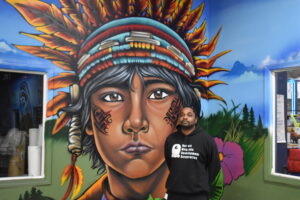
Detroit has seen an historic decline in non-fatal shootings in recent years. However, from 2018 to 2021, firearm homicide rates among Hispanics rose 48%, compared to a 22% increase for white non-Hispanics.
But the numbers are just part of the story. In Southwest Detroit, the response in the aftermath of gun violence speaks to another part: The issues that arise when the trust between a community and the larger institution it belongs to has eroded.
This reality came into focus for the neighborhood in February of 2025. Amid the immigration crackdowns directed by the Trump administration, a 54-inch water main broke, causing massive flooding to streets and homes. Cars were submerged and basements were filled with water in the freezing Michigan winter. As city officials conducted welfare checks in the area, some residents were fearful of opening their doors. In the end, community volunteers stepped in to conduct door-to-door checks to make sure their neighbors had any resources they needed and to translate critical information where necessary.
Those residents’ hesitation had everything to do with the fear of immigration crackdowns and the people’s lack of trust in institutions, which revealed a larger tension in the community.
“When you break down those basic and foundational community ties, then so many other aspects of a community begin to falter,” said Mara Ostfeld, Research Director at the University of Michigan’s Center for Racial Justice. “Trust is such a prize and a rare resource right now.”
The dynamics that influenced whether the residents of Southwest Detroit were reluctant to open their doors to officials during the water main break – mainly fear and lack of trust – also continue to shape how that community responds to the collective harm of gun violence. Experts agree that community safety depends not only on enforcement, but on relationships.
Cierra Hardaway, Director of Programs at FORCE (Faithfully Organizing Resources for Community Empowerment) Detroit – an advocacy group working toward reducing firearm violence – explains, “It is that love and the trust that we build in the community that just can’t be shared with a number.”
No one understands that better than a person impacted by firearm violence. Statistics are more than a number. They are the qualitative outcome wrapped up in grief and tucked in a casket.
The lack of trust in institutions within communities like Southwest Detroit has other immediate consequences to safety. “We know people don’t trust the police,” Ostfeld said. “There are a lot of reasons why people are not going to report [instances of gun violence]. So [available data is] likely an underestimate.”
Sam Stragand, Senior Program Manager for the Detroit Partnership on Economic Mobility at Poverty Solutions, notes that Detroiters have a longstanding skepticism toward researchers, which can make it difficult to gain a deep understanding of community needs and challenges or to implement effective strategies to improve outcomes.
“You really have to work to earn Detroiters’ trust when you’re talking to them,” said Stragand. “For so long, people in Detroit… have had their information taken from them without necessarily getting anything in return. And so there’s a healthy distrust of researchers.”
When people don’t trust the system, they don’t participate in programs or share information about themselves. They won’t seek help. Without trust, prevention strategies falter.
Firearm violence cannot be separated from that context because violence does not emerge in a vacuum. According to the Aspen Institute, firearm violence risk increases when members of a community experience “poverty, living in an area with low social mobility, or being in a historically marginalized group impacted by structural racism.” These very conditions have shaped Southwest Detroit for decades.
That was the reality of Ellis’ environment as a teenager.
“I was probably like 15,” said Ellis. “A friend of mine shot somebody over an argument. It was a fight and he came back and got a gun and shot him.”
What began as an argument ended in gunfire. That pattern – a dispute, access to a firearm, and a split-second decision – is one outreach workers say continues to drive violence in the community today.
Southwest Detroit’s history of heavy policing in the 1980s left a complicated legacy. For some residents, increased enforcement brought a sense of safety. For others, it deepened an existing skepticism of the systems ostensibly built to protect them. Layer onto that decades of immigration enforcement cycles, economic disinvestment, and housing instability, and the result is a community where the relationship between residents and the institutions that structure their lives can feel uneasy, fragile.
Then it becomes clear that the issues that arise from firearm violence go beyond firearms and beyond violence. They raise important questions about whether all families feel safe calling for help in times of crisis, whether all young people can envision and access options beyond the streets, and whether all communities can believe the systems meant to protect them are working in their interest.
For Ellis, this work is personal.
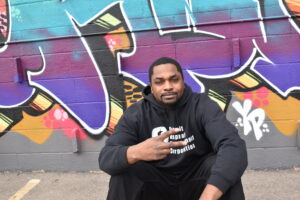
He once was caught up in the cycle of violence, but he chose to disrupt it and has since been working to help others in his community to break the cycle for good. Connecting with the Detroit Hispanic Development Corporation’s (DHDC) Community Violence Intervention (CVI) program was the first step. Now, he works for the CVI as an Outreach Specialist.
CVI programs focus on building relationships with individuals at high risk of involvement in firearm violence. Participants receive support with employment, housing, counseling, and mentorship.
Ellis now walks the same neighborhoods where he once saw violence as a constant presence. But instead of watching from the sidelines, he can intervene; as an Outreach Specialist, he can connect young people in Southwest Detroit to the resources they need.
“A lot of the gun violence can be prevented if it is just a better presence, if it’s more mentors around,” said Ellis. “I had to carry guns around because I didn’t feel safe. I felt like I needed to be protected. I didn’t feel like the police were protecting us.”
Michael Peterson, CVI Program Administrator for the City of Detroit, emphasizes the need for intentional collaboration between city systems and communities to address firearm violence. And Julian Gonzalez, CVI Director at DHDC agrees wholeheartedly.
“If we could get more community involvement, I feel like that would be wonderful,” said Gonzalez. “I feel like ultimately gun violence is preventable when we invest in people, not just systems and institutions and organizations.”
In Southwest Detroit, reducing firearm violence may depend as much upon city institutions’ investment in rebuilding trust with the community as it does upon actually removing guns from the streets. Without a sense of trust, arguments become shootings, and silence keeps the numbers hidden. With it, as Ellis believes, the community can begin to break the cycle of violence.
Ron Ellis nunca tuvo la oportunidad de conocer a su abuela, Marita Reasonover. Ella emigró a Estados Unidos desde Cuba y eventualmente se estableció en Michigan. Pero fue asesinada por la violencia armada en las calles del suroeste de Detroit antes de que Ellis naciera.
Él creció al borde de ese mismo barrio durante la década de 1980 y fue testigo de cómo su comunidad luchaba contra las drogas y la violencia de pandillas.
“Fue duro. Había muchas drogas, mucha violencia con armas, violencia de pandillas. Pasaban muchas cosas cuando yo crecí”, dijo Ellis.
En los años ochenta, el suroeste de Detroit fue un punto crítico de actividad constante de pandillas y de una fuerte presencia policiaca, incluidas redadas. En ese entonces, también era un mosaico de distintas culturas unidas por una identidad mexicana muy marcada, tanto así que el vecindario empezó a llamarse a sí mismo “Mexicantown”.
Décadas después, la violencia que marcó la infancia de Ellis sigue resonando en comunidades latinas de todo el país. Un estudio de 2023 de los U.S. Centers for Disease Control and Prevention (CDC) concluye que los latinos tienen el doble de probabilidades de morir por violencia con armas de fuego que las personas blancas. Los estadounidenses hispanos de entre 15 y 29 años, aunque representan aproximadamente el cuatro por ciento de la población del país, constituyen el ocho por ciento de todas las víctimas de homicidios con armas de fuego. Hoy en día, la violencia armada es la principal causa de muerte entre los jóvenes hispanos.
Detroit ha registrado una disminución histórica en los tiroteos no mortales en los últimos años. Sin embargo, entre 2018 y 2021, las tasas de homicidios con armas de fuego entre hispanos aumentaron un 48%, en comparación con un aumento del 22% entre personas blancas no hispanas.
Pero los números solo cuentan una parte de la historia. En el suroeste de Detroit, la respuesta después de un episodio de violencia armada revela otra dimensión: los problemas que surgen cuando se ha erosionado la confianza entre una comunidad y las instituciones más amplias a las que pertenece.
Esa realidad quedó en evidencia para el barrio en febrero de 2025. En medio de las redadas migratorias impulsadas por la administración de Trump, se rompió una tubería principal de agua de 54 pulgadas, causando inundaciones masivas en calles y viviendas. Autos quedaron sumergidos y los sótanos se llenaron de agua durante el crudo invierno de Michigan. Mientras funcionarios de la ciudad realizaban revisiones de bienestar en la zona, algunos residentes tenían miedo de abrir sus puertas. Al final, voluntarios comunitarios intervinieron para tocar puerta por puerta, asegurarse de que sus vecinos tuvieran los recursos necesarios y traducir información clave cuando fue necesario.
La renuencia de esos residentes tuvo todo que ver con el temor a las redadas migratorias y con la falta de confianza en las instituciones, lo que dejó al descubierto una tensión más profunda en la comunidad.
“Cuando se rompen esos lazos comunitarios básicos y fundamentales, muchos otros aspectos de una comunidad empiezan a debilitarse”, dijo Mara Ostfeld, directora de investigación del Center for Racial Justice de la University of Michigan. “La confianza es un tesoro y un recurso muy escaso en este momento”.
Las mismas dinámicas que influyeron en que los residentes del suroeste de Detroit dudaran en abrir sus puertas durante la ruptura de la tubería —principalmente el miedo y la falta de confianza— siguen moldeando la manera en que la comunidad responde al daño colectivo de la violencia armada. Los expertos coinciden en que la seguridad comunitaria no depende solo de la aplicación de la ley, sino de las relaciones.
Cierra Hardaway, directora de programas de FORCE (Faithfully Organizing Resources for Community Empowerment) Detroit, un grupo defensor que trabaja para reducir la violencia armada, explica: “Es ese amor y esa confianza que construimos en la comunidad lo que no se puede medir con un número”.
Nadie entiende eso mejor que quien ha sido impactado por la violencia con armas de fuego. Las estadísticas son más que cifras. Son resultados cualitativos envueltos en duelo y depositados en un ataúd.
La falta de confianza en las instituciones dentro de comunidades como el suroeste de Detroit tiene otras consecuencias inmediatas para la seguridad. “Sabemos que la gente no confía en la policía”, dijo Ostfeld. “Hay muchas razones por las que las personas no van a reportar [incidentes de violencia armada]. Así que [los datos disponibles] probablemente están subestimados”.
Sam Stragand, gerente senior de programas del Detroit Partnership on Economic Mobility en Poverty Solutions, señala que los habitantes de Detroit tienen desde hace mucho tiempo un escepticismo hacia los investigadores, lo que dificulta comprender a fondo las necesidades y desafíos de la comunidad o implementar estrategias efectivas para mejorar los resultados.
“De verdad hay que trabajar para ganarse la confianza de los habitantes de Detroit cuando se habla con ellos”, dijo Stragand. “Durante mucho tiempo, la gente en Detroit ha visto cómo se les extrae información sin recibir necesariamente nada a cambio. Por eso existe una desconfianza saludable hacia los investigadores”.
Cuando las personas no confían en el sistema, no participan en programas ni comparten información sobre sí mismas. No buscan ayuda. Sin confianza, las estrategias de prevención fallan.
La violencia con armas de fuego no puede separarse de ese contexto, porque la violencia no surge en el vacío. Según el Aspen Institute, el riesgo de violencia armada aumenta cuando los miembros de una comunidad experimentan “pobreza, vivir en un área con baja movilidad social o pertenecer a un grupo históricamente marginado afectado por el racismo estructural”. Precisamente esas condiciones han moldeado al suroeste de Detroit durante décadas.
Esa era la realidad del entorno de Ellis cuando era adolescente.
“Yo tendría como 15 años”, recordó Ellis. “Un amigo mío le disparó a alguien por una discusión. Fue una pelea, regresó, agarró un arma y le disparó”.
Lo que comenzó como una discusión terminó en un tiroteo. Ese patrón —una disputa, acceso a un arma de fuego y una decisión tomada en segundos— es, según trabajadores comunitarios, algo que sigue impulsando la violencia en la comunidad hoy en día.
La historia de fuerte presencia policiaca en el suroeste de Detroit durante los años ochenta dejó un legado complejo. Para algunos residentes, el aumento de la vigilancia trajo una sensación de seguridad. Para otros, profundizó un escepticismo ya existente hacia los sistemas supuestamente diseñados para protegerlos. Si a eso se le suman décadas de ciclos de aplicación de leyes migratorias, desinversión económica e inestabilidad en la vivienda, el resultado es una comunidad donde la relación entre los residentes y las instituciones que estructuran su vida puede sentirse tensa y frágil.
Entonces queda claro que los problemas que surgen de la violencia armada van más allá de las armas y más allá de la violencia misma. Plantean preguntas importantes: si todas las familias se sienten seguras al pedir ayuda en momentos de crisis, si todos los jóvenes pueden imaginar y acceder a opciones más allá de la calle, y si todas las comunidades pueden creer que los sistemas creados para protegerlas realmente trabajan en su favor.
Para Ellis, este trabajo es personal.
Él mismo estuvo atrapado en el ciclo de la violencia, pero decidió romperlo y desde entonces ha trabajado para ayudar a otros en su comunidad a hacer lo mismo de manera definitiva. Conectarse con el programa de Intervención Comunitaria contra la Violencia (CVI) de la Detroit Hispanic Development Corporation (DHDC) fue el primer paso. Hoy, trabaja para el CVI como especialista de alcance comunitario.
Los programas CVI se enfocan en construir relaciones con personas en alto riesgo de involucrarse en la violencia armada. Los participantes reciben apoyo en empleo, vivienda, consejería y mentoría.
Ahora Ellis camina por los mismos barrios donde antes veía la violencia como una presencia constante. Pero en lugar de observar desde la orilla, puede intervenir. Como especialista de alcance, conecta a jóvenes del suroeste de Detroit con los recursos que necesitan.
“Mucha de la violencia con armas se puede prevenir si hay una mejor presencia, si hay más mentores alrededor”, dijo Ellis. “Yo cargaba armas porque no me sentía seguro. Sentía que necesitaba protección. No sentía que la policía nos estuviera protegiendo”.
Michael Peterson, administrador del programa CVI para la Ciudad de Detroit, subraya la necesidad de una colaboración intencional entre los sistemas de la ciudad y las comunidades para enfrentar la violencia armada. Y Julian Gonzalez, director del CVI en DHDC, coincide plenamente.
“Si pudiéramos lograr más participación comunitaria, creo que sería algo maravilloso”, dijo Gonzalez. “Al final, siento que la violencia armada es prevenible cuando invertimos en las personas, no solo en sistemas, instituciones y organizaciones”.
En el suroeste de Detroit, reducir la violencia con armas de fuego puede depender tanto de que las instituciones de la ciudad inviertan en reconstruir la confianza con la comunidad como de retirar armas de las calles. Sin confianza, las discusiones se convierten en tiroteos y el silencio mantiene ocultas las cifras. Con ella, como cree Ellis, la comunidad puede empezar a romper el ciclo de la violencia.