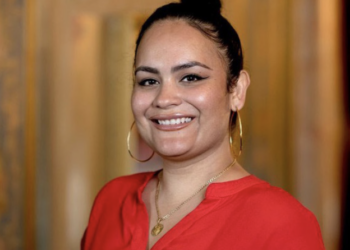























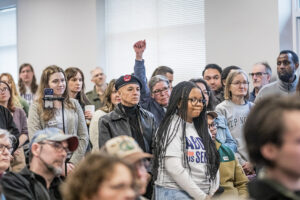
“When I talk about abolishing ICE, I’m talking about abolishing a paramilitary force that exists specifically to weaponize hatred through the government,” said the Democratic candidate for U.S. Senate in Michigan, Abdul El-Sayed, to a packed room in a recent Grand Rapids town hall.
As part of his campaign across the state, El-Sayed gathered with supporters and residents for a meeting on Saturday, February 21 organized by the Latino Community Coalition. Guaranteeing healthcare, empowering unions, accessible housing, and defunding genocides were topics he mentioned during the speech; however, his remarks focused mostly on the abolition of ICE, a position he’s pushed since 2018.

“It cannot be reformed. It cannot be retrained,” El-Sayed said, referring to ICE. The candidate appealed to his family’s immigrant past to criticize how the federal government is “trying to end the idea of immigration” and pouring money into ICE, which he described as an overfunded paramilitary force, surpassing agencies like the FBI or the Marines. “Instead of investing so much money in ICE, maybe we should be creating the infrastructure to create pathways to citizenship that are accessible to everybody,” he said.
El-Sayed, who also ran for MI governor in 2018, maintained that abolishing ICE would not affect or weaken immigration control. On the contrary, he condemned ICE’s actions as not how immigration policies should be enforced. “You can tell when the culture of an agency has turned. It’s not possible to fix anymore,” he said.” It’s proven that the law doesn’t apply to them.”
In pursuit of the vacant seat left by retiring Democratic Senator Gary Peters, El-Sayed, former Wayne County Health Director, is seeking the U.S. Senate along with U.S. Rep. Haley Stevens (D-Birmingham), state Sen. Mallory McMorrow (D-Royal Oak), and former U.S. Rep. Mike Rogers (R-White Lake).
Although the three Democrat candidates openly criticize the Trump administration and condemn ICE, El-Sayed is the sole candidate pushing for abolishing the agency. His Democratic opponents have opted for more moderate options, such as increased oversight and accountability, or appealing to laws that limit ICE activities in the United States.
Stevens supports the removal of Kristi Noem from office and has maintained her support for bills that would cut ICE’s budget if the agency is not reformed or does not prohibit its officers from wearing masks. She visited the North Lake Correctional Facility a week ago and reiterated her demands for greater transparency and accountability from the immigration agency.
On the other hand, McMorrow maintains that ICE needs extensive reform. She previously defended ICE’s existence in an interview on WDET aired on January 9, arguing that because Michigan is a border state, the immigration agency is necessary, but without resorting to terrorizing the community or targeting people based on skin color or accent.
Republican Rogers has defended ICE and, according to an analysis by The Gander, Rogers has received donations totaling up to $20,000 to his campaign from private prison companies that operate detention centers for ICE, such as GEO Group and CoreCivic.
El-Sayed was endorsed last year by U.S. Senator Bernie Sanders and, loyal to his style, the candidate also took the opportunity to launch a harsh critique of his Democratic colleagues and the political financing system.
He accuses them of being complicit in the social crisis by accepting money from the corporations that cause it. El-Sayed argued that not even mass deportations would solve structural problems such as the high cost of housing or the decline in education, stating that while immigrants are blamed, it is the same corporate donors who are “picking the pockets” of citizens.
In response to ICE’s acquisition of a warehouse in Romulus to convert it into a new immigrant detention center, the candidate strongly opposed it and, like McMorrow, expressed that it is no coincidence that it comes months before the midterm elections and after Trump pointed out Detroit as a place where he would like to ‘nationalize’ the elections.
“What do you think they’re setting up for? They’re setting up so that they can deploy ICE in and around polling facilities to nationalize our elections,” accused El-Sayed, who also encouraged his supporters to “step up and step out with all peaceful means”.
“Cuando hablo de abolir ICE, estoy hablando de abolir una fuerza paramilitar que existe específicamente para convertir el odio en un arma a través del gobierno”, dijo el candidato demócrata al Senado de Estados Unidos por Michigan, Abdul El-Sayed, ante una sala llena durante un reciente town hall en Grand Rapids.
Como parte de su campaña por todo el estado, El-Sayed se reunió con simpatizantes y residentes en un encuentro realizado el sábado 21 de febrero, organizado por Latino Community Coalition. Garantizar el acceso a la atención médica, fortalecer a los sindicatos, promover vivienda accesible y dejar de financiar genocidios fueron algunos de los temas que mencionó durante su discurso; sin embargo, sus comentarios se centraron principalmente en la abolición de ICE, una postura que ha defendido desde 2018.
“No se puede reformar. No se puede reentrenar”, dijo El-Sayed al referirse a ICE. El candidato apeló a la historia inmigrante de su propia familia para criticar cómo el gobierno federal está “tratando de acabar con la idea de la inmigración” mientras destina grandes recursos a ICE, al que describió como una fuerza paramilitar con un presupuesto excesivo, incluso mayor que el de agencias como el FBI o los Marines. “En lugar de invertir tanto dinero en ICE, tal vez deberíamos estar creando la infraestructura para abrir caminos hacia la ciudadanía que sean accesibles para todos”, señaló.
El-Sayed, quien también se postuló para gobernador de Michigan en 2018, sostuvo que abolir ICE no afectaría ni debilitaría el control migratorio. Por el contrario, condenó las acciones de la agencia y afirmó que así no deberían aplicarse las políticas migratorias. “Uno puede darse cuenta cuando la cultura de una agencia ha cambiado por completo. Ya no es posible arreglarla”, dijo. “Está demostrado que la ley no se aplica para ellos”.
En busca del escaño que dejará vacante el senador demócrata Gary Peters al retirarse, El-Sayed, exdirector de salud del Wayne County, compite por el Senado de Estados Unidos junto con la representante federal Haley Stevens (D-Birmingham), la senadora estatal Mallory McMorrow (D-Royal Oak) y el exrepresentante federal Mike Rogers (R-White Lake).
Aunque los tres candidatos demócratas critican abiertamente a la administración de Trump y condenan a ICE, El-Sayed es el único que impulsa la abolición total de la agencia. Sus rivales dentro del Partido Demócrata han optado por posturas más moderadas, como aumentar la supervisión y la rendición de cuentas, o respaldar leyes que limiten las actividades de ICE en Estados Unidos.
Stevens apoya la destitución de Kristi Noem y ha reiterado su respaldo a proyectos de ley que reducirían el presupuesto de ICE si la agencia no se reforma o si no prohíbe que sus agentes utilicen máscaras. La semana pasada visitó el North Lake Correctional Facility y volvió a exigir mayor transparencia y responsabilidad por parte de la agencia de inmigración.
Por su parte, McMorrow sostiene que ICE necesita una reforma profunda. En una entrevista con WDET transmitida el 9 de enero, defendió previamente la existencia de la agencia, argumentando que, debido a que Michigan es un estado fronterizo, la agencia migratoria es necesaria, pero sin recurrir a tácticas que aterroricen a la comunidad o que apunten a las personas por su color de piel o su acento.
El republicano Rogers ha defendido a ICE y, según un análisis de The Gander, ha recibido donaciones de hasta 20,000 dólares para su campaña provenientes de compañías de prisiones privadas que operan centros de detención para ICE, como GEO Group y CoreCivic.
El año pasado, El-Sayed recibió el respaldo del senador estadounidense Bernie Sanders y, fiel a su estilo, el candidato también aprovechó la ocasión para lanzar duras críticas contra sus colegas demócratas y contra el sistema de financiamiento político.
Los acusa de ser cómplices de la crisis social al aceptar dinero de las mismas corporaciones que la provocan. El-Sayed argumentó que ni siquiera las deportaciones masivas resolverían problemas estructurales como el alto costo de la vivienda o el deterioro de la educación. Mientras se culpa a los inmigrantes, afirmó, son esos mismos donantes corporativos quienes están “metiendo la mano en los bolsillos” de los ciudadanos.
En respuesta a la adquisición de un almacén en Romulus por parte de ICE para convertirlo en un nuevo centro de detención de inmigrantes, el candidato expresó una fuerte oposición y, al igual que McMorrow, señaló que no es casualidad que ocurra a pocos meses de las elecciones de medio término y después de que Trump señalara a Detroit como un lugar donde le gustaría “nacionalizar” las elecciones.
“¿Para qué creen que se están preparando? Se están preparando para poder desplegar ICE dentro y alrededor de los centros de votación y así nacionalizar nuestras elecciones”, acusó El-Sayed, quien también alentó a sus seguidores a “dar un paso al frente y salir a actuar por todos los medios pacíficos”.