






















July 9. My phone lights up. It’s one of Detroit’s most prolific music video directors, who I had met a month prior, asking if Donut Villa, my brother’s shop, is available for a couple hours. Diego Cruz, the talent behind the music videos of some of Detroit’s biggest rappers, needs to shoot something for a local artist inspired by that diner scene from Paid in Full, the one between Regina Hall and Wood Harris. It’s no problem with me – I had been a direct recipient of Cruz’s generosity just weeks prior on a short film I had filmed – and in just a few calls, the location’s secured.
The next day, Cruz and his crew arrive. Eighty-five degrees. No clouds. Just heat and light bouncing off concrete. Today’s talent is Samuel Shabazz performing his song “Go Baby” from his album Heat Check 2. His manager, the same guy who reps Babyface Ray, tells me Cruz isn’t their only go-to director, but he’s the one they call when they need it done right and done fast. Frequent collaborator Sabrina Araj is there too, Cruz’s go-to for almost everything, be it the assistant director, production manager, or behind the scenes photographer. She and Cruz clash sometimes, but it’s the kind of friction that sharpens the work. The rest of the crew filters in – some faces I recognize, some I don’t – but the energy’s unmistakable. It’s the vibe of a set where people actually care about what they’re making.
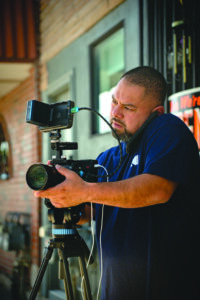
The shoot runs like controlled chaos, but Cruz never loses the thread. Between takes, he breaks down his process for me. Why this angle, what he’s building toward. Then he looks up. “You should come to the next location. Abandoned warehouse over by Eastern Market.”
This is how Cruz has operated for the past decade, becoming one of Detroit’s most recognized and sought after music video directors. He’s shot for Icewear Vezzo, Tee Grizzley, Big Sean, Kevin Gates, Tyga, Gunna (the list goes on) and built his reputation turning around projects in days when other directors needed weeks. He brought cinematic narrative to a genre built on performance shots and flashy visuals, pulling together full productions through a few phone calls and Instagram messages. That speed and hustle is what got him recognized. Now he’s aiming for something bigger.
When I first met Diego Cruz, 38, at La Jalisciense earlier this summer, construction noise fills the restaurant. A jackhammer tears into brick outside. It’s the kind of noise that makes conversation feel like a shouting match. Cruz sits there in a Black Aztlan T-shirt and thick square glasses, unbothered. I ask if we should go somewhere quieter, hoping he’ll say yes. He shrugs and smiles. “I used to work in construction. I’m used to it.”
His adaptability is an admirable trait, one that I envy, and it defines how Cruz has operated since committing himself full-time to directing music videos. “Detroit is such a run and gun city,” he says. “We make it happen any way we can. That’s just a part of our culture.”
He believes Detroit music video directors can go “toe-to-toe with the best filmmakers from any other city.” Watching how he operates – from his resourcefulness to the undeniable final product – it’s hard to argue.
Cruz, 38, comes from a tight Southwest Detroit household, one of nine kids who spent their Sundays at MJR Southgate. He spent years in construction, pouring concrete for his father’s company, before ever picking up a camera. Now he shoots everything from underground artists counting every dollar to major label budgets. What separates him isn’t pedigree or connections, but the way he makes every artist look like they’ve already blown up.
Sundays at the Movies
Cruz grew up in a packed Detroit house where Sundays meant the movies. His father couldn’t afford nine tickets, so he’d buy a few, wave them through, and the family would disappear into the dark for hours. One film turned into two. Sometimes they stayed past sunset. “He wasn’t being cheap,” Cruz says. “He just wanted us to have that experience.”
Those days built his eye. 1998’s Belly starring Nas and DMX burned itself into his brain. He remembers watching Shawshank Redemption and Ghost. They were films that taught him about what a person could do with a camera, and they made Detroit feel closer to the screen.
When he’s shooting now, setting up a diner scene like Paid in Full, he thinks of that ritual. “One day I want my family in the theater watching one of my films,” he says.

His father’s drive stayed with him. He ran Cruz Cement and gave people from Mexico a place to land, like so many business owners in Southwest who offer work as a form of care. Cruz picked that up, too. The instinct to share resources, to call and say, “whatever you need, I got you,” extended even to me, after just one hour of our first interview. And he’s not all talk. The man delivers.
Starting from Scratch
Sometime around 2011, Cruz bought his first real camera (a Canon T3i) after selling back an $800 handycam to Amazon and saving up another week or two of construction paychecks. His ex-wife supported the purchase, even putting equipment on her credit card when he couldn’t fully afford upgrades. She knew Matthew Castro, Cruz’s friend who appears in his early videos posted exclusively to Facebook—they were friends before Cruz and Castro even went to school together. “She got what we were doing, just having fun with it,” Cruz says.
Those first videos with Castro were nothing fancy, just two friends lip-syncing to Beyoncé. They were learning angles and composition not from a textbook or a professor, but by actually doing it. “We were just messing around, but it made me realize this camera was more than a tool. I could actually use it to have fun and create something. I bought it for a dream, but why can’t the dream be fun?”
By 2013, Cruz was ready to try something bigger. He shot a 38-minute short film, pulling together friends, family, and any anyone else from the neighborhood who wanted to help. His ex-wife did makeup. His friend Riyadh helped promote it. Manny, another friend, helped shoot. His older brother starred in it, and his younger brothers filled out the cast. It premiered at Royal Oak Main Art Theatre, a screening that pulled everyone in from friends to family, but, too nervous to stay, Cruz paced outside while the 38-minute film played. He knows now what he didn’t then, mainly that the short ran long and lost its thread, but that’s how it works. You make something bad before you make something good.
“I could’ve easily quit right there. Thought, ‘People think it sucks, whatever.’ But no one actually told me it sucks. And they still came out and supported it.”
Someone told him afterward, “Nobody from here is doing this.” That validation, whether directly stated or not, pushed him forward. “I was like, who cares what anyone thinks? If it sucks, it sucks. If they think it’s amazing, great. But either way, I’m gonna keep making stuff.”
The decision to keep creating despite anyone’s opinion would define everything that came next. In 2014, Cruz started hustling for paid work while still working construction during the day at his dad’s company. He’d reach out to artists he thought were cool, be them rappers, singers, really anyone who was making music, and offer to shoot videos. “If you hate it, don’t put it out,” he’d say. “If you like it, cool.”
He did a lot for underground artists like Name Tag and Ty, and he learned on sets with his friend Arturo, whatever would build skill and speed. “2014 was mostly unpaid stuff,” he says. “I probably made like 500 bucks total, and I shot maybe 10 to 20 videos that year. The next year, I told myself, ‘If I did 10 this year, I want to double that—and actually get paid.’”
Meanwhile, he was still breaking his body working 40-hour weeks pouring concrete. Still figuring out what to charge artists who were just as independent as he was. Still learning how to light a scene, how to scout a location, how to turn around a finished product fast enough that artists would keep coming back.
Seeing in Light and Shadow
Cruz arrives at the abandoned Detroit Water and Sewage plant on the corner of Erskine and Orleans near Eastern Market before Shabazz and his crew to film the last scene of the “Go Baby” music video. He scopes the area to finalize shots within the plant, and I follow him as he moves through cavernous rooms that haven’t seen legitimate use in years, noticing him read the space the way a cinematographer reads a script. Then he stops.
Light falls through a crack in the ceiling, one clean stroke across the dark. Dust drifts through it, slow and silver. For a moment, the room feels like it’s waiting to be filmed. “That’s the money shot right there,” Cruz says.

It’s both craft and instinct, something that Cruz learned by doing it wrong a hundred times first, spanning back to when he shot those early Beyoncé lip-sync videos with Castro, all the way to making that too-long short film in 2013, and then by taking every opportunity to put his hands on a camera.
Most people starting out don’t have a clear vision. They have the notion of an idea and usually figure it out along the way and hope something clicks. Cruz knew what he wanted. He also had a support system that believed in him, which matters more than people admit. And he had his father’s example of running a construction company and breaking his body for the work.
Watching Cruz work, it was clear that he absorbed that ethic. The dream could be fun, sure, but it was also real and unglamorous. It was the kind of entrepreneurial start that included shooting for artists who couldn’t pay and reaching out cold to people who might say no. Eventually, that same determination pulled him into the orbit of another grinder trying to build something from nothing: Icewear Vezzo.