






















Michigan leaders, advocates, and caregivers are sounding an increasingly urgent alarm about a growing family-separation crisis unfolding not at the southern border, but right here in our neighborhoods, schools, and workplaces. On Friday, Nov. 14, a coalition of attorneys, educators, and policymakers joined a press call to share what they are witnessing in a growing atmosphere of deep fear and instances of children in detention for extended stays. Michigan Immigrant Rights Center (MIRC) intensified its enforcement actions linked directly to immigration policies implemented by the Trump Administration since January.
Hosted by the MIRC, the call included State Senator Stephanie Chang, representatives from Sen. Mary Cavanagh’s office, the Young Center for Immigrant Children’s Rights, Kent School Services Network, and foster caregivers who have supported separated children in Michigan.
Jennifer Venegas, managing attorney at the Young Center, explained that while the era of dramatic border-station separations may have faded from national news cycles, the crisis has not ended; it has simply changed form.
“Family separation hasn’t ended. It just looks different,” Venegas said. “Today, it’s happening quietly through internal enforcement actions that tear families apart right here in Michigan, not at the border, but in our own communities.”
She also laid out troubling trends happening inside federal custody. In December 2024, a child remained in detention for an average of 35 days before being released to a legal sponsor. By March 2025, that number had tripled.
That means children are spending birthdays, holidays, and entire school semesters without seeing their families.
“You only get brief monitored calls with your mom,” Venegas said.
“And she has no idea how to get you back.”
Attorneys and advocates say the shift began the day President Donald Trump returned to office, when his Administration quickly dissolved longstanding protections that once prohibited immigration enforcement at “sensitive locations” such as schools, churches, and health clinics.

“On day one, we saw the end of the decades-long policy that limited enforcement in sensitive locations,” said Molly Huffaker, supervising attorney at the Michigan Immigrant Rights Center.
“Children are children, regardless of their nationality, and our law and our values require us to act in their best interest.”
Now, Huffaker said, parents are being urged to prepare for detention with grim practicality, such as signing temporary guardianship documents, arranging backup childcare, and organizing legal files, much as one might prepare a will.
The ramifications are immediate in schools, especially those serving large immigrant populations. Dr. Keenan King, executive director of Kent School Services Network, said fear is spreading faster than accurate information.
“Sometimes it’s just a feeling,” King said. “If you talk to your communities, they’ll tell you, if they don’t trust the systems, they’re not going to send their babies to those spaces.”
He described a continuing chain reaction of children staying home, absenteeism increasing, and students becoming vulnerable to punitive systems.
“Kids not going to school is bad for business. It’s bad for our community and society, whether the fear is real or not,” King said. “We’ve been on our heels since January trying to help our community navigate these situations.”
The trauma of forced family separation leaves imprints not just by the numbers, but on children’s bodies and minds.
“Lauren”, to keep her identity private, is a former refugee foster mom in Michigan who has cared for approximately ten immigrant children who arrived alone, spoke candidly.
“We know firsthand the separation is horribly traumatizing,” she said. “Government officials who are charged with keeping the country safe are instead terrorizing families, especially children.”
She described children who arrive anxious and withdrawn, and yet astonishingly resilient. “Despite all these scary times, these children continue to be loving and funny and creative,” Lauren said. “All children deserve safety.”
Michigan lawmakers say they are working to enact state-level protections. State Senator Stephanie Chang stressed that protecting immigrant communities isn’t just a moral imperative; it is essential for public safety.
“What’s best for public safety for immigrant families is best for public safety for all of us,” Chang said. “When law enforcement operates without clear identification and without oversight, it undermines democratic norms and community relationships.”
Representing Sen. Mary Cavanagh, legislative director Grace Rowley highlighted Senate Bill 508, one of three proposed measures to re-establish protections in schools and health-care settings.

“These bills ensure the constitutional rights of all Michiganders are upheld,” Rowley said, noting that more than 170 U.S. citizens have been mistakenly detained by immigration agents nationwide since March 2025.
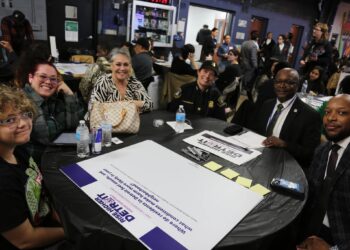
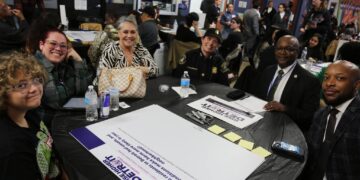
That urgency is being echoed in Detroit. On November 11, the activist group Detroit People’s Assembly mobilized parents, educators, and students to press the Detroit school district for stronger protections at a monthly Board of Education meeting.
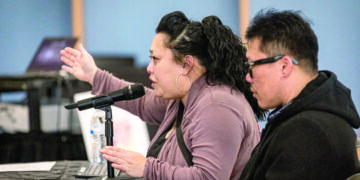
Members addressed the board during public comment, urging immediate action rather than symbolic reassurance, and the group says Detroit Public Schools Community District (DPSCD) is falling short.
“The district is failing to adequately support and protect immigrant students, families, and staff,” People’s Assembly wrote this week on Instagram. “We deserve better!”
They are urging the district to stand up and strengthen its sanctuary policy by requiring mandatory staff training on immigrant rights, establishing clear protocols for interacting with law enforcement, and prohibiting the sharing of student information with immigration agencies unless a judicial warrant is presented.
Additionally, they want “clear and timely” communication to families when immigration-related incidents occur near schools.
For those on the front lines, educators, lawyers, and foster parents, the message is consistent: children are not political collateral.
The crisis unfolding in Michigan may not make national headlines, but for the families living through it, the fear is heavy and constant. Advocates warn that, without intervention, both in Lansing and within institutions like Detroit’s public schools, the most vulnerable members of our communities will continue to pay the highest price.