





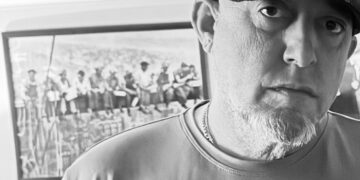


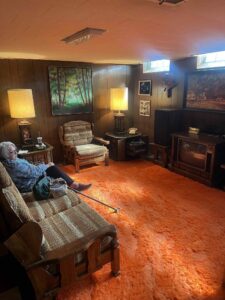
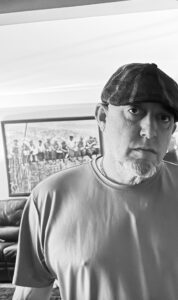
Every morning, Justin Burbank sits down in a living room that doesn’t exist anymore—at least not in its original form. The whole space, outfitted in orange shag carpet and plaid furniture, is a physical reconstruction of the Brandon Street living room where he grew up in the ‘70s, built in the basement of his Warren home. Transported to his childhood by 5:30am, he opens his phone, types what comes to him, and within minutes posts it to “Southwest Detroit ‘In Words,’” the Facebook group he runs.
“So all that I write and the lines in my brains? / Always lead back to Junction and Brandon Street drains…. / It’s been 30 or more years since I sat on my porch….. / And I still call it mine like I own it of course.”
Within hours, hundreds of the group’s five-thousand-plus members fill the comments section. Current and former residents tag old friends and share photos of corner stores and school hallways, or recount their own versions of the streets he just put into poetry. Neighbors find each other in the thread, connected by a poem that was written over coffee before most people’s alarms go off.
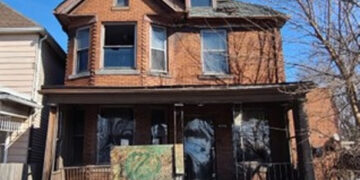
Southwest Detroit in the 1970s and ‘80s was a time that resists easy summary. Burbank, who grew up at 4796 Brandon Street, describes it plainly: “Black, Puerto Rican, Mexican, white, Laotian, Armenian—it was like the world in a quarter mile.” To Burbank, the local poet who goes by the pen name JB McBurbs, the neighborhood’s identity was built from the factories and river docks that made Detroit possible, including the Ford Rouge complex that Burbank still refuses to call Dearborn. “There’d be no suburbs without Southwest Detroit first,” he says. “So yeah, we’re cocky. Damn right we are.”
That pride is everywhere in the poetry he writes daily and shares across Facebook, and it doesn’t shy away from challenging times in the neighborhood’s history. Burbank writes candidly about Southwest as it endured economic hardship, population decline, gang violence, Devil’s Night fires, and even the crack epidemic. He also writes about his complicated father, a drug dealer, and about friends who caught bullets over hat colors. “The beauty in the hell,” is how he puts it. If you catch one of his daily poems in your Facebook feed, you’re sure to feel both in each one.
Burbank didn’t start writing by choice. In fourth grade at St. Hedwig, he says he “pissed off the wrong nun,” and his punishment was to write poetry for a month. “It has been nonstop in my head like that ever since,” he says.
Last year, he nearly died after a three-foot blood clot had caused a 100% blockage in his femoral vein, building for two and a half years while he worked as a general contractor. When he finally drove himself to the hospital, doctors told him they usually don’t find clots like his until autopsy. Today, he still faces the possibility of losing his left leg. “They medically disabled me, and they put me down,” says Burbank. “And that’s when I really ramped up.”
Aside from the relatable content about Southwest, the style of Burbank’s poems feels accessible, not academic. Nearly all of them come to him within minutes and are typed directly into his phone. Sometimes he finishes one and genuinely doesn’t know where it came from. All rhyme and use everyday language that the people they’re about relate to and use themselves. He even intentionally misspells words to throw off AI from cloning his voice. “I will never be Shakespeare,” he wrote to his followers. “Ain’t no one talking like that where we’re from.”
The beauty is that his audience isn’t looking for meter and form, they’re just looking to recognize themselves.
“Southwest Detroit ‘In Words’” has become something more than a Facebook group. Spend some time perusing Burbank’s countless poems (once you’re admitted) and you realize it feels more like a digital class reunion for graduates of the Southwest school of hard knocks. “We do backyard barbecues in words around here,” wrote Burbank in a welcome post.
A large portion of the people flooding the group with comments and old photographs are, like Burbank himself, former residents, many who left during the same years he did, for the same reasons, now reaching back toward a neighborhood they no longer live in.
In “My Prayer at Redeemer,” Burbank turns the act of leaving Southwest into a confession, and in doing so, speaks for everyone in his audience who made the same choice and carries the same guilt:
“I’ll say a million Our Fathers / And fill that basket with my Dollars / If your collar could undo what’s been done…… / I want back My Junction, / If only again to understand the simple Function…. / Of what it meant??? To be a SOUTHWEST DETROIT SON !!!”
Like the poems themselves, the group holds the diaspora of Southwest Detroiters together across both distance and decades, but it also raises the question: is Southwest Detroit a memory to be eulogized, or a living place whose story is still unfolding?
Leaving Southwest Detroit in those years wasn’t a choice made lightly or without cause, says Burbank. Crime was high, opportunities were shrinking, and families moved because they had to, not because they stopped loving the place.
That’s exactly the audience Burbank writes for: people shaped by Southwest Detroit who couldn’t stay in it, whose connection to the neighborhood is real and earned even if their zip code changed decades ago. Just because they aren’t active participants in Southwest’s current renaissance doesn’t make their experience any less woven into its fabric. Burbank gives that experience its due, and his work serves as a reminder that the hardship didn’t hollow Southwest out. Instead, the neighborhood responded to that struggle by pulling closer together.
Much like the team behind VOCES, the oral history project of Southwest’s Latino community, Burbank is doing something related, but in his own way. His archive is unedited, unapologetic, posted before sunrise, written from the gut, and self-published on Facebook. After all, Burbank is just a man in a basement that smells like 1979, typing what comes to him, with eight million eyeballs a year on it.
Find Justin Burbank’s work in the Facebook group “Southwest Detroit ‘In Words.’” New members welcome—especially if you’re from the neighborhood, or wish you were.
Cada mañana, Justin Burbank se sienta en una sala que ya no existe —al menos no como era antes. El espacio completo, con alfombra naranja estilo “shag” y muebles de cuadros, es una reconstrucción física de la sala en la calle Brandon donde creció en los años setenta. La construyó en el sótano de su casa en Warren. A las cinco y media de la mañana, ya transportado a su infancia, abre su teléfono, escribe lo que le llega a la mente y en cuestión de minutos lo publica en “Southwest Detroit ‘In Words,’” el grupo de Facebook que él administra.
“Así que todo lo que escribo y las líneas en mi cabeza / Siempre me llevan de regreso a Junction y a las coladeras de Brandon… / Han pasado más de treinta años desde que me senté en mi porche… / Y todavía lo llamo mío, como si fuera el dueño.”
En pocas horas, cientos de los más de cinco mil miembros del grupo llenan la sección de comentarios. Residentes actuales y antiguos etiquetan a viejos amigos, comparten fotos de tienditas de la esquina y pasillos de escuelas, o cuentan sus propias versiones de las calles que él acaba de convertir en poesía. Vecinos se reencuentran en el hilo, unidos por un poema escrito con café en mano, antes de que sonara la mayoría de las alarmas.
Southwest Detroit en los años setenta y ochenta fue una época difícil de resumir. Burbank, quien creció en el 4796 de la calle Brandon, lo describe sin rodeos: “Negros, puertorriqueños, mexicanos, blancos, laosianos, armenios… era como el mundo entero en menos de media milla.”
Para Burbank, el poeta local que firma como JB McBurbs, la identidad del vecindario nació de las fábricas y los muelles del río que hicieron posible a Detroit, incluyendo el complejo Ford Rouge, que él todavía se niega a llamar Dearborn. “No habría suburbios sin Southwest Detroit primero,” dice. “Claro que somos orgullosos. Y con razón.”
Ese orgullo está presente en los poemas que escribe a diario y comparte en Facebook, y no evita los momentos difíciles de la historia del barrio. Burbank escribe con franqueza sobre los años de crisis económica, la pérdida de población, la violencia de pandillas, las noches de incendios en Devil’s Night y la epidemia del crack. También habla de su padre, quien vendía drogas, y de amigos que murieron por el color de una gorra.
“La belleza dentro del infierno,” así lo describe. Y en cada poema se sienten las dos cosas.
Burbank no empezó a escribir por gusto. En cuarto grado, en la escuela St. Hedwig, dice que “hizo enojar a la monja equivocada,” y su castigo fue escribir poesía durante un mes. “Desde entonces no se ha detenido en mi cabeza,” cuenta.
El año pasado estuvo al borde de la muerte. Un coágulo de sangre de casi un metro le bloqueó por completo la vena femoral, algo que se fue formando durante dos años y medio mientras trabajaba como contratista general. Cuando finalmente manejó al hospital por su cuenta, los doctores le dijeron que coágulos así normalmente se descubren en una autopsia. Hoy todavía enfrenta la posibilidad de perder su pierna izquierda.
“Me declararon médicamente discapacitado y me tumbaron,” dice Burbank. “Y ahí fue cuando de verdad le metí más.”
Más allá del contenido sobre Southwest, el estilo de sus poemas es directo y fácil de entender. No es académico ni complicado. Casi todos le llegan en minutos y los escribe directamente en su teléfono. A veces termina uno y ni siquiera sabe de dónde salió. Todos riman y usan el mismo lenguaje cotidiano que la gente del barrio reconoce como propio. Incluso escribe palabras mal a propósito para que la inteligencia artificial no pueda copiar su voz.
“Nunca seré Shakespeare,” les escribió a sus seguidores. “Nadie habla así de donde venimos.”
Y la verdad es que su audiencia no busca métrica perfecta ni reglas literarias. Solo quiere verse reflejada.
“Southwest Detroit ‘In Words’” se ha convertido en algo más que un grupo de Facebook. Después de leer varios de los incontables poemas de Burbank —una vez que lo aceptan al grupo— se siente como una reunión digital de exalumnos de la escuela dura de Southwest.
“Aquí hacemos carnes asadas en palabras,” escribió en una publicación de bienvenida.
Muchos de los que llenan el grupo con comentarios y fotos antiguas son, como él, exresidentes. Personas que se fueron en los mismos años y por las mismas razones, y que ahora miran hacia atrás, hacia un barrio donde ya no viven.
En el poema “My Prayer at Redeemer,” Burbank convierte el acto de irse de Southwest en una confesión. Y al hacerlo, habla por todos los que tomaron la misma decisión y cargan con la misma culpa:
“Rezaré un millón de Padres Nuestros / Y llenaré esa canasta con mis dólares / Si tu cuello clerical pudiera deshacer lo que ya se hizo… / Quiero de vuelta mi Junction, / Aunque sea solo para entender de nuevo / Lo que significaba ser un hijo de SOUTHWEST DETROIT.”
Como los poemas mismos, el grupo mantiene unida a la diáspora de Southwest Detroit a través de la distancia y de las décadas. Pero también plantea una pregunta: ¿es Southwest un recuerdo al que se le rinde homenaje, o un lugar vivo cuya historia todavía se está escribiendo?
Irse de Southwest en aquellos años no fue una decisión fácil ni caprichosa, dice Burbank. El crimen era alto, las oportunidades disminuían y muchas familias se mudaron porque no tenían otra opción, no porque dejaran de amar el barrio.
Ese es precisamente el público para el que escribe: personas formadas por Southwest Detroit que no pudieron quedarse, cuya conexión con el vecindario es real y ganada, aunque su código postal haya cambiado hace décadas. No participar en el renacimiento actual del área no borra su historia. Burbank le da valor a esa experiencia y recuerda que las dificultades no vaciaron a Southwest. Al contrario, el barrio respondió acercándose más.
Así como el trabajo de Ozzie Rivera con VOCES —el proyecto de historia oral de la comunidad latina de Southwest—, Burbank está haciendo algo similar, pero a su manera. Su archivo no está editado ni filtrado. Se publica antes del amanecer, nace del corazón y vive en Facebook.
Al final del día, es solo un hombre en un sótano que huele a 1979, escribiendo lo que le llega, con ocho millones de ojos al año leyendo sus palabras.
Puede encontrar el trabajo de Justin Burbank en el grupo de Facebook “Southwest Detroit ‘In Words.’” Nuevos miembros son bienvenidos — especialmente si usted es del barrio… o quisiera serlo.