













March 17th is St. Patrick’s Day, the patron saint of the Irish. The Irish have held a special place in Mexican history.
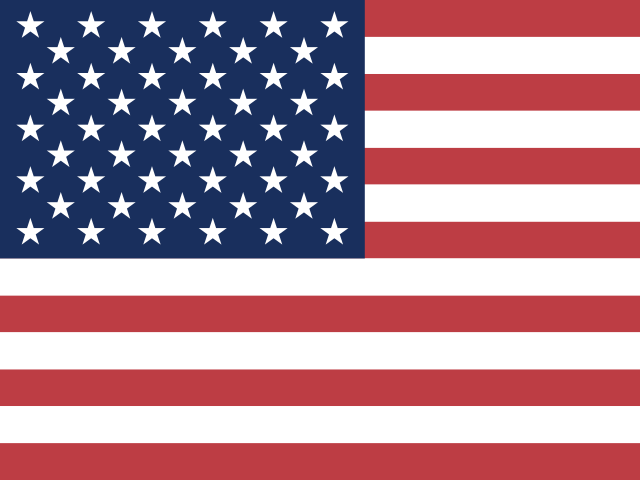
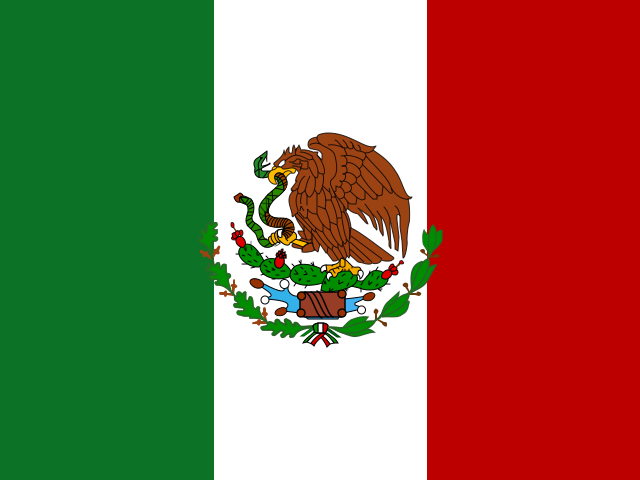
In the 19th century, from 1846 to 1848, the American Intervention took place in the north of what was then the newly formed Mexico.
The purpose of this war was to acquire territories that at that time comprised northern Mexico, including the proposed incorporation of Texas.

The war began on May 13, 1846, when the United States declared war on Mexico, bolstered at that time by Catholic artillery, primarily Irish, led by Lieutenant John O’Reilly. In September 1846, John O’Reilly, witnessing the mockery of the Irish by Americans and the religious differences within the Protestant Christian army, deserted along with his battalion of approximately three hundred soldiers. He joined Patrick Dalton in the Mexican army to defend the territory that at that time comprised northern Mexico.
The Saint Patrick’s Battalion, also known as Los Patricios, grew to approximately 800 soldiers, who shared a common Catholic background and came from various European countries, primarily Ireland, but also Germany.
On September 21, 1846, they fought for the first time on the Mexican side at the Battle of Monterrey, Nuevo León. They continued to defend Mexico during the Battle of Buena Vista, the Battle of Cerro Gordo, the Battle of Churubusco, and the Battle of Mexico City.
In the Battle of Churubusco, near Mexico City, John O’Reilly, later known as Juan Reley or Juan Riley, along with several members of his artillery, were captured, many of whom were hanged by the U.S. Army. In 1848, the U.S. Army entered Mexico City, where they forced Mexican President Antonio López de Santa Anna to sign the Treaty of Guadalupe Hidalgo on February 2, 1848, by which Mexico ceded 55% of what was then Mexican territory. The Patriot hero, John O’Reilly, after his capture, was sentenced to hard labor, which he endured for 12 months under torture. He was later released, and his whereabouts became unknown. After a persistent search, the writer and historian Robert Ryal Miller found the death certificate of a man named Juan Reley in the parish of the port of Veracruz, which reads:

“In the Heroic City of Veracruz, on the thirty-first of August, one thousand eight hundred and fifty, I, Don Ignacio José Jiménez, parish priest of this Parish, named the Assumption of Our Lady, gave ecclesiastical burial in the general cemetery to the body of Juan Reley, forty-five years of age, a native of Ireland, single, his parents are unknown.”
Song to Juan Riley
Juan Riley is recognized in Mexico for the Ballad of John Riley, or Hymn of the Saint Patrick’s Battalion. This song, a product of popular genius, bears witness to the American invasion of Mexico and is an ode to a great heroic battalion formed by Irish, German, and other nationalities who switched from the invading ranks to the defenders of Mexico.
My name is John Riley
listen to me for a moment:
I left my deer at home,
in Ireland.
There, death reigned:
hunger or exile.
When I arrived in America
it was my duty
to join the Navy
and I marched from Texas
to join the war
against Mexico.
It was there,
in those towns and ravines
that I understood the mistake I had made.
I saw myself conquering poor and dying Catholics
with the gospel of bayonets.
I saw Him in the prisons
where raped mothers
and screaming children
denounced the pestilent stench
of this war.
I and three hundred Irishmen
decided to rise up
to the call of Him who guided us.
We,
from Dublin to San Diego
bore witness to the denied freedom.
We formed the Saint Patrick’s Battalion
and fought on the Mexican side.
We marched under the green banner of Saint Patrick:
Erin Go Bragh emblazoned with “Erin Go Bragh.”
Shining upon it were the harp and the shamrock,
and the motto:
“Freedom for Mexico.”
Only fifty years after Wolfstone.
All this happened five thousand miles from there.
The Yankees called us a Legion of Strangers,
the Heroes Without a Country.
We fought them in Matamoros,
because their volunteers were raping the nuns.
In Monterrey and Cerro Gordo,
we fought like sons of Ireland.
We were the red warriors of liberty,
fighting
alongside these brown men and women.
They and we,
fought against tyranny.
And I dare say that…
We would do it again!
We fought in five great battles.
Churubusco was the last of them.
Overwhelmed by the cannons of Boston,
we fell after each deadly shot.
Many of us died at our posts,
like Mexicans!
Far from our also occupied homeland,
we were heroes and martyrs.
Such is destiny,
this is how it calls us.
De 1846 a 1848 se llevó a cabo la Intervención Estadounidense en el norte de lo que en ese momento era el recién formado México.
El propósito de esta guerra era obtener territorios de lo que en aquel momento fue parte el norte del territorio mexicano, entre lo que se proponía incorporar Texas.
La guerra dio inicio el 13 de mayo de 1846, cuando Estados Unidos declaró la guerra a México, fortalecido en ese momento por la artillería católica, principalmente irlandesa, liderada por el teniente John O’Reilly.
En septiembre de 1846, John O’Reilly al ver cómo se burlaban los estadounidenses de los irlandeses, así como las diferencias religiosas del ejército protestante cristiano, desertó junto con su batallón de unos trescientos soldados, uniéndose junto con Patrick Dalton al ejército mexicano en la defensa del territorio que en ese momento formaba parte del norte de México.
El batallón de San Patricio, también llamado, Los Patricios fue aumentando de fuerzas hasta llegar a aproximadamente 800 soldados, que tenían en común ser católicos de diferentes países de Europa, principalmente Irlanda, pero también de Alemania.
El 21 de septiembre de 1846 se enfrentan por primera vez del lado mexicano en la batalla de Monterrey, Nuevo León. Continuaron con la defensa mexicana durante la Batalla de Buena Vista, la Batalla de Cerro Gordo, la Batalla de Churubusco, la Batalla de la Ciudad de México.
En la Batalla de Churubusco, de la Ciudad de México, John O’Reilly, posteriormente conocido como Juan Reley o Juan Riley, junto con varios miembros de su artillería fueron aprehendidos, siendo muchos de ellos ahorcados por el ejército estadounidense. En 1848 sumadas las derrotas mexicanas, entrando el ejército estadounidense hasta la Ciudad de México, donde fuerzan al presidente mexicano Antonio López de Santa Anna el 2 de febrero de 1848 a firmar el Tratado de Guadalupe Hidalgo con el que México cedió forzosamente el 55% de lo que en ese momento era el territorio mexicano.
El héroe Patricio, John O’Reilly, posterior a su aprehensión fue condenado a trabajos forzados que cumplió durante 12 meses de tortura, posteriormente fue liberado perdiéndose su rastro. Tras una pertinaz búsqueda, el escritor e historiador Robert Ryal Miller, encontró el acta de defunción de un hombre de nombre Juan Reley, en la parroquia del puerto de Veracruz, la cual dice:
“En la Heroica Ciudad de Veracruz, en treinta y uno de agosto de mil ochocientos cincuenta, Yo Don Ignacio José Jiménez, cura propio de esta Parroquia, título la Asunción de Nuestra Señora, di sepultura eclesiástica en el cementerio general al cuerpo de Juan Reley, de cuarenta y cinco años de edad, natural de Irlanda, soltero, se ignora los padres”.
Balada de Juan Riley
Juan Riley ha sido reconocido en México con la Balada de John Riley o Himno del Batallón de San Patricio, es una canción, producto del genio popular, que atestigua la invasión estadounidense a México y es oda a un gran batallón heroico formado por soldados irlandeses, alemanes y otras nacionalidades, que se pasaron desde las filas invasoras a las defensoras de México.
Mi nombre es John Riley
escúchame un momento:
dejé mi venado en casa,
en Irlanda.
Allá imperaba la muerte:
hambre o exilio.
Cuando llegué a América
estaba en mi deber
entrar a la Armada
y marché desde Texas
para unirme a la guerra
contra México.
Fue ahí,
en esos pueblos y barrancos
cuando comprendí el error que había hecho.
Me vi conquistando pobres y moribundos católicos
con el evangelio de las bayonetas
Yo lo vi en las cárceles
donde madres violadas
y niños gritones,
denunciaban el hedor pestilente
de esta guerra.
Yo y trescientos irlandeses
decidimos levantarnos
a la llamada de Él que nos guiaba.
Nosotros,
desde Dublín a San Diego
dimos testimonio de la libertad negada.
Formamos el Batallón de San Patricio
y peleamos del lado mexicano.
Marchamos bajo el verde pabellón de San Patricio:
Blasonado con el “Erin Go Bragh”.
Brillaban en él, el arpa y el trébol,
y el lema:
“Libertad para México”.
Solo cincuenta años después de Wolftone.
Todo esto sucedió a cinco mil millas de aquello.
Los yanquis nos llamaron una Legión de Extraños,
los Héroes Sin Patria.
Los combatimos en Matamoros,
porque sus voluntarios violaban a las monjas.
En Monterrey y Cerro Gordo,
nosotros peleamos como hijos de Irlanda.
Fuimos los guerreros rojos de la libertad,
luchando
junto a estos hombres y mujeres morenos.
Ellos y nosotros,
peleamos contra la tiranía.
Y me atrevo a decir que…
¡Lo haríamos otra vez!
Combatimos en cinco grandes batallas.
Churubusco fue la última de ellas.
Abrumados por los cañones de Boston,
caímos después de cada disparo mortal.
Muchos de nosotros murieron en sus puestos,
¡Cómo mexicanos!
Muy lejos de nuestra también ocupada Patria,
fuimos héroes y mártires.
Así es el destino,
así es que nos llama.