





















After a drawn out ceremony that tested the patience of a global audience, FIFA eventually conducted the much-anticipated draw for the first ever 48-team World Cup. The large number of participants, spread out over 12 groups of four for the first round, meant that there will be few blockbuster group matches. For the hosts, which will be the focus in this issue, it meant largely avoiding the big powers.
The United States, which will host the majority of the games, will have perhaps its most favorable draw ever. First, basketball legend Shaquille O’Neal pulled Australia out of Pot 2. Mauricio Pochettino’s team dispatched the Socceroos 2-1 in October without being at full strength. When the two teams meet in Seattle on June 19, the stakes will be much higher. Sounders fans typically make Lumen Field the loudest venue in MLS. The national team will be hoping for the same level of support.
If US fans weren’t sufficiently pleased with drawing Australia, they really gave a sigh of relief when Paraguay joined the group next. It could have been Norway with Erling Haaland or Egypt led by Mohammed Salah. And, much like Australia, the US already has experience against Paraguay, having defeated them 2-1 during the November international window. Those results should give the Americans confidence, but not arrogance.
The Americans’ third opponent will be the winner of a European playoff pool that includes Turkiye, Romania, Slovakia, and Kosovo. The USA lost to Turkiye last June 2-1 but played reasonably well just ahead of the CONCACAF Gold Cup. The Turks do have some star quality in Real Madrid’s Arda Guler and Juventus’ Kenan Yildiz, but in one-off playoff games results are not guaranteed. Overall, the group is manageable. The US has to expect to win this group at home. They will open group play on June 12 against Paraguay at SoFi Stadium in Inglewood, California, and finish group play there on June 25 against the European team.
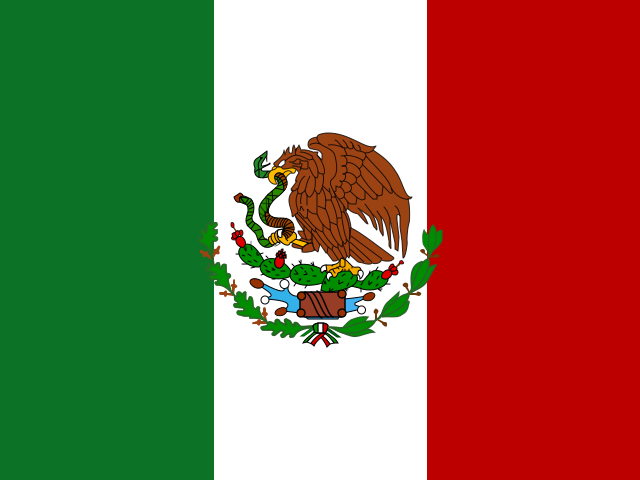
Mexico is hosting the World Cup for the third time. No other country has hosted more. While the Mexicans did win the Gold Cup over the USA last summer, they have not had happy times since. In November, they failed to beat either Paraguay or Uruguay. Coach Javier Aguirre will appreciate playing two group matches in the Azteca. It won’t be the altitude that bothers his team, but the pressure as hosts. The local fans will be expecting entertaining and winning football.
Much like the US, Mexico dodged the big powers. They will open in the Azteca against South Africa. It is the reverse fixture of the game that opened the 2010 World Cup. In a strange coincidence, this will also be the first kickoff on June 11. Hosting the opening ceremonies in the Azteca will give Mexico a distinct advantage. Even given their less than inspiring play during the fall, this will have to be a big performance in front of a global audience.
Like the US, Mexico will change venues for the middle game of group play. South Korea won’t mind meeting Mexico somewhere other than the Azteca. The Estadio Akron in Guadalajara will welcome the hosts on June 18 against star forward Son Heung-Min and South Korea. Then, Mexico will return to its spiritual home to finish up against a European opponent. Ukraine, Sweden, Poland, and Albania will battle it out in March to join Mexico’s group.
The lowest ranked host country is Canada. They also have the longest travel of the three hosts during the group phase. They have to go from Toronto, where they will open against a European playoff winner, to Vancouver where they will play their last two group matches. The Canadians have been to the World Cup twice and lost all six matches. They will be hoping to change that this summer.
However, their path has the potential to become extremely difficult. Their potential opening game on June 12 could be against Italy. The four-time winners are in the playoffs with Northern Ireland, Wales, and Bosnia-Herzegovina. The Italians have failed to qualify for the last two World Cups. Failing again is almost unthinkable, especially when a game in Toronto to start would be close to a home match given the large Italian population there.
Jesse Marsch will have his work cut out for him no matter which team comes through the playoffs. Upon moving out to Vancouver for the last two group games, Canada will meet Qatar. The 2022 hosts exited in the group phase, which only South Africa had done previously. They will be motivated to give Canada the same pain. That game will be a must win for the Canadians, because they will meet Switzerland in the group finale.
Now that the groups have been drawn, the real work starts for the managers. They now have about six months to develop a plan for each group phase opponent, as well as trim their selections down to 26 players with a few emergency players in reserve in case of an injury prior to the first group match. Most national teams will not have a chance to get together until March, but the African Cup of Nations starting on December 21 will give the African teams an intense competitive environment only few months before the World Cup. Teams who have drawn Africa sides in the group phase will be sure to send their scouts to Morocco to see what they will be up against.
The host nations will gather their national teams in March. The USA and Mexico will face Belgium and Portugal. The USA will host both teams, top seeds like themselves, in Atlanta’s Mercedes Benz Stadium, a World Cup venue. Mexico will welcome Portugal to the Azteca and then travel to Chicago for their meeting with Belgium. Canada has yet to announce any friendly games for the March window.
The US has announced they will have two games during their pre-World Cup camp at the end of May and into early June. There will be a game in Charlotte, North Carolina on May 31 with an opponent to be determined and a send-off game at Chicago’s Soldier Field against Germany on June 6. Then, it will be time for the real thing. The next six months will be equally slow due to the anticipation and fast because June 11 will be here before we know it. The biggest World Cup ever staged will attract a massive audience, those who can afford the eye-watering ticket prices and the vast majority who will be glued to screens around the world at all hours to see which country claims the sport’s biggest prize.