


















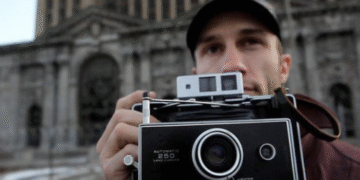




Cruz shot about 20 music videos in 2015, the year he connected with Icewear Vezzo.
Vezzo was grinding independently then, still unsigned to Motown, still funding his own music. But he carried legitimate street credibility and a relentless work ethic that resonated across Detroit’s hip-hop scene.
“I did that first video for free,” Cruz recalls. “I was like, ‘Yeah, hell yeah, let’s do it.’ We shot it, turned it around quick—boom. The rest is history.”

The first video, “Camera Off,” came out in September 2015. Shortly thereafter, Vezzo wanted another one. Cruz quoted him a price that, in hindsight, makes him wince. He won’t say what he charged. Cruz says, “I was trying to figure out, like, what do people even charge for videos at this level? And I thought, ‘This isn’t bad—it’s a day’s worth of [construction] work.’ So I just did it.”
Over the next year, Vezzo and Cruz became close collaborators. In February 2016, they dropped “Rain,” co-directed with Nick Margetic, one of Detroit’s established directors. The video would eventually climb to 1.5 million views. When Vezzo’s team started planning the video for “Moon Walken” in spring 2016, they initially wanted Cruz to work with Margetic again, but Cruz pushed back. Cruz wanted more than shared credit—he wanted to direct it himself. Not because of any beef with Margetic – there was nothing but respect between the two – but because Cruz needed to prove he could do it alone.
When “Moon Walken” dropped in April 2016, Cruz recalls, “That video was huge for me. It showed people I could do this on my own. It was a breakout hit for [Vezzo] and I.”
While, comparatively, the video would only go on to rack up over 300,000 views – small numbers for Vezzo nowadays – Cruz had stepped out from under anyone else’s shadow. Now, he wasn’t just a credit share, but a name.
“Angel Wings” came in February 2017 and blew past a million views. It was clear that at this point, Cruz and Vezzo had developed a rhythm: fast turnarounds, street authenticity, and that polished look that made independent artists seem like they already had label backing. Things were going well for Cruz, and the frequent collaborator he had in Vezzo was making a name for himself on a national level.
Then, in 2017, Vezzo went to prison.
It had gone down back in fall 2015—a Detroit gas station, Vezzo passing off a Glock. With a prior on his record, touching a firearm was a violation. The conviction came in 2017. Vezzo would spend 20 months behind bars. Just like that, one of Cruz’s most consistent collaborators would be gone for nearly two years.

But while Vezzo was locked up, people started asking Cruz to shoot with them
“There were artists who thought I was only shooting for Vezzo,” Cruz recalls. “Like, they didn’t want to reach out because they assumed it was exclusive—which wasn’t true. They’d say, ‘We didn’t know, we didn’t want to disrespect him.’ And I’d tell them, ‘All you had to do was ask.’”
One by one, artists who’d been holding back started reaching out, and Cruz kept shooting, building a reputation that was his alone.
FRESH OUT
Vezzo had limited time out of his halfway house in 2018. That’s when he called Cruz to pull up.
“I was like, ‘Bet. Of course,’” Cruz says. “So he gets to the studio, makes the song, and while he’s recording it, I’m filming everything—right there as it’s happening.”
According to Cruz, Vezzo had around an hour outside of the halfway house. A few hours after Vezzo returned to the house, Cruz had already edited the video and dropped it on YouTube.
“I think it’s at almost 3 million views now, but at the time it hit a million fast,” Cruz recalls of the Drank God Back Freestyle. “It was his first track out, and it just took off. And right after that, he got signed.”
In the fall of 2018, Vezzo signed with Motown Records, joining a roster that included Lil Baby, Migos, and City Girls, artists who were heavyweights in the trap and street music space that was dominating hip-hop. For Cruz, it validated something he’d been betting on: that Detroit artists could compete at the highest level, and that the videos he was making could help get them there.
“That became my reputation,” Cruz says. “Artists were used to waiting weeks for their videos. I was cutting that down to maybe a few days, sometimes a week.”
It’s true that the mix of the visuals, the lyrics, and the public’s yearning for Vezzo’s music after nearly two years of silence had all contributed to the freestyle’s viral success. And while the music video’s visuals themselves are flashy and the editing is frenetic and highly stylized, the visuals weren’t representative of what Cruz would eventually become known for in the Detroit music video community.
His real breakthrough came later in 2018 with one of Detroit’s biggest breakout stars, an artist whose 2017 track “First Day Out” had exploded like a gunshot and racked up millions of views in days, forcing the industry to pay attention to what was happening in Detroit for the first time since Dej Loaf broke into the scene. He’d opened doors that had been locked for years and proved Detroit rappers could go national, could go platinum, could compete with anyone. When an artist at that level works with a new director, it sends a signal through the entire scene. That artist was Tee Grizzley.
THE NARRATIVE TURN
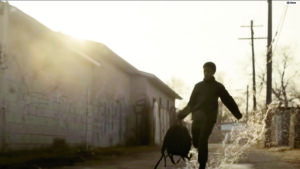
The “We Dreamin’” video follows a Black teenage boy hunched over a notebook, crafting lyrics while his overworked mother struggles to put breakfast on the table. Desperation pulls him toward fast money, and though his friend pushes back, it’s already too late. An introduction gets made to a house full of hard men, and then the flashing lights come: a raid, bodies scattering, his friend hitting the pavement while the boy keeps running. Cruz even added subtitles so you could follow every word of unspoken dialogue, and eventually you can’t tell whether you’re watching a music video or a short film that happens to have a soundtrack.

“People in the comments were like, ‘Yo, this touched me,’ or, ‘This hit different, emotionally,’” Cruz remembers. “And that’s when people started to notice my style… In this city, it’s always like, ‘Who’s the most popular artist right now? Okay, who shot their video?’ That’s the person everyone wants.”
“Detroit artists, once they find a videographer they like, they usually stick with them,” Cruz explains. “So when Tee started shooting with me, that was a big deal. It was the first time he worked with someone new.”
With both Tee and Vezzo on his reel – two of Detroit’s biggest names – Cruz felt like he had arrived. Alongside CT Films, Jerry, and the MVP crew of Margetic and Kiefer, he was easily one of the top directors working in Detroit.
Going Full-Time
By winter 2018, the math had become undeniable. Cruz’s video work had grown so consistent (and lucrative) that staying in construction made no sense.
“You gotta think, I was physically breaking my body working 40 hours a week,” recounts Cruz. “Then I started charging more for my videos and realized I could make that same money in a day or two.”
Cruz was getting booked so often that during the winter, when most construction workers file for unemployment as projects slow down, he forgot to file at all. When he finally went to file and realized what he’d missed, the choice crystallized. He wasn’t going back to construction.
“I was doing video full-time. And I told myself, ‘Even if I just do one video a week, I’ll be good.’ Because I was charging what I used to make in a week.” But Cruz wasn’t doing just one a week. He was doing two, sometimes three. The bookings kept coming, and he began to build something he finally had a true calling for.
That had been the mission from the beginning. Cruz would study videos from the coasts, dissecting lighting, framing, production value. He’d ask himself: “What are they doing that we’re not?” But it wasn’t just technical polish Cruz was chasing. It was the storytelling. It was the emotional depth he’d absorbed back in those days at MJR Southgate, watching how his favorite films invested audiences in characters beyond their Hollywood spectacle. Braggadocious raps needed more than just flex, they needed context, consequence, and humanity. Cruz was meshing the flashy visuals with the grounded narrative choices that belonged in feature films.

Cruz was merging the two—slick visuals and grounded storytelling; music video style meets narrative cinema.
By late 2018, he’d made his point. He wasn’t just Vezzo’s director anymore. He’d become one of Detroit’s top visual storytellers, someone who could make shoestring budgets look limitless and understood that great music videos, like great lyrics, told stories. It was the story that made any song remarkable.
Then in October 2019, his mentor Gerard Victor told him he’d maxed out in Detroit. Bigger opportunities existed elsewhere, and that “elsewhere” existed in New York City. Cruz was skeptical—but he left the city anyway, not knowing that walking away would be the only way to understand what he’d be walking back to.