




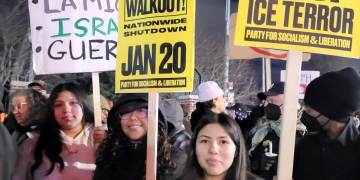

















Tension filled the February 19th Board of Police Commission meeting, as many upset residents attended in person and others voiced their frustration online. After meeting in executive session, the Detroit Board of Police Commissioners voted unanimously to suspend two officers who called the U.S. Border Patrol during a recent traffic stop. While the community is calling for the officers to be fired, a complicated legal dispute is already underway, making it harder for the department to respond quickly.
The incident resulted in two people being detained in Southwest Detroit and caused strong reactions, especially in District 6, where many immigrants live. The board voted 10-0 to place Sgt. Denise Wallet and Officer James Corsy on unpaid leave for 30 days. They will keep their medical benefits while the investigation continues.
However, the narrative surrounding the Feb. 9 incident has recently taken a turn. Detroit police Sgt. Denise Wallet, a 27-year veteran of the Detroit Police Department, filed a lawsuit, arguing that her unpaid suspension violates her due process rights.
The lawsuit says Wallet did not call federal agents to enforce immigration law. According to the complaint, Wallet says she called the U.S. Border Patrol “solely for the purpose of identifying the individual who was in custody, not to enforce immigration law or to inquire into the subject’s immigration status.” The lawsuit also claims she made the call only after her lieutenant told her to, and that she did not know the person’s immigration status.
For some residents, a 30-day unpaid suspension is not enough. They were demanding immediate termination, arguing that any collaboration with federal immigration agencies blatantly violates Detroit Police Department policy and continues the already fragile trust between law enforcement and the city’s immigrant neighborhoods.
“We have a big issue of mistrust in our community with the police and increasing that trust with our community begins by holding police officers accountable,” Guadalupe A., a resident of Southwest Detroit, urged the board.
“Detroit police officers are here to work for the citizens in the community, not to work for the federal government.”
During public comment, residents demanded accountability and noted that rules preventing DPD from acting as federal law enforcement have been in place for some time. Some community members said that because Sgt. Wallet has worked for so long, she should have known better.
Alexis E., District 6 resident and member of the grassroots collective The People’s Assembly, pointed out how these incidents affect public safety.
“Day by day, our community, and especially in Southwest Detroit, is afraid to call the cops for any help,” he said. “If the board wants to build that relationship with the community and the police…we need to get rid of all the police officers that’s not protecting or serving.”
Despite the public pressure to terminate the officers, the department’s leadership appears to be walking back its initial hardline stance. Chief of Police Todd A. Bettison originally intended to fire both officers. However, Bettison is now stating that he is satisfied with 30-day suspensions.
When pressed on what the department is doing to uncover other potential instances of non-compliance, Detroit Police Deputy Franklin Hayes assured the board that DPD is ramping up its internal oversight. Hayes noted that the department is reinforcing the “duty to intervene” policy and increasing audits of body-worn and in-car cameras from the command level down to frontline supervisors.
To help build trust and transparency, Hayes announced that DPD will host a procedural justice and police forum on Saturday, March 7th, at the SAY Detroit Play Center, located at 19320 Van Dyke Ave. in Northeast Detroit.
“…To strengthen the relationship between policing and the needs of the community, community members are encouraged to voice their concerns and learn the procedures police use to accomplish and carry out their duties,” Hayes said.
For more information, updates, and meeting schedule visit: https://detroitmi.gov/government/boards/board-police-commissioners
This article and photos were made possible thanks to a generous grant to EL CENTRAL Hispanic News by Press Forward, the national movement to strengthen communities by reinvigorating local news. Learn more at www.pressforward.news.
Las exigencias comunitarias de rendición de cuentas terminan con suspensiones en la policía de Detroit por llamada a la Patrulla Fronteriza
La tensión llenó la reunión del 19 de febrero de la Junta de Comisionados de Policía, a la que asistieron en persona muchos residentes molestos, mientras otros expresaron su frustración en línea. Tras reunirse en sesión ejecutiva, la Junta de Comisionados de Policía de Detroit Board of Police Commissioners votó por unanimidad suspender a dos oficiales que llamaron a la Patrulla Fronteriza de Estados Unidos durante una parada de tránsito reciente. Aunque la comunidad exige que los oficiales sean despedidos, ya está en marcha una disputa legal compleja, lo que dificulta que el departamento responda con rapidez.
El incidente resultó en la detención de dos personas en el suroeste de Detroit y provocó fuertes reacciones, especialmente en el Distrito 6, donde vive un gran número de inmigrantes. La junta votó 10-0 para colocar a la sargento Denise Wallet y al oficial James Corsy en licencia sin goce de sueldo por 30 días. Mantendrán sus beneficios médicos mientras continúa la investigación.
Sin embargo, la narrativa en torno al incidente del 9 de febrero ha dado un giro reciente. La sargento Denise Wallet, con 27 años de servicio en el Detroit Police Department, presentó una demanda alegando que su suspensión sin pago viola su derecho al debido proceso.
La demanda sostiene que Wallet no llamó a agentes federales para hacer cumplir la ley migratoria. Según la queja, Wallet afirma que llamó a la Patrulla Fronteriza de Estados Unidos “únicamente con el propósito de identificar a la persona que estaba bajo custodia, no para hacer cumplir la ley migratoria ni para indagar sobre el estatus migratorio del sujeto”. La demanda también afirma que realizó la llamada solo después de que su teniente se lo indicara y que no conocía el estatus migratorio de la persona.
Para algunos residentes, una suspensión de 30 días sin sueldo no es suficiente. Exigieron el despido inmediato, argumentando que cualquier colaboración con agencias federales de inmigración viola claramente la política del Departamento de Policía de Detroit y profundiza la ya frágil confianza entre las fuerzas del orden y los barrios inmigrantes de la ciudad.
“Tenemos un gran problema de desconfianza en nuestra comunidad con la policía, y aumentar esa confianza empieza por exigir que los oficiales rindan cuentas”, exhortó Guadalupe A., residente del suroeste de Detroit, a la junta.
“Los oficiales de policía de Detroit están aquí para servir a la gente de la comunidad, no para trabajar para el gobierno federal”.
Durante los comentarios públicos, los residentes exigieron rendición de cuentas y señalaron que las reglas que impiden que el DPD actúe como autoridad federal existen desde hace tiempo. Algunos miembros de la comunidad dijeron que, por la larga trayectoria de la sargento Wallet, ella debería haberlo sabido.
Alexis E., residente del Distrito 6 y miembro del colectivo comunitario The People’s Assembly, señaló cómo estos incidentes afectan la seguridad pública.
“Día tras día, nuestra comunidad —y especialmente en el suroeste de Detroit— tiene miedo de llamar a la policía para pedir ayuda”, dijo. “Si la junta quiere construir esa relación entre la comunidad y la policía… tenemos que deshacernos de todos los oficiales que no están protegiendo ni sirviendo”.
A pesar de la presión pública para despedir a los oficiales, el liderazgo del departamento parece estar retrocediendo de su postura inicial más dura. El jefe de policía Todd A. Bettison había manifestado originalmente su intención de despedir a ambos oficiales. Sin embargo, ahora Bettison dice que está conforme con las suspensiones de 30 días.
Cuando se le preguntó qué está haciendo el departamento para detectar otros posibles casos de incumplimiento, el subjefe Franklin Hayes aseguró a la junta que el DPD está reforzando su supervisión interna. Hayes señaló que el departamento está fortaleciendo la política de “deber de intervenir” y aumentando las auditorías de cámaras corporales y cámaras en patrullas, desde el nivel de mando hasta los supervisores de primera línea.
Para ayudar a construir confianza y transparencia, Hayes anunció que el DPD organizará un foro sobre justicia procesal y policía el sábado 7 de marzo, en el SAY Detroit Play Center, ubicado en 19320 Van Dyke Ave., en el noreste de Detroit.
“…Para fortalecer la relación entre la labor policial y las necesidades de la comunidad, se invita a los miembros de la comunidad a expresar sus preocupaciones y a conocer los procedimientos que utiliza la policía para cumplir con sus funciones”, dijo Hayes.
Para más información, actualizaciones y el calendario de reuniones, visite:
https://detroitmi.gov/government/boards/board-police-commissioners