



















Detroit Public Theatre (DPT) recently launched its 11th season with a production that positions the city at the forefront of American theater. The opening play, Here There Are Blueberries, was conceived by Venezuelan-born Moisés Kaufman and written by Kaufman and Amanda Gronich. This acclaimed drama unearths a startling piece of World War II history while probing humanity’s capacity for both cruelty and conscience.
Directed by Amy Marie Seidel and produced in partnership with Gary L. Wasserman and Wasserman Projects, this staging marks the first licensed production of the play in the United States outside of the Tectonic Theater Project’s own tour. For DPT, a company known for its bold storytelling and civic-minded work, it’s a moment of both artistic honor and cultural responsibility.
At the heart of Here There Are Blueberries lies a mystery: in 2007, a photo album filled with never-before-seen images from Auschwitz arrives at the U.S. Holocaust Memorial Museum. The photographs, captured not by victims but by Nazi officers, document the daily lives of the perpetrators who worked and lived near the concentration camp.

“If you’re a Holocaust denier, this play shows you the photographs of these people doing what we all know they did,” Kaufman said.
“The play is a detective story, a mysterious album arrives at the United States Holocaust Memorial Museum, and we have to figure out what it can tell us about what happened in that historical moment, and what it can tell us about us as human beings, living in society. I think that one of the things that we explore in the play is the difference between culpability, complicity and complacency.”
As curators piece together the story behind the album, they uncover unsettling truths about the ordinariness of evil and how humanity’s darkest chapters are preserved in plain sight. The play, based on true events, dramatizes the museum’s investigation with a careful balance of empathy, precision, and moral tension.
The Los Angeles Times hailed the original Tectonic Theater Project production as “the greatest detective story ever written.” At the same time, journalist Anderson Cooper described it as “a play that makes all of us ask the question, what am I capable of doing?”
Those are the questions Detroit Public Theatre wants audiences to wrestle with. Sarah Clare Corporandy, one of DPT’s founding Producing Artistic Directors, noted that when the opportunity to work with Tectonic Theater Project arose, DPT was deeply honored and inspired.
“This piece is fascinating and profoundly relevant. It invites us to consider both the past and the present, and ask ourselves what we are capable of,” Corporandy said.
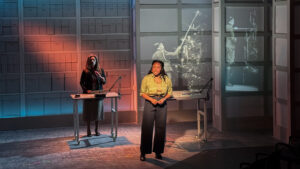
Founded by Kaufman in 1991, Tectonic Theater Project is celebrated for its boundary-pushing documentary theatre, including The Laramie Project and Gross Indecency: The Three Trials of Oscar Wilde. Kaufman, who received the National Medal of Arts from President Barack Obama, is known for blending investigative storytelling with emotional honesty, crafting works that probe the moral complexities of real-world events.
Playwright and co-creator Amanda Gronich, an original Tectonic member and Emmy-nominated television writer, helped shape the company’s signature “moment work” method. This approach turns documentary evidence into theatrical movement and dialogue.
Together, Kaufman and Gronich developed Here There Are Blueberries as a collaboration between Tectonic Theater Project and La Jolla Playhouse, where it premiered to national acclaim.
The Detroit production features a cast of accomplished local and regional performers: Eric Gutman, Diane Hill, Artun Kircali, Kate McClaine, Sam Reeder, Cheryl Turski, Ron Williams, and veteran actress Rebecca Rose Mims, who started with Mosaic Youth Theater of Detroit.
Mims, who plays Charlotte, emphasized that the play’s moral is that anyone can be complicit in genocide. And it’s not only what you do, it’s what you don’t do. Not only what you say, it’s what you don’t say, what you choose to ignore.
“There’s a lot that’s happening in the world that’s happening outside America,” Mims said.

“There are a lot of killings and murders happening inside America, and there are so many ways to support or make other people aware.”
For a play that deals so intimately with visual documentation, Here There Are Blueberries is as much about the ethics of looking as it is about history itself. It challenges audiences to confront how images, especially those of suffering, are used, interpreted, and remembered.
Corporandy believes that question is as urgent now as ever.
Detroit Public Theatre hopes the production will serve as both an artistic and communal experience, a chance for audiences to reflect on the fragility of memory and the endurance of empathy.
Now, Detroit audiences will experience the play through the lens of DPT’s own creative team and ensemble of Michigan-based actors.
“We’re inviting our community to experience Here There Are Blueberries together, to have brave and essential conversations,” Corporandy said.
“Let’s wrestle with history and the present through this story and consider how we will meet this moment.”
Here There Are Blueberries will run through Sunday, November 2, at 2 p.m. For tickets and more information, visit www.detroitpublictheatre.org.