






















Demonstrations have once again taken to the streets against ICE across Michigan’s Lower Peninsula. This time, the main protagonists were university and high school students.
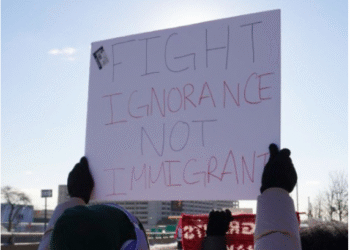
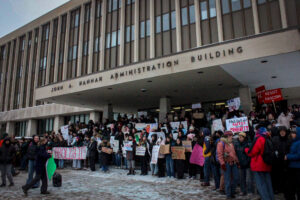
Hundreds of students began marching on Thursday afternoon, January 29, at Michigan State University in East Lansing, protesting immigration policies as they made their way to the statue of Sparty, where the crowd spilled over onto the road. The steam rising from their chants reflected the freezing 13 °F shown on the thermometer, and the signs—shaken by thick gloves warming their hands—once again declared, “No one is illegal in stolen land.”
The demonstration at MSU was followed by a series of national protests and strikes organized on Friday against the Trump administration’s immigration policies and abuses committed by immigration agents across the country. Rallies in Grand Rapids, Ann Arbor, and Detroit drew hundreds one more time despite the frigid temperatures.
The president of Culturas de las Razas Unidas (CRU), a Latino organization at MSU, Rafael Gordillo Serrano, told EL CENTRAL that this mobilization is a way of saying “enough” to the actions of immigration agents and that they had long wanted to raise their voices for the immigrant community from MSU.
At 19 years old—two years as an MSU student and ten living in the U.S.—Gordillo says that fear of ICE “wasn’t something you thought about that much.” He and his parents arrived from Guatemala and are legal permanent residents, but now that fear goes beyond any legal paperwork. “Anyone who looks Latino like us right now is a target. We’re all vulnerable, whether we’re naturalized citizens or residents. Those people (immigration agents) don’t care,” he said.
On the morning of Tuesday, January 27, ICE agents arrested four individuals at a bus stop near several Ypsilanti Community Schools campuses, which, according to MLive, include Ypsilanti Puentes Multilingual School, Washtenaw International High School, and Ypsilanti International Elementary School. And although an ICE spokesperson stated in a release that local schools are not targets, three of those arrested were parents who were detained while waiting to pick up their children at a school bus stop. They are being held at the North Lake Processing Center in Baldwin, Mich., Michigan Advance reported.
Gordillo grew up in Ann Arbor, not far from Ypsilanti. “In school, ICE wasn’t something you thought about that much. And seeing what’s happening in Ypsilanti, right now, so close to my home, it’s crazy to think what I would do if that happened to me. It’s very hard to accept that things have changed and that fear is real now,” Gordillo said.
Led by Michigan State Senator Stephanie Chang and a handful of Democrats, the Michigan Senate held a public hearing—primarily through the Civil Rights, Judiciary, and Public Safety Committee—on a package of three Senate bills (SB 508, SB 509, and SB 510) and Senate Resolution 86 designed to limit the actions of federal immigration agents in the state. The package would prohibit the enforcement of immigration laws in certain locations, restrict collaboration between state personnel and immigration agents, and reduce the use of face coverings by those agents.
Republican Senator Jim Runestad, the sole opposition in the room, expressed support for ICE and engaged in tense exchanges with Chang. He questioned the idea that those detained by immigration agents are necessarily essential workers or innocent courtroom witnesses, calling the argument “ridiculous on its face.” “I don’t think there’s a person in Lansing or in the state of Michigan who has a problem with legal immigration. This is strictly about people who are here illegally,” Runestad said.
During the debate, Runestad grew frustrated at not being able to directly rebut testimony and, at the close of his remarks, called the hearing a “kangaroo court.” The Republican argued that immigration agents should cover their faces due to “atrocious attacks” against them and to protect their families.
Throughout the session, attorneys, community leaders, and immigrant rights advocates delivered emotional and detailed testimony in support of the proposals.
Gabriela Santiago-Romero, a member of the Detroit City Council, backed the bills, arguing that vulnerable community members have abandoned their daily routines out of fear of immigration agents’ presence. “I’m here to emphasize the real fear, the real impacts that are happening in Detroit, across the state, and across the country, and to make it very clear that ICE and federal immigration agents are not making our communities any safer. This is not an undocumented immigrant versus citizens issue.” Santiago-Romero said.
Chang, who sponsors SB 509, hopes the bills will soon be voted on and sent to the full Senate for consideration at a future hearing.
For Ivan Diaz, a candidate for the Michigan Senate, this is something the Senate should have done when it had Democratic control between 2023 and 2024. “I’m pleased to see that they are finally taking action. I would also like to see other changes, such as the eventual passage of the Drive SAFE bill and the abolition and prohibition of 287(g) agreements at the local level,” said the candidate to EL CENTRAL.

On Friday, near the University of Michigan campus, about 200 people marched and chanted against ICE through the streets of Ann Arbor. Among them was Antonella Sara, a U of M student, who told EL CENTRAL about her fears as an immigrant of eight years.
“Migrating is not easy. It disrupted my life a lot, and it definitely took a long time to adapt,” Sara said. “The fear isn’t new and has been around for a long time, and although it’s been stronger lately, it hurts that only when white people are killed by ICE does the majority finally take to the streets with their signs around the block.”
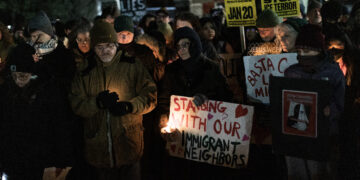
Fear had also reached high school students, where they have family members or friends facing deportation or immigration enforcement that impacts them directly. And although three of the Western International High School students arrested by ICE have already been released, hundreds of Detroit students at Cass Tech High School walked out of their classes on Friday as part of a coordinated protest against federal immigration enforcement actions, chanting slogans like “Immigrants are welcome here” and “No justice, no peace,” defying the freezing temperatures. (See accompanying story on page 7). At these demonstrations, at least 200 persons joined with signs and banners at 7 Mile and Telegraph, protesting on the side of the road.
Community leaders, including Dr. Wendell Anthony, president of the NAACP Detroit Branch, also urged accountability measures such as cutting new funding for ICE, requiring agents to wear body cameras, and ending federal immunity.
“Every person, regardless of race, ethnicity, immigration status, or political belief, deserves to feel safe, protected, and treated with dignity under the law. This is not a partisan issue; it is a human rights issue. Public trust in our institutions depends on fair and humane enforcement of the law, and we must insist on accountability when that trust is broken,” stated Mary Carmen Munoz, executive director for Latin Americans for Social and Economic Development (LASED).
Una vez más, manifestaciones contra ICE han tomado las calles en la Península Inferior de Michigan. En esta ocasión, los principales protagonistas fueron estudiantes universitarios y de secundaria
Cientos de estudiantes habían marchado la tarde del jueves 29 de enero en la Universidad Estatal de Michigan (MSU), en East Lansing, para protestar contra las políticas migratorias. Al llegar a la estatua de Sparty, la multitud era tanta que se desbordaba hacia la pista. El vapor que salía de sus bocas reflejaba los gélidos 13 °F que marcaba el termómetro, y los letreros —sacudidos por manos cubiertas con gruesos guantes para combatir el frío— volvían a consignar: “Nadie es ilegal en tierra robada”.
La manifestación en MSU fue seguida por una serie de protestas y huelgas nacionales organizadas el viernes contra las políticas migratorias de la administración Trump y los abusos cometidos por agentes de inmigración en todo el país. Concentraciones en Grand Rapids, Ann Arbor y Detroit reunieron nuevamente a cientos de personas, a pesar de las temperaturas bajo cero.
El presidente de Culturas de las Razas Unidas (CRU), organización latina en MSU que lideró la marcha del jueves , Rafael Gordillo Serrano, dijo a EL CENTRAL que esta movilización es una forma de decir “basta” a las acciones de los agentes de inmigración y que desde hace tiempo querían alzar la voz por la comunidad inmigrante desde MSU.
Con 19 años de edad —dos como estudiante de MSU y diez viviendo en Estados Unidos— Gordillo afirma que el miedo a ICE “no era algo en lo que se pensara tanto”. Él y sus padres llegaron desde Guatemala y son residentes permanentes, legales, pero ahora ese temor va más allá de cualquier documento legal. “Cualquiera que se vea latino como nosotros en este momento es un objetivo. Todos somos vulnerables, ya seamos ciudadanos naturalizados o residentes. A esa gente (los agentes de inmigración) no les importa”, dijo.
La mañana del martes 27 de enero, agentes de ICE arrestaron a cuatro personas en una parada de autobús cerca de varias escuelas del Distrito Escolar Comunitario de Ypsilanti, que, según MLive, incluyen la escuela multilingüe Ypsilanti Puentes, la Washtenaw International High School y la Ypsilanti International Elementary School. Y aunque un portavoz de ICE declaró a medios de comunicación que las escuelas locales no son objetivos, tres de los detenidos eran padres que esperaban recoger a sus hijos en una parada del autobús escolar. De acuerdo con Michigan Advance, se encuentran detenidos en el Centro de Procesamiento North Lake, en Baldwin, Michigan.
Gordillo creció en Ann Arbor, no muy lejos de Ypsilanti. “En la escuela, ICE no era algo en lo que pensarás mucho. Y ver lo que está pasando en Ypsilanti, ahora mismo, tan cerca de mi casa, es una locura pensar qué haría si me pasara a mí. Es muy difícil aceptar que las cosas han cambiado y que el miedo ahora es real”, expresó.
Encabezado por la senadora de Michigan Stephanie Chang y un puñado de demócratas, el Senado de Michigan organizó una audiencia pública —principalmente a través del Comité de Derechos Civiles, Poder Judicial y Seguridad Pública— sobre un paquete de tres proyectos de ley del Senado (SB 508, SB 509 y SB 510) y la Resolución del Senado 86, diseñados para limitar las acciones de los agentes federales de inmigración en el estado. El paquete prohibiría la aplicación de leyes migratorias en ciertos lugares, restringiría la colaboración entre personal estatal y agentes de inmigración, y reduciría el uso de cubrebocas o coberturas faciales por parte de dichos agentes.
El senador republicano Jim Runestad, la única voz de oposición en la sala, expresó su apoyo a ICE y sostuvo tensos debates con Chang. El republicano cuestionó la idea de que las personas detenidas por agentes de inmigración sean necesariamente trabajadores esenciales o testigos inocentes en tribunales, calificando ese argumento como “ridículo a simple vista”. “No creo que haya una sola persona en Lansing o en el estado de Michigan que tenga un problema con la inmigración legal. Esto se trata estrictamente de personas que están aquí ilegalmente”, afirmó Runestad.
Durante el debate, Runestad se mostró frustrado por no poder refutar directamente los testimonios y, al concluir sus comentarios, calificó la audiencia como un “juicio canguro”. El republicano argumentó que los agentes de inmigración deberían cubrirse el rostro debido a “ataques atroces” en contra de ellos y para proteger a sus familias.
A lo largo de la sesión, abogados, líderes comunitarios y defensores de los derechos de los inmigrantes ofrecieron testimonios emotivos y detallados en apoyo a las propuestas.
Gabriela Santiago-Romero, miembro del Concejo Municipal de Detroit, respaldó los proyectos de ley, argumentando que miembros vulnerables de la comunidad han abandonado sus rutinas diarias por miedo a la presencia de agentes de inmigración. “Estoy aquí para enfatizar el miedo real, los impactos reales que están ocurriendo en Detroit, en todo el estado y en todo el país, y para dejar muy claro que ICE y los agentes federales de inmigración no están haciendo que nuestras comunidades sean más seguras. Este no es un tema de inmigrantes indocumentados contra ciudadanos”, dijo Santiago-Romero.
Chang, quien patrocina el SB 509, espera que los proyectos pronto sean sometidos a votación y enviados al pleno del Senado para su consideración en una futura audiencia.
Para Iván Díaz, candidato al Senado de Michigan, esto es algo que el Senado debió haber hecho cuando tuvo control demócrata entre 2023 y 2024. “Me complace ver que finalmente están tomando acción. También me gustaría ver otros cambios, como la eventual aprobación del proyecto de ley Drive SAFE y la abolición y prohibición de los acuerdos 287(g) a nivel local”, declaró el candidato a EL CENTRAL.
El viernes, cerca del campus de la Universidad de Michigan, unas 200 personas entre estudiantes y residentes marcharon contra ICE por las calles de Ann Arbor. Entre ellas estaba Antonella Sara, estudiante de 20 años de U of M, quien habló con EL CENTRAL sobre sus temores como inmigrante desde hace ocho años.
“Migrar no es fácil. Alteró mucho mi vida y definitivamente me tomó mucho tiempo adaptarme”, dijo Sara. “El miedo no es nuevo y ha existido desde hace mucho tiempo, y aunque últimamente ha sido más fuerte, duele que solo cuando personas blancas son asesinadas por ICE la mayoría finalmente salga a las calles con sus carteles alrededor de la cuadra”.
El miedo no ha sido ajeno a los estudiantes de secundaria, muchos de los cuales tienen familiares o amigos que enfrentan deportación o ellos mismos enfrentan acciones de control migratorio que los afectan directamente. Y aunque tres de los estudiantes de Western International High School arrestados por ICE ya han sido liberados, cientos de estudiantes de Cass Tech High School en Detroit abandonaron sus clases el viernes como parte de una protesta coordinada a favor de los inmigrantes, coreando consignas como “Los inmigrantes son bienvenidos aquí”, desafiando las gélidas temperaturas. Acompañando estas manifestaciones, al menos 200 personas se reunieron con pancartas y banderas en 7 Mile y Telegraph, protestando con las mismas consignas a un costado de la carretera.
Líderes comunitarios, incluido el Dr. Wendell Anthony, presidente de la filial de Detroit de la NAACP, también instaron a medidas de rendición de cuentas, como recortar nuevos fondos para ICE, exigir que los agentes usen cámaras corporales y poner fin a la inmunidad federal.
“Cada persona, independientemente de su raza, etnia, estatus migratorio o creencia política, merece sentirse segura, protegida y tratada con dignidad bajo la ley. Este no es un tema partidista; es un tema de derechos humanos. La confianza pública en nuestras instituciones depende de una aplicación justa y humana de la ley, y debemos exigir rendición de cuentas cuando esa confianza se rompe”, afirmó Mary Carmen Muñoz, directora ejecutiva de Latin Americans for Social and Economic Development (LASED).