










ADVERTISEMENT
63.6571428571 °f
Detroit
EL CENTRAL Hispanic News
  • Home
  • About
    • Resources
  • Community

    Celebrate Together’: DSO and Southwest Detroit Unite for Clark Park Festival

    Southwest Detroit Roots Inspire Public Health Journey

    Yerlys Moreno López fue sometida a una cirugía tras una violenta detención migratoria. Crédito de la foto: Jim West para Outlier Media.

    Detroiter says ICE agents broke her knee, disputing agency’s account

    After Being Released from North Lake, Life Continues for a Venezuelan Immigrant

    Three New Developments to Bring Nearly 200 Units of Deeply Affordable, Mixed-income Housing to Corktown

    Poverty Elimination is a Growth Strategy

    From Metal to Monarchs: Detroit Sculptor Juan Martinez Creates Art Meant to Be Experienced

    2026 Skillman Visionary Awards Celebrate Education Changemakers

    Detroit Public Schools Community District Foundation Announces Reopening of Detroit Children’s Museum

  • Featured

    Mexico, Canada and the USA Welcome Most of the World: Let the Games Begin!

    BofA Kicks Off FIFA World Cup 2026™ With 2 Million Free Fan Bands and Fan Experiences Nationwide

    After Being Released from North Lake, Life Continues for a Venezuelan Immigrant

    L to R: Adam Tonge: ACCU Vice President of Retail Services, Joe Valentic: ACCU Board Chair, Veronica North: ACCU Board of Directors, Gabriela Santiago-Romero: District 6 Councilmember, Sylvia Lozoya: ACCU Vice President of Human Resources and Community Relations, Daniel Davidson: ACCU EVP / Chief Operations Officer, Msgr., Chuck Kosanke: Basilica of Ste. Anne de Detroit and Most Holy Trinity Parish, Fr. John Robinson: SOLT Family of Parishes, Rob Grech: ACCU President CEO, Rodolfo Pantoja: ACCU Branch Manager, Juana Saavedra: ACCU Business Development Manager

    Alliance Catholic CU Breaks Ground on New Southwest Detroit Branch

    From Metal to Monarchs: Detroit Sculptor Juan Martinez Creates Art Meant to Be Experienced

    Alex Palou (Spain, #10) celebrates his first place victory at the 2026 Detroit Grand Prix alongside second place Kyle Kirkwood (USA, #27), and third place Graham Rahal (USA, #15) on top of the winners circl

    Detroit Grand Prix 2026 Highlights

    Mexicana Emprende Program Helps Women Grow Business Acumen

    Grand stand fans watching the Detroit Grand Prix with the Renaissance Center in the background

    Detroit Grand Prix Fast Facts – Friday through Sunday, May 29-31

    Movement 2026: Cultural Fusion Shapes the Sound of Electronic Music

  • Opinion
  • Culture & Arts
    • All
    • World Cultures

    Sacatepéquez, Guatemala

    Julianna Sanromán Wins Second Place in Art Exhibit

    From Metal to Monarchs: Detroit Sculptor Juan Martinez Creates Art Meant to Be Experienced

    España

    default

    El Salvador Consuelo Saint-Exupéry

    Detroit Rep’s Season Finale Offers Satirical Masterpiece ‘Spit in Your Face’

    Granada

    Blessing of the Lowriders 2026: USPS Honors Chicano Culture

    Ecuador

    • World Cultures
  • Latest Issue
  • Past Issues
    • Throwbacks
  • Events
  • Newsletter
  • Contact
    • Advertise
  • en English
    • en English
    • es Spanish
No Result
View All Result
EL CENTRAL Hispanic News
  • Home
  • About
    • Resources
  • Community

    Celebrate Together’: DSO and Southwest Detroit Unite for Clark Park Festival

    Southwest Detroit Roots Inspire Public Health Journey

    Yerlys Moreno López fue sometida a una cirugía tras una violenta detención migratoria. Crédito de la foto: Jim West para Outlier Media.

    Detroiter says ICE agents broke her knee, disputing agency’s account

    After Being Released from North Lake, Life Continues for a Venezuelan Immigrant

    Three New Developments to Bring Nearly 200 Units of Deeply Affordable, Mixed-income Housing to Corktown

    Poverty Elimination is a Growth Strategy

    From Metal to Monarchs: Detroit Sculptor Juan Martinez Creates Art Meant to Be Experienced

    2026 Skillman Visionary Awards Celebrate Education Changemakers

    Detroit Public Schools Community District Foundation Announces Reopening of Detroit Children’s Museum

  • Featured

    Mexico, Canada and the USA Welcome Most of the World: Let the Games Begin!

    BofA Kicks Off FIFA World Cup 2026™ With 2 Million Free Fan Bands and Fan Experiences Nationwide

    After Being Released from North Lake, Life Continues for a Venezuelan Immigrant

    L to R: Adam Tonge: ACCU Vice President of Retail Services, Joe Valentic: ACCU Board Chair, Veronica North: ACCU Board of Directors, Gabriela Santiago-Romero: District 6 Councilmember, Sylvia Lozoya: ACCU Vice President of Human Resources and Community Relations, Daniel Davidson: ACCU EVP / Chief Operations Officer, Msgr., Chuck Kosanke: Basilica of Ste. Anne de Detroit and Most Holy Trinity Parish, Fr. John Robinson: SOLT Family of Parishes, Rob Grech: ACCU President CEO, Rodolfo Pantoja: ACCU Branch Manager, Juana Saavedra: ACCU Business Development Manager

    Alliance Catholic CU Breaks Ground on New Southwest Detroit Branch

    From Metal to Monarchs: Detroit Sculptor Juan Martinez Creates Art Meant to Be Experienced

    Alex Palou (Spain, #10) celebrates his first place victory at the 2026 Detroit Grand Prix alongside second place Kyle Kirkwood (USA, #27), and third place Graham Rahal (USA, #15) on top of the winners circl

    Detroit Grand Prix 2026 Highlights

    Mexicana Emprende Program Helps Women Grow Business Acumen

    Grand stand fans watching the Detroit Grand Prix with the Renaissance Center in the background

    Detroit Grand Prix Fast Facts – Friday through Sunday, May 29-31

    Movement 2026: Cultural Fusion Shapes the Sound of Electronic Music

  • Opinion
  • Culture & Arts
    • All
    • World Cultures

    Sacatepéquez, Guatemala

    Julianna Sanromán Wins Second Place in Art Exhibit

    From Metal to Monarchs: Detroit Sculptor Juan Martinez Creates Art Meant to Be Experienced

    España

    default

    El Salvador Consuelo Saint-Exupéry

    Detroit Rep’s Season Finale Offers Satirical Masterpiece ‘Spit in Your Face’

    Granada

    Blessing of the Lowriders 2026: USPS Honors Chicano Culture

    Ecuador

    • World Cultures
  • Latest Issue
  • Past Issues
    • Throwbacks
  • Events
  • Newsletter
  • Contact
    • Advertise
  • en English
    • en English
    • es Spanish
No Result
View All Result
EL CENTRAL Hispanic News
No Result
View All Result

Explore Michigan connections, Latino history of black velvet paintings at new museum exhibit

Visit Michigan History Museum now through November – with free admission Jan. 17 – to learn about black velvets’ cultural impact

EL CENTRAL by EL CENTRAL
January 15, 2026
in Culture & Arts, Featured
Reading Time: 11 mins read
Home Culture & Arts
ShareShareTweetEmail to a friend
Español Abajo

History and art join in the Michigan History Museum’s latest special exhibit, “Black Velvet: A Rasquache Aesthetic” – open now through late November. The exhibit explores black velvet paintings and their place in Latino history.

“The exhibit showcases more than 100 black velvet paintings on loan from Michigan collectors Diana Rivera, Elena Herrada and Minerva Martinez,” said Jillian Reese, curator of exhibits for the Michigan History Museum. “They not only loaned us paintings from their personal collections but also shared their expansive knowledge and personal experience with us.
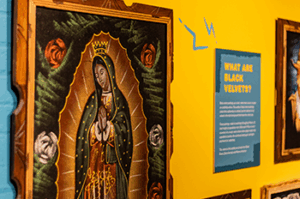
Black velvets are created on rich, textured fabric. The term “rasquache” refers to the creation of art and beauty from everyday materials.

Celebrate the opening of the exhibit with a free day at the museum Saturday, Jan. 17. From 1 to 3 p.m., enjoy hands-on craftmaking inspired by the exhibit’s vivid black velvet paintings.

ADVERTISEMENT

“This exhibit is vital to the Latino community, and its presence at a state institution is significant,” said Minerva Martinez, guest curator.
Inside ‘Black Velvet: A Rasquache Aesthetic’

Instead of canvases or paper, black velvets are painted on rich, textured fabric. While the subject of each painting varies, the deep black background is a staple that helps the colors pop. The term “rasquache” refers to the creation of art and beauty from everyday materials.

“The importance of black velvet must be understood as an instinct: the right to appreciate beauty in all its forms,” said Elena Herrada, guest curator. “Love of velvet is a class statement. We grew up with velvets in our homes.”

The pieces, many made in workshops throughout Mexico and the Southwest U.S., became popular among tourists in the 1960s and ’70s. As a result, many of them reflect subject matter that appealed to tourists, such as bull fights, American celebrities and Southwest landscapes. Other popular subject matter includes animals and religious figures.

While most of the paintings were created in Mexico or the Southwest, a section of the exhibit features Michigan artists who have been inspired by the guest curators’ collections.

On the back wall of the exhibit, a staged black velvet workshop demonstrates the artistic process. To create a black velvet, an artist stretches velvet over a wooden frame, then applies one color at a time.

“We’re very pleased that the Michigan History Museum is exhibiting the black velvet collection,” said Diana Rivera, guest curator. “Despite their profound influence on Michigan’s social, economic and cultural development, Latino communities have been underrepresented in state and national cultural institutions for generations.”

With guidance from the guest curators, the MHC exhibits team designed and fabricated the exhibit. After a brief introduction, including a velvet wall visitors can touch, the exhibit flows through different sections of paintings.

“This exhibit includes a lot of unique design and fabrication,” said Reese. “This is the first time the museum has provided bilingual labels for all content. Each label is written in both English and Spanish. For any unframed velvets, our carpenters crafted frames that match the look of traditional black velvet frames.”

The design team pulled inspiration from Mexican American culture and the paintings themselves for color and font choices.

“The museum’s 2026 yearlong sharing of the velvets addresses the historical gaps in our Chicanx and Latinx representation in a significant State of Michigan institution while demonstrating their commitment to equity, educational inclusion and cultural stewardship,” said Rivera.

Why Black Velvet?

  • Elena Herada
  • January 15, 2026

The importance of Black Velvet must be understood as an instinct. The right to appreciate beauty in all of its forms. Love of velvet is a class statement. We grew up with velvets in our homes; Popo, Elvis, bullfighters dominated the themes, but also animals, Indian chiefs; beautiful naked women, all found their way to this esteemed media. 

To Chicanos, to Mexican Americans, pride is the inverse of shame. To other groups who are raised in their ancestral culture, ethnic or racial pride is a given. To us, not necessarily. I remember one time my father saying to us, “Never be ashamed of what you are.” 

The Michigan History Museum’s new exhibit explores black velvet paintings and their connection to Latino history. The museum’s exhibits team created and designed the exhibit with help from three guest curators, who loaned paintings from their personal collections.

What? Wait? Ashamed? The conversation ended there, but my suspicions  were confirmed. Something about us was different. Less than. I must have been around seven years old when I heard that admonition. 

The art we surround ourselves with reflects our sense of beauty. In my grandparents’ house, there were Popo and Itza images on the walls from years and years of calendars collected from the Mexican grocery stores. There were tapestries of bullfighters and Abraham, Martin and John. This was the aesthetic of pride. This was the beauty I identified with. Razquache. 

Chicano Studies provided a space for us to share these ideas and locate them in our own experiences. 

It’s hard to describe the feeling of being in a room with people who identify with this notion of aesthetic pride. To understand that art can be dismissed and condescended and even shamed. The Chicano Movement turned that on its head and claimed with militance the right to love what we love; to display proudly what our people consider beauty. With our elders, our parents, each other. 

In my own experience, we did not speak Spanish at home, we did not have any connection to Mexican holidays beyond Christmas gatherings with my grandfather’s legendary pinatas, which no human could break without an ouzi. We had tamales, good times, all of which came to an end with their deaths. 

When the moment came that we would exhibit our collection of velvets, we were on a mission.  The first exhibit was in Lansing at the Rosado Gallery. We did not need to explain ourselves to anyone there or anyone who attended. Lansing is full of Chicanos with their own velvets. 

At the  Detroit exhibit at the Latino Cultural Center, patrons of this beloved medium came with their own velvets in hand and added them to our exhibit. Others brought theirs and donated them as they were so happy to see the velvets all together, As if they had been waiting in attics and garages and basements for their beauty to be remembered. 

Explora las conexiones con Michigan, la historia latina de las pinturas en terciopelo negro en una nueva exhibición de museo

La historia y el arte se unen en la más reciente exposición especial del Michigan History Museum, “Black Velvet: A Rasquache Aesthetic”, abierta desde ahora y hasta finales de noviembre. La muestra explora las pinturas en terciopelo negro y su lugar dentro de la historia latina.

“La exposición presenta más de 100 pinturas en terciopelo negro, prestadas por las coleccionistas de Michigan Diana Rivera, Elena Herrada y Minerva Martinez”, dijo Jillian Reese, curadora de exposiciones del Michigan History Museum. “No solo nos prestaron obras de sus colecciones personales, sino que también compartieron con nosotros su amplio conocimiento y experiencia personal”.

Celebra la inauguración de la exposición con un día gratuito en el museo el sábado 17 de enero. De 1 a 3 p.m., el público podrá disfrutar de actividades prácticas de creación artística inspiradas en las vibrantes pinturas en terciopelo negro de la exposición.

“Esta exposición es vital para la comunidad latina, y su presencia en una institución estatal es muy significativa”, dijo Minerva Martinez, curadora invitada.

Dentro de Black Velvet: A Rasquache Aesthetic

En lugar de lienzo o papel, las pinturas en terciopelo negro se realizan sobre una tela rica y texturizada. Aunque los temas varían, el fondo negro profundo es un elemento constante que hace resaltar los colores. El término “rasquache” se refiere a la creación de arte y belleza a partir de materiales cotidianos.

“La importancia del terciopelo negro debe entenderse como un instinto: el derecho a apreciar la belleza en todas sus formas”, dijo Elena Herrada, curadora invitada. “El amor por el terciopelo es una declaración de clase. Crecimos con terciopelos en nuestros hogares”.

Muchas de las piezas, creadas en talleres de México y del suroeste de Estados Unidos, se popularizaron entre turistas en las décadas de 1960 y 1970. Como resultado, muchas reflejan temas que atraían a los visitantes, como corridas de toros, celebridades estadounidenses y paisajes del suroeste. Otros temas comunes incluyen animales y figuras religiosas.

Aunque la mayoría de las pinturas fueron creadas en México o en el suroeste, una sección de la exposición destaca a artistas de Michigan que se han inspirado en las colecciones de las curadoras invitadas.

En la pared del fondo de la exhibición, un taller escenificado de terciopelo negro muestra el proceso artístico. Para crear una obra, el artista estira el terciopelo sobre un marco de madera y luego aplica un color a la vez.

“Estamos muy contentas de que el Michigan History Museum esté exhibiendo la colección de terciopelo negro”, dijo Diana Rivera, curadora invitada. “A pesar de su profunda influencia en el desarrollo social, económico y cultural de Michigan, las comunidades latinas han estado subrepresentadas durante generaciones en las instituciones culturales estatales y nacionales”.

Con la guía de las curadoras invitadas, el equipo de exposiciones del MHC diseñó y fabricó la muestra. Después de una breve introducción, que incluye una pared de terciopelo que los visitantes pueden tocar, la exposición fluye a través de distintas secciones de pinturas.

“Esta exposición incluye mucho diseño y fabricación únicos”, dijo Reese. “Es la primera vez que el museo ofrece etiquetas bilingües para todo el contenido. Cada texto está escrito tanto en inglés como en español. Para los terciopelos sin marco, nuestros carpinteros crearon marcos que replican el estilo tradicional de los marcos de terciopelo negro”.

El equipo de diseño se inspiró en la cultura mexicoamericana y en las propias pinturas para elegir los colores y las tipografías.

“El compartir los terciopelos durante todo el año 2026 por parte del museo aborda vacíos históricos en la representación chicanx y latinx dentro de una institución tan importante del Estado de Michigan, y al mismo tiempo demuestra su compromiso con la equidad, la inclusión educativa y la preservación cultural”, dijo Rivera.


¿Por que el Terciopelo Negro?

  • Elena Herada
  • January 15, 2026

La importancia del Black Velvet debe entenderse como un instinto. El derecho a apreciar la belleza en todas sus formas. El amor por el terciopelo es una declaración de clase. Crecimos con terciopelos en nuestras casas; Popo, Elvis y los toreros dominaban los temas, pero también animales, jefes indígenas y mujeres desnudas hermosas encontraron su lugar en este medio tan apreciado.

Para los chicanos, para los mexicoamericanos, el orgullo es el reverso de la vergüenza. Para otros grupos criados dentro de su cultura ancestral, el orgullo étnico o racial es algo dado. Para nosotros, no necesariamente. Recuerdo una vez que mi padre nos dijo: “Nunca te avergüences de lo que eres”.

¿Qué? ¿Cómo? ¿Avergonzarse? La conversación terminó ahí, pero mis sospechas se confirmaron. Algo en nosotros era diferente. Menor. Debía tener unos siete años cuando escuché esa advertencia.

El arte del que nos rodeamos refleja nuestro sentido de la belleza. En la casa de mis abuelos había imágenes de Popo e Itza en las paredes, tomadas de calendarios recolectados durante años en las tiendas mexicanas. Había tapices de toreros y de Abraham, Martin y John. Esa era la estética del orgullo. Esa era la belleza con la que yo me identificaba. Rasquache.

Los estudios chicanos nos dieron un espacio para compartir estas ideas y ubicarlas dentro de nuestras propias experiencias.

Es difícil describir lo que se siente estar en un cuarto con personas que se identifican con esta idea del orgullo estético. Entender que el arte puede ser descartado, tratado con condescendencia e incluso motivo de vergüenza. El Movimiento Chicano le dio la vuelta a eso y reclamó con firmeza el derecho a amar lo que amamos, a mostrar con orgullo lo que nuestro pueblo considera bello. Junto a nuestros mayores, nuestros padres, entre nosotros mismos.

En mi experiencia personal, no hablábamos español en casa. No teníamos conexión con las celebraciones mexicanas más allá de las reuniones navideñas con las legendarias piñatas de mi abuelo, que ningún ser humano podía romper sin una uzi. Había tamales, buenos momentos, y todo eso terminó con sus muertes.

Cuando llegó el momento de exhibir nuestra colección de terciopelos, estábamos en una misión. La primera exposición fue en Lansing, en la Rosado Gallery. No tuvimos que explicarnos ante nadie ahí ni ante quienes asistieron. Lansing está llena de chicanos con sus propios terciopelos.

En la exposición de Detroit, en el Latino Cultural Center, quienes aman este medio tan querido llegaron con sus propios terciopelos en mano y los sumaron a la muestra. Otros llevaron los suyos y los donaron, felices de verlos todos juntos, como si hubieran estado esperando en áticos, garajes y sótanos a que su belleza fuera recordada.

Tags: artistslatinosMexico
Previous Post

The 2026 Detroit Auto Show, Opens To The Public, Saturday, January 17th

Next Post

Shouts of “ICE off our streets” Heard Loudly from Coast to Coast across Michigan

EL CENTRAL

EL CENTRAL

Related Posts

Español

Mexico, Canada and the USA Welcome Most of the World: Let the Games Begin!

by David Levine
June 12, 2026
0

2026 World Cup preview explores favorites, dark horses, ticket controversies, and host nation hopes before the biggest tournament ever

Read moreDetails
Events

BofA Kicks Off FIFA World Cup 2026™ With 2 Million Free Fan Bands and Fan Experiences Nationwide

by EL CENTRAL
June 12, 2026
0

BofA Fan Bands debut across FIFA World Cup 2026 host cities with collectible bracelets, fan experiences, and free giveaways

Read moreDetails
Community

After Being Released from North Lake, Life Continues for a Venezuelan Immigrant

by Erick Díaz Veliz
June 12, 2026
0

ICE detention survivor Willians Molina shares life after release, family reunification, and the challenges immigrants face

Read moreDetails
Español

Sacatepéquez, Guatemala

by Mariana Ayón RV
June 9, 2026
0

San Antonio de Aguas Calientes offers colorful festivals, artisan textiles, volcano views, and hidden natural wonders

Read moreDetails
Culture & Arts

Julianna Sanromán Wins Second Place in Art Exhibit

by EL CENTRAL
June 7, 2026
0

Julianna Sanromán Rojas earns new recognition in Detroit's art scene after multiple exhibitions and awards

Read moreDetails
L to R: Adam Tonge: ACCU Vice President of Retail Services, Joe Valentic: ACCU Board Chair, Veronica North: ACCU Board of Directors, Gabriela Santiago-Romero: District 6 Councilmember, Sylvia Lozoya: ACCU Vice President of Human Resources and Community Relations, Daniel Davidson: ACCU EVP / Chief Operations Officer, Msgr., Chuck Kosanke: Basilica of Ste. Anne de Detroit and Most Holy Trinity Parish, Fr. John Robinson: SOLT Family of Parishes, Rob Grech: ACCU President CEO, Rodolfo Pantoja: ACCU Branch Manager, Juana Saavedra: ACCU Business Development Manager
Español

Alliance Catholic CU Breaks Ground on New Southwest Detroit Branch

by Michael D. Gutierrez
June 4, 2026
0

Alliance Catholic Credit Union breaks ground on a new branch in Southwest Detroit with bilingual services, community space and local...

Read moreDetails
Next Post

Shouts of “ICE off our streets” Heard Loudly from Coast to Coast across Michigan

  • Trending
  • Comments
  • Latest

Volunteers Needed for Refugee Resettlement in Michigan

February 14, 2024

Why We Celebrate “CINCO DE MAYO, THE 5TH OF MAY”

May 2, 2024
Steve Nagi Vanessa and Joanna Velazquez

Infamous Highwaymen Motorcycle Club Leader Pursues a Second Chance at Life

February 1, 2024

MSHDA Opens $60 Million MI Neighborhood Applications

April 4, 2024

Community and RuboFest 2022 

0

“Vemos a México como un socio igualitario”

0

Ford Hispanic and Latino Network Beautifies Clark Park

0

Editorial Opinion “The Fifth, I take the Fifth”

0

Celebrate Together’: DSO and Southwest Detroit Unite for Clark Park Festival

June 14, 2026

Southwest Detroit Roots Inspire Public Health Journey

June 14, 2026
Yerlys Moreno López fue sometida a una cirugía tras una violenta detención migratoria. Crédito de la foto: Jim West para Outlier Media.

Detroiter says ICE agents broke her knee, disputing agency’s account

June 14, 2026

Mexico, Canada and the USA Welcome Most of the World: Let the Games Begin!

June 12, 2026
ADVERTISEMENT

Celebrate Together’: DSO and Southwest Detroit Unite for Clark Park Festival

June 14, 2026

Southwest Detroit Roots Inspire Public Health Journey

June 14, 2026
Yerlys Moreno López fue sometida a una cirugía tras una violenta detención migratoria. Crédito de la foto: Jim West para Outlier Media.

Detroiter says ICE agents broke her knee, disputing agency’s account

June 14, 2026

Mexico, Canada and the USA Welcome Most of the World: Let the Games Begin!

June 12, 2026

BofA Kicks Off FIFA World Cup 2026™ With 2 Million Free Fan Bands and Fan Experiences Nationwide

June 12, 2026

After Being Released from North Lake, Life Continues for a Venezuelan Immigrant

June 12, 2026
ADVERTISEMENT
ADVERTISEMENT
EL CENTRAL Hispanic News

Michigans #1. Oldest. Largest & Only
Bilingual Hispanic News for 33 Years.

Follow Us

Browse by Category

  • Business
  • Classifieds
  • Community
  • Culture & Arts
  • Education
  • Entrepreneurs
  • Español
  • Events
  • Featured
  • Finance
  • Food
  • Latest News
  • Local News
  • Local Small Business
  • Music
  • National News
  • Opinion
  • Others
  • People
  • Politics
  • Resources
  • Restaurants
  • Sports
  • Throwbacks
  • World
  • World Cultures

Recent News

Celebrate Together’: DSO and Southwest Detroit Unite for Clark Park Festival

June 14, 2026

Southwest Detroit Roots Inspire Public Health Journey

June 14, 2026
  • Latest Issue
  • Newsletter
  • Advertise
  • About
  • Contact
  • Privacy Policy
  • Terms
  • MHCC Member
  • Created with EyeBreatheDesign

© 2026 EL CENTRAL HISPANIC NEWS

No Result
View All Result
  • Home
  • Sections
    • Featured
    • Local News
    • Community
    • Culture & Arts
    • Español
    • Music
    • Sports
  • Events
  • Latest Issue
  • Past Issues
  • Contact
  • Advertise
  • Privacy & Cookie Policy
  • Terms of Service

© 2026 EL CENTRAL HISPANIC NEWS