




















Cristopher Santiago-García had already emptied all his pockets onto the hood of his truck as four immigration agents, three men and one woman, interrogated him; meanwhile, an officer questioned his companion, a U.S. citizen, off to the side.
“Are you a U.S. citizen?” one officer asked.
“I’m a resident of Detroit; I live here,” Santiago-García replied.
“Stop playing games with us and don’t make this any harder. Are you a U.S. citizen, yes or no?” the officer shot back.
“I am not,” Santiago-García stated firmly, and they transferred him to another office, where they told him he was in custody.
A GPS error on his cell phone, as he described it, led him toward Canada instead of Mexicantown while he was driving home that night on the highway. Suddenly, he found his truck surrounded by police; since he had neither an ID nor a driver’s license, they handed him over to immigration officials. Only his companion was able to leave that night, driving his truck to Santiago-Garcia’s parents.
When he was sent to an ICE field and check-in office in Detroit, he was allowed one phone call to his family to let them know that he would not be coming home that night. He was told to speak only English; his parents don’t speak English. He barely managed to tell his mother he wouldn’t be home that night. “Stop joking around,” she replied while nervously laughing. He simply said he loved them and that they would be in touch soon, all in English. The following day, he was finally able to speak to his mother in Spanish, thanks to an officer who let him use his cell phone; by then, he had been moved to the Calhoun County Detention Center in Battle Creek.
Of his 22 years, Santiago-García, born in Matamoros, Mexico, has lived in Detroit for nearly 18; he finished high school and this summer graduated from Wayne State University with a Bachelor of Science in Business Administration with a major in Finance and a minor in Business Law. Following the advice of his grandfather, who had migrated to Michigan in 2007, his parents decided to move here while he and his sister were still young, utilizing the tourist visas the family held, in hopes that the children would receive a better education, his mother explains.
Eventually, the visas expired; the fear of immigration-related arrests remained a concern solely for his parents, until in 2018, when he was 14 years old, Santiago-García witnessed his own father’s arrest by immigration agents outside his house, at which point his mother explained what they were: undocumented.
After his father was released under bond, he had to learn about being what some would call illegal. “I began to open my eyes and realized that I wasn’t the same as the others in the community. But despite that, I never felt rejected here,” Santiago-García says. Applying to university or for scholarships was different for him compared to others. “You had to be careful,” his mother would tell him, careful to avoid accidents, since they had no health insurance and no way to obtain any; careful when driving or going out with friends. “Traveling elsewhere simply wasn’t an option, and one had to be extremely cautious; if I were stopped, the police might call in ICE or CBP agents,” he says
For his mother, after so much advice and so many precautions, the fact that Santiago-García ended up in a jail cell because of one bad turn feels almost ironic. While inside, he sustained himself through his Catholic faith, praying for those who supported him rather than for himself, and by holding onto the belief that “everything happens for a reason.”

Inside, he found friends who, despite coming from different countries, being of different ages, and having different backgrounds, were just like him: undocumented. Any such term would fit. He learned about their lives, their children, and their wives; he learned to shuffle cards in a thousand and one ways, to play dominoes, and to perform a handshake that ended with a fist placed over the heart. During their downtime, they would dissect their food because “it was so unappealing that we didn’t believe it could be real,” recalls Santiago-García.
English helped them stay closer together, and for “el carnalito”, the nickname they gave Santiago-García because of his youth, it provided a sense of purpose. Most of the inmates spoke little or no English, he explains, which meant they couldn’t voice their needs, understand the guards, address instances where they were denied something, or read documents from their lawyers. His friends try to return the favor by sharing sandwiches, coffee, instant noodle cups, or treats from the vending machines, but he would simply say, “That’s what we’re here for, to support one another.”
“But after I got out, that experience I had in there really opened my eyes. It was a huge eye-opener to realize that I had the capacity to help others, something I hadn’t seen while I was still inside,” recalls Santiago-Garcia. “At the time, I just thought, ‘I’ll do it, why not?’ But when I left, everyone thanked me and hugged me. I kept saying, ‘I didn’t really do anything.’ One of them replied to me, ‘You might think you didn’t do anything, but you helped a lot of people in here; that’s why we respect you.'”
Carnalito managed to get out thanks to a lawyer and bond; he received support from the Latino community at WSU, as well as from friends and neighbors. By the time he was released, many of his fellow inmates had already been deported. Noem, from Honduras, his first cellmate, who always kept his spirits up, was deported. Jairo, nicknamed “the hummingbird” after he mistook a peacock for one while everyone else was watching a movie, was transferred to another prison. Don Mario, his final cellmate, from whom he learned a thousand and one ways to shuffle a deck of cards, was deported to Guatemala, leaving behind three children in Ohio. Santiago-Garcia shared his contact information with those he could, in case they ever see each other again.

Now back home, his mother mentions that the family is calmer, though she anticipates that the road ahead will be an “exhausting process, emotionally and financially, since nothing is settled yet.” “He still has a hearing with the judge; they haven’t determined the timeline or what will happen to him,” she adds. “It’s a long, tedious ordeal, and then there’s the uncertainty, the fear that it might happen all over again, that he might get picked up once more, given the current situation, or perhaps they’ll simply say, ‘You’re leaving.'” And for the family, going back to Matamoros is not an option anymore.
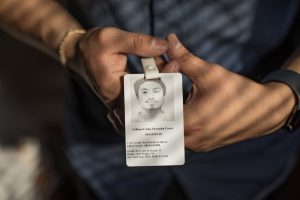
Among his belongings, Santiago-Garcia still keeps his detention ID, because “that is what I am to the United States,” he concludes.
Cristopher Santiago-García ya había vaciado todos sus bolsillos sobre el capó de su camioneta mientras cuatro agentes de inmigración, tres hombres y una mujer, lo interrogaban. A un lado, otro agente cuestionaba a su acompañante, ciudadana estadounidense.
—”¿Eres ciudadano estadounidense?”, preguntó uno de los agentes.
—”Soy residente de Detroit, vivo aquí”, respondió Santiago-García.
— “Deja de jugar con nosotros y no hagas esto más difícil. ¿Eres ciudadano estadounidense, sí o no?”, replicó el agente.
— “No lo soy”, zanjó Santiago-García con firmeza. Entonces lo trasladaron a otra oficina, donde le informaron que estaría bajo custodia.
Según su relato, un error en el GPS de su teléfono celular lo había dirigido hacia Canadá en lugar de Mexicantown, mientras conducía de regreso a casa por la autopista aquella noche. De pronto, se encontró con su camioneta rodeada de policías. Como no tenía identificación ni licencia de conducir, los agentes lo entregaron a las autoridades migratorias. Solo su acompañante pudo marcharse esa noche, conduciendo la camioneta hasta la casa de los padres de Santiago-García.
Cuando fue trasladado a una oficina de campo y registro de ICE en Detroit, le permitieron hacer una llamada a su familia para comunicarles que no regresaría a casa esa noche. Le indicaron que hablara únicamente en inglés, pero sus padres no hablan ese idioma. Apenas logró hacerle entender a su madre.
— “Deja de bromear”, respondió ella, entre risas nerviosas.
Él simplemente le dijo que los quería y que pronto volverían a comunicarse. Todo en inglés. Al día siguiente, finalmente pudo hablar con su madre en español gracias a un agente que le permitió utilizar su teléfono celular. Para entonces, ya había sido trasladado al Centro de Detención del Condado de Calhoun, en Battle Creek.
De sus 22 años de vida, Santiago-García, nacido en Matamoros, México, ha pasado casi 18 en Detroit. Terminó la secundaria y este verano se graduó de la Universidad Estatal Wayne (WSU) con una licenciatura en Administración de Empresas, con especialización en Finanzas y una mención secundaria en Derecho Empresarial. Siguiendo el consejo de su abuelo, quien había migrado a Michigan en 2007, sus padres decidieron mudarse cuando él y su hermana todavía eran pequeños. La familia contaba con visas de turista y esperaba que sus hijos pudieran recibir una mejor educación, explica su madre.
Con el tiempo, las visas vencieron. El temor a ser detenidos por motivos migratorios siguió siendo una preocupación exclusiva de sus padres hasta 2018, cuando Santiago-García tenía 14 años y presenció cómo agentes de inmigración arrestaban a su propio padre frente a su casa. Fue entonces cuando su madre le explicó cuál era su situación: eran indocumentados.
Después de que su padre fuera liberado bajo fianza, tuvo que aprender lo que significaba vivir en una condición que algunos llamarían ilegal. “Empecé a abrir los ojos y me di cuenta de que no era igual que los demás de la comunidad. Pero, a pesar de eso, nunca me sentí rechazado aquí”, cuenta Santiago-García.
Solicitar el ingreso a la universidad o conseguir becas era diferente para él que para otros jóvenes. “Tienes que tener cuidado”,le repetía su madre. Cuidado para evitar accidentes, porque no tenían seguro médico ni forma de conseguirlo; cuidado al conducir o al salir con amigos.
“Viajar a otros lugares simplemente no era una opción y uno tenía que ser extremadamente precavido. Si me detenían, la policía podía llamar a agentes de ICE o de la Oficina de Aduanas y Protección Fronteriza (CBP)”, explica. Para su madre, después de tantos consejos y precauciones, que Santiago-García terminara en una celda por haber tomado una mala curva resulta casi irónico, hasta gracioso.
Durante su detención, encontró consuelo en su fe católica. Rezaba por las personas que lo apoyaban, más que por sí mismo, y se aferraba a la convicción de que “todo pasa por algo”. Allí encontró amigos que, a pesar de venir de distintos países, tener diferentes edades e historias, eran como él: indocumentados. Cualquier término que se utilizara para describirlos podía encajar.
Supo de sus vidas, a sus hijos y a sus esposas. Aprendió mil y una maneras de barajar las cartas, a jugar dominó y a realizar un saludo de manos que terminaba con un puño sobre el corazón. Durante los momentos de descanso, diseccionaban sus alimentos porque “tenía un aspecto tan desagradable que no creíamos que pudiera ser real”, recuerda Santiago-García.
El inglés los ayudaba a mantenerse unidos y, para “el carnalito”, el apodo que le pusieron a Santiago-García por ser el más joven, también se convirtió en una manera de encontrar un propósito.
La mayoría de los detenidos hablaba poco o nada de inglés, explica. Eso les impedía expresar sus necesidades, entender a los guardias, reclamar cuando les negaban algo o leer los documentos de sus abogados.
Sus compañeros intentaban devolverle el favor compartiendo sándwiches, café, vasos de fideos instantáneos o golosinas de las máquinas expendedoras. Pero él simplemente les decía: “Para eso estamos, para apoyarnos”.
”Pero después de salir, esa experiencia que viví allí realmente me abrió los ojos. Fue un despertar enorme darme cuenta de que tenía la capacidad de ayudar a otras personas, algo que no había llegado a ver mientras todavía estaba adentro”, recuerda Santiago-García.
“En ese momento simplemente pensaba: “Lo haré, ¿por qué no?”. Pero cuando salí, todos me dieron las gracias y me abrazaron. Yo seguía diciendo: ‘En realidad no hice nada’. Uno de ellos me respondió: ‘Tal vez pienses que no hiciste nada, pero ayudaste a muchas personas aquí adentro. Por eso te respetamos’”.
El Carnalito logró salir gracias a la intervención de un abogado y al pago de una fianza. También recibió el apoyo de la comunidad latina de WSU, así como de amigos y vecinos. Para cuando fue liberado, muchos de sus compañeros de detención ya habían sido deportados.
Noem, de Honduras, su primer compañero de celda, quien siempre intentaba levantarle el ánimo, fue deportado. Jairo, apodado “el colibrí” después de confundir un pavo real con uno mientras los demás veían una película, fue trasladado a otra prisión. Don Mario, su último compañero de celda, de quien aprendió mil y una maneras de barajar un mazo de cartas, fue deportado a Guatemala y dejó atrás a sus tres hijos en Ohio. Santiago-García compartió sus datos de contacto con aquellos con quienes pudo hacerlo, por si algún día vuelven a encontrarse.
Ahora de regreso en casa, su madre comenta que la familia está más tranquila, aunque anticipa que el camino que tienen por delante será un “proceso agotador, tanto emocional como económicamente, porque todavía no hay nada resuelto”.
“Todavía tiene una audiencia con el juez. No han determinado los plazos ni qué va a pasar con él”, agrega ella. “Es un proceso largo y tedioso, y luego está la incertidumbre, el miedo de que todo vuelva a suceder, de que puedan detenerlo otra vez, dada la situación actual, o que simplemente le digan: “Te tienes que ir”. Y para la familia, regresar a Matamoros ya no es una opción.
Entre sus pertenencias, Santiago-García todavía conserva su identificación de detenido, porque “eso es lo que soy para Estados Unidos”, concluye.