






ADVERTISEMENT
75.1875 °f
Detroit
EL CENTRAL Hispanic News
  • Home
  • About
    • Resources
  • Community
    Motorized tricycle taxis carrying passengers pass each other on a wide Havana street lined with weathered colonial-style buildings.

    Cubans Raise Their Voices Amidst the Darkness of Sanctions

    Frank Venegas and Ideal Steel Employee Francisco Orozco

    For 30 years, Frank Venegas Jr. has demonstrated that business success and community investment can grow together

    Assembly for Hope Ratifies Statewide Policy Platform to Support Immigrants

    Houston Welcomes the World 

    Detroit Health Department Releases Community Health Roadmap Informed by 6,000+ Detroiters 

    “With Heavy Hearts”: Venezuelans Living in Michigan React to the Earthquakes That Devastated Their Homeland

    Detroit Hometown Summit Offers Vision For Affordable Housing

    Mayor Sheffield Releases Rise Higher Community Survey Data and Resident-Driven Framework for Detroit’s Future

    Wayne County Treasurer Urges Homeowners with Delinquent Property Taxes to Enroll in Interest Reduction Payment Agreement Plan by June 30, 2026

  • Featured
    Emergency responder wearing a helmet and backpack walking across a large field of debris and rubble.

    Ann Arbor Asylum-seeker Deported Hours Before Venezuela Earthquakes Dies in Building Collapse

    Two women unveiling a green Michigan Historic Site marker reading "Dra. Lucile Gajec" by pulling away a red, green, and blue striped serape, with a young boy watching beside them.

    A Museum, A Memory, A Marker: Honoring Dr. Gajec’s Lifelong Mission

    Wide view of a crowd watching a band perform on an outdoor stage under a banner reading "We Tell These Truths: All Humans Are Created Equal," trees and buildings in the background.

    The Concert of Colors Neighborhood Series Presents “We Tell These Truths: All Humans Are Created Equal”

    “With Heavy Hearts”: Venezuelans Living in Michigan React to the Earthquakes That Devastated Their Homeland

    Medicina Scarlett Expands Bilingual Healthcare in Southwest Detroit with Help from Motor City Match

    Panelists speak during the State of Construction 2026 forum at The Edit in Detroit on Thursday, June 11, 2026. Co-hosted by READ and DFO313, the discussion provided developers, contractors, and industry professionals with practical insights on navigating today's construction market. (Photo by Brayan Gutierrez)

    Detroit’s Veteran Builders Pass Down Lessons That Cost Them

    USA and Mexico Advance in Thrilling World Cup Play 

    Oficialmente en marcha el proyecto de restauración de la Basílica de Santa Ana tras recibir la bendición

    E&L Supermercado reopening

  • Opinion
  • Culture & Arts
    • All
    • World Cultures

     United States of America

    French Guiana

    Qoyllur Rit’i: The Snow Star pilgrimage in the Peruvian Andes

    Guyana

    Why This Year’s Concert of Colors Is Different, Yet the Same

    Haiti

    Sacatepéquez, Guatemala

    Julianna Sanromán Wins Second Place in Art Exhibit

    From Metal to Monarchs: Detroit Sculptor Juan Martinez Creates Art Meant to Be Experienced

    • World Cultures
  • Latest Issue
  • Past Issues
    • Throwbacks
  • Events
  • Newsletter
  • Contact
    • Advertise
  • en English
    • en English
    • es Spanish
No Result
View All Result
EL CENTRAL Hispanic News
  • Home
  • About
    • Resources
  • Community
    Motorized tricycle taxis carrying passengers pass each other on a wide Havana street lined with weathered colonial-style buildings.

    Cubans Raise Their Voices Amidst the Darkness of Sanctions

    Frank Venegas and Ideal Steel Employee Francisco Orozco

    For 30 years, Frank Venegas Jr. has demonstrated that business success and community investment can grow together

    Assembly for Hope Ratifies Statewide Policy Platform to Support Immigrants

    Houston Welcomes the World 

    Detroit Health Department Releases Community Health Roadmap Informed by 6,000+ Detroiters 

    “With Heavy Hearts”: Venezuelans Living in Michigan React to the Earthquakes That Devastated Their Homeland

    Detroit Hometown Summit Offers Vision For Affordable Housing

    Mayor Sheffield Releases Rise Higher Community Survey Data and Resident-Driven Framework for Detroit’s Future

    Wayne County Treasurer Urges Homeowners with Delinquent Property Taxes to Enroll in Interest Reduction Payment Agreement Plan by June 30, 2026

  • Featured
    Emergency responder wearing a helmet and backpack walking across a large field of debris and rubble.

    Ann Arbor Asylum-seeker Deported Hours Before Venezuela Earthquakes Dies in Building Collapse

    Two women unveiling a green Michigan Historic Site marker reading "Dra. Lucile Gajec" by pulling away a red, green, and blue striped serape, with a young boy watching beside them.

    A Museum, A Memory, A Marker: Honoring Dr. Gajec’s Lifelong Mission

    Wide view of a crowd watching a band perform on an outdoor stage under a banner reading "We Tell These Truths: All Humans Are Created Equal," trees and buildings in the background.

    The Concert of Colors Neighborhood Series Presents “We Tell These Truths: All Humans Are Created Equal”

    “With Heavy Hearts”: Venezuelans Living in Michigan React to the Earthquakes That Devastated Their Homeland

    Medicina Scarlett Expands Bilingual Healthcare in Southwest Detroit with Help from Motor City Match

    Panelists speak during the State of Construction 2026 forum at The Edit in Detroit on Thursday, June 11, 2026. Co-hosted by READ and DFO313, the discussion provided developers, contractors, and industry professionals with practical insights on navigating today's construction market. (Photo by Brayan Gutierrez)

    Detroit’s Veteran Builders Pass Down Lessons That Cost Them

    USA and Mexico Advance in Thrilling World Cup Play 

    Oficialmente en marcha el proyecto de restauración de la Basílica de Santa Ana tras recibir la bendición

    E&L Supermercado reopening

  • Opinion
  • Culture & Arts
    • All
    • World Cultures

     United States of America

    French Guiana

    Qoyllur Rit’i: The Snow Star pilgrimage in the Peruvian Andes

    Guyana

    Why This Year’s Concert of Colors Is Different, Yet the Same

    Haiti

    Sacatepéquez, Guatemala

    Julianna Sanromán Wins Second Place in Art Exhibit

    From Metal to Monarchs: Detroit Sculptor Juan Martinez Creates Art Meant to Be Experienced

    • World Cultures
  • Latest Issue
  • Past Issues
    • Throwbacks
  • Events
  • Newsletter
  • Contact
    • Advertise
  • en English
    • en English
    • es Spanish
No Result
View All Result
EL CENTRAL Hispanic News
No Result
View All Result

U-M Nursing strengthens health education ties with Latin America and the Caribbean 

Juan Ochoa by Juan Ochoa
February 28, 2026
in Community
Home Community
ShareShareTweetEmail to a friend
  • Juan Ochoa
  • September 25, 2025
Español Abajo

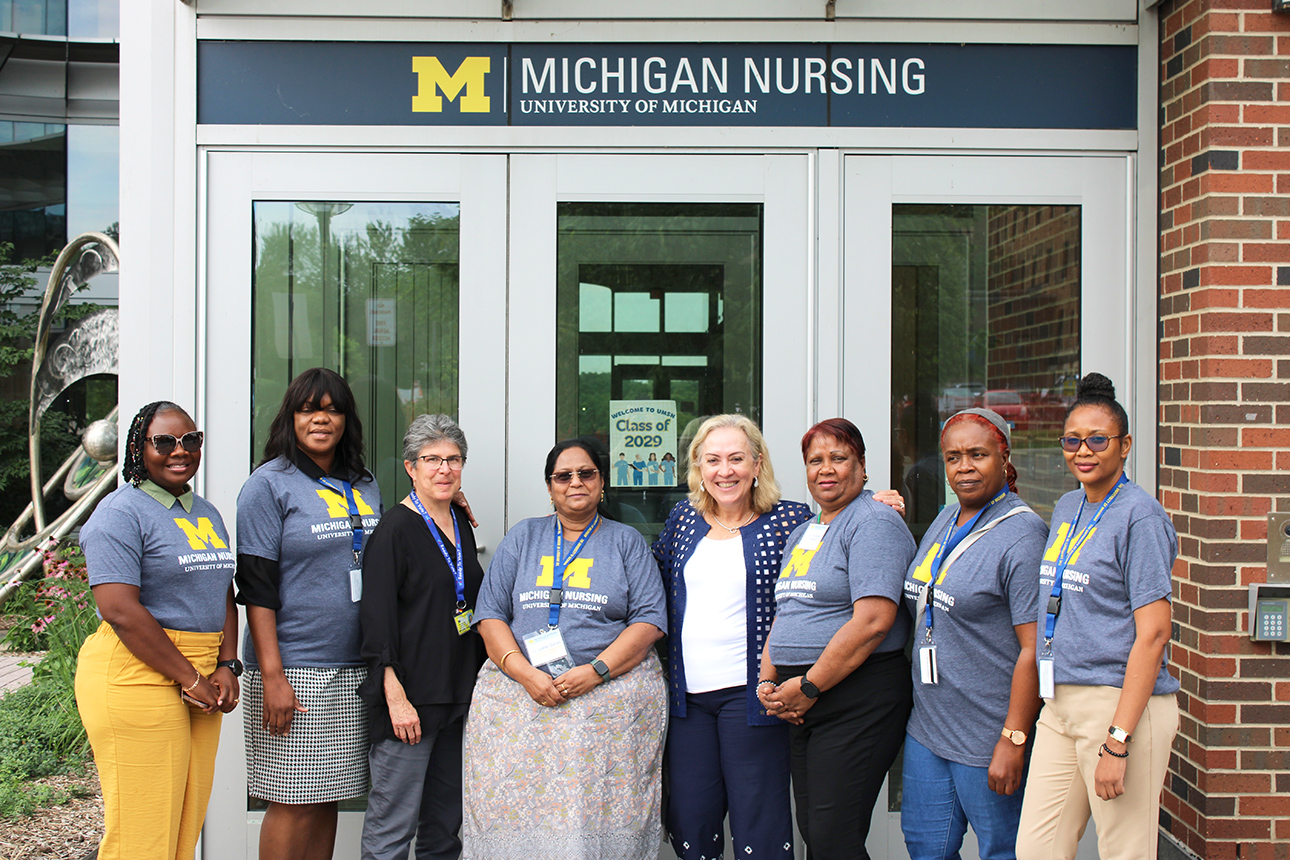
ANN ARBOR—The University of Michigan School of Nursing recently welcomed nursing leaders from across the Caribbean and Latin America for immersive, hands-on training and exchanges focused on improving health care education across the regions.

The School of Nursing’s Office of Global Affairs, in partnership with the Pan American Health Organization/World Health Organization (PAHO/WHO), hosted a cohort of nurse educators from Barbados, Jamaica, and Trinidad and Tobago for the “Train the Trainer” Caribbean simulation initiative—an effort housed within its 27-year designation as a PAHO/WHO Collaborating Center.
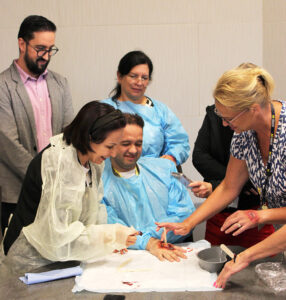
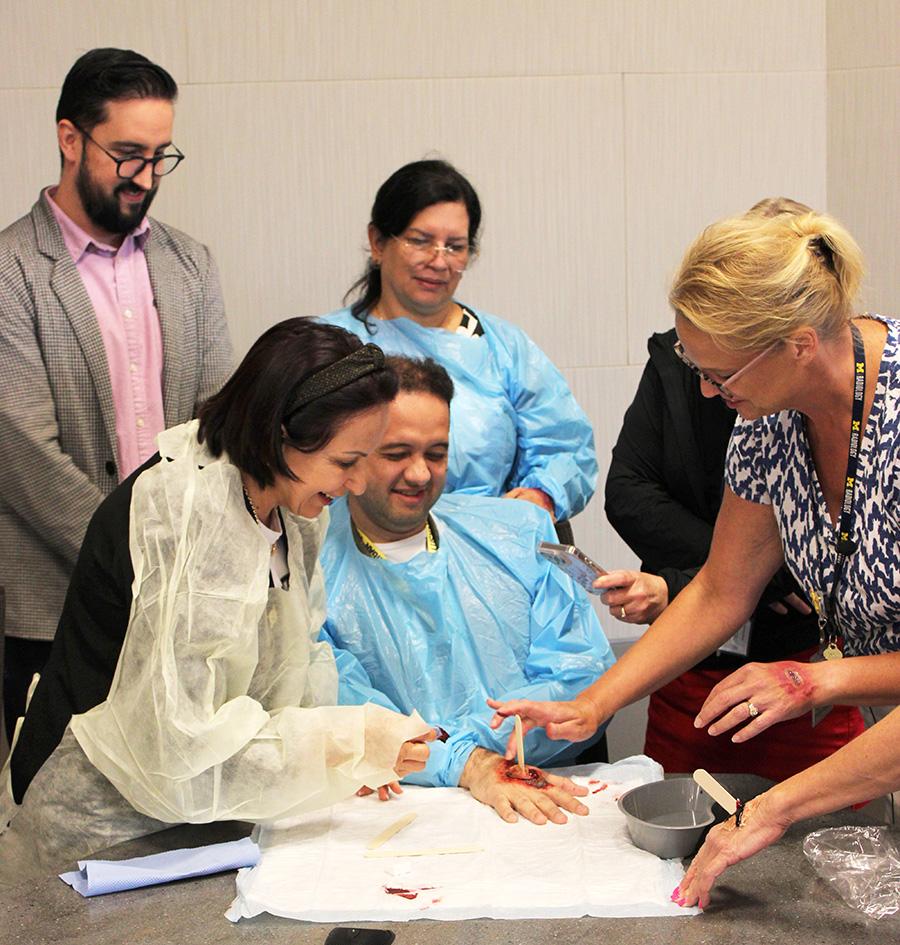
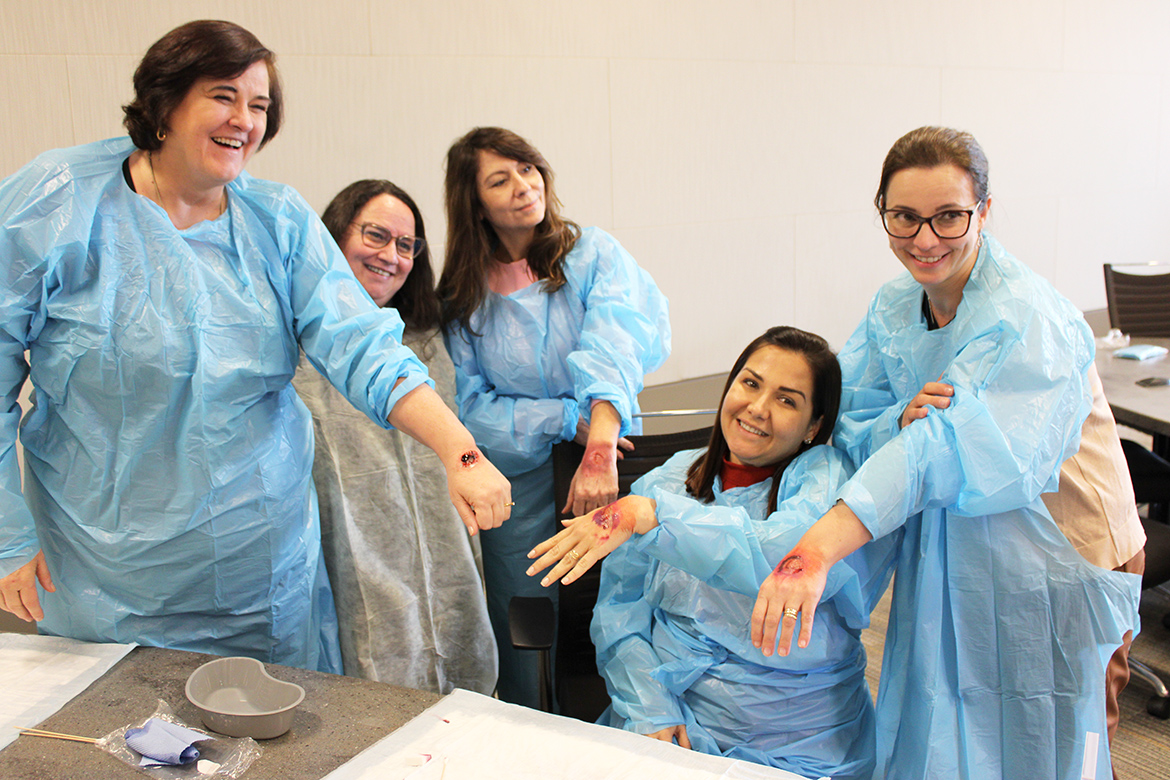
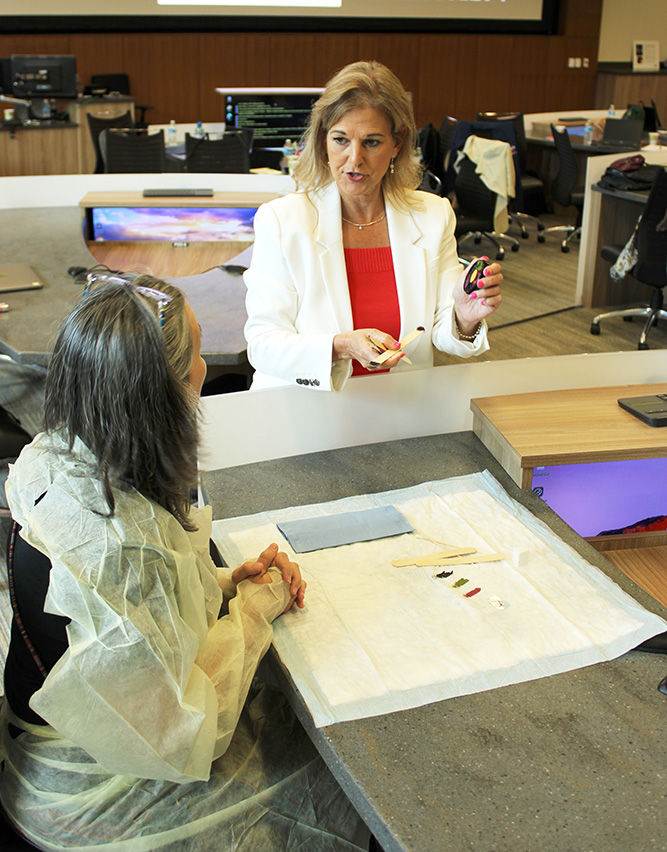
Participants collaborate to create a simulated wound.

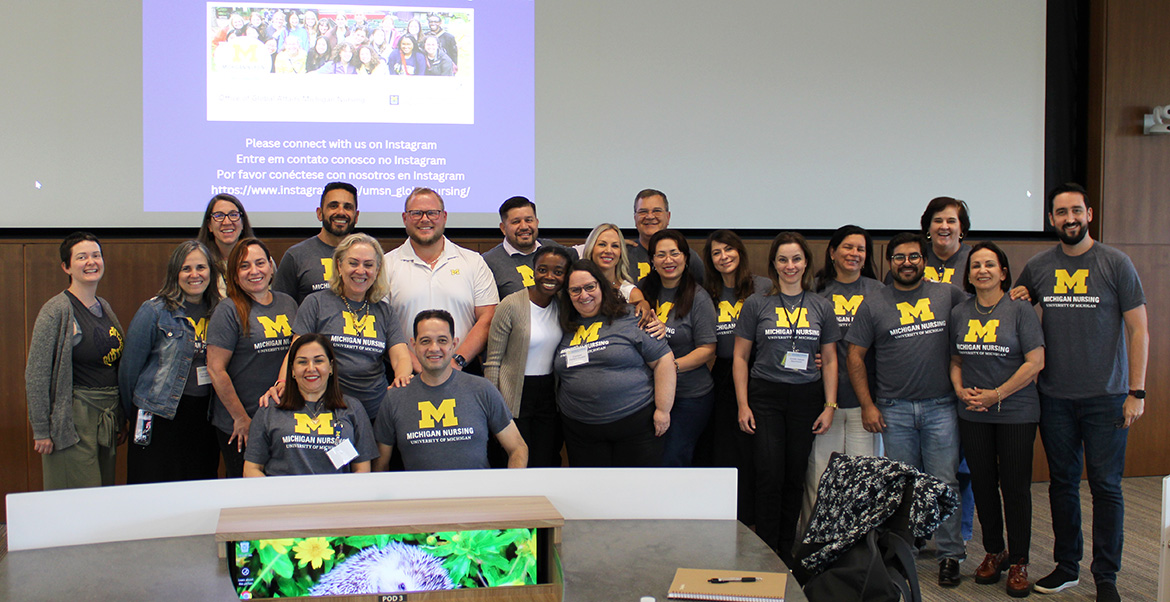
Additionally, the School of Nursing welcomed nursing partners from Argentina, Brazil, Chile, Paraguay, Uruguay, and Mexico to support the development of Nurse Practitioners in Latin America.

ADVERTISEMENT

Both programs reflect the School’s decades-long commitment to advancing nurse and midwifery education, empowering nurses, cultivating leadership, and fostering knowledge exchange. These efforts are driven by a vision to promote global health leadership, support low- and middle-income regions, and build educational capacity to address health disparities, according to Jeanne-Marie Stacciarini, associate dean for global affairs and co-director of the PAHO/WHO Collaborating Center at the University of Michigan School of Nursing.

Bridging knowledge to practice in the Caribbean

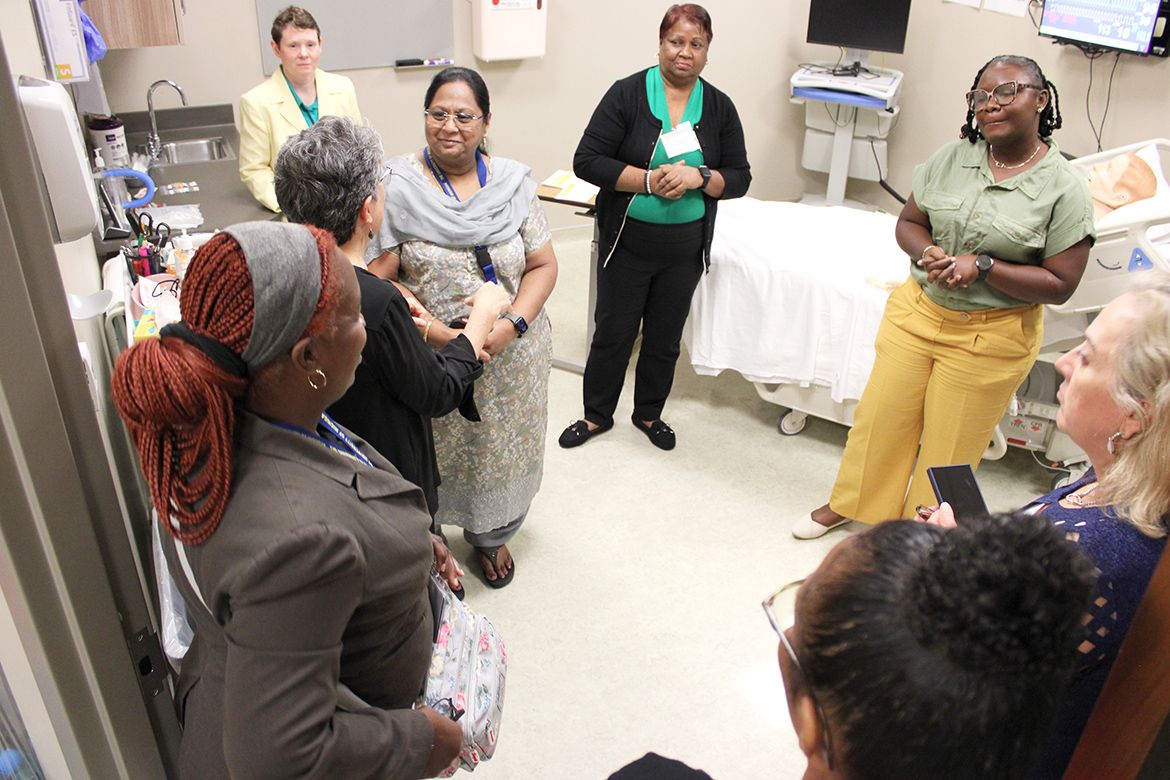
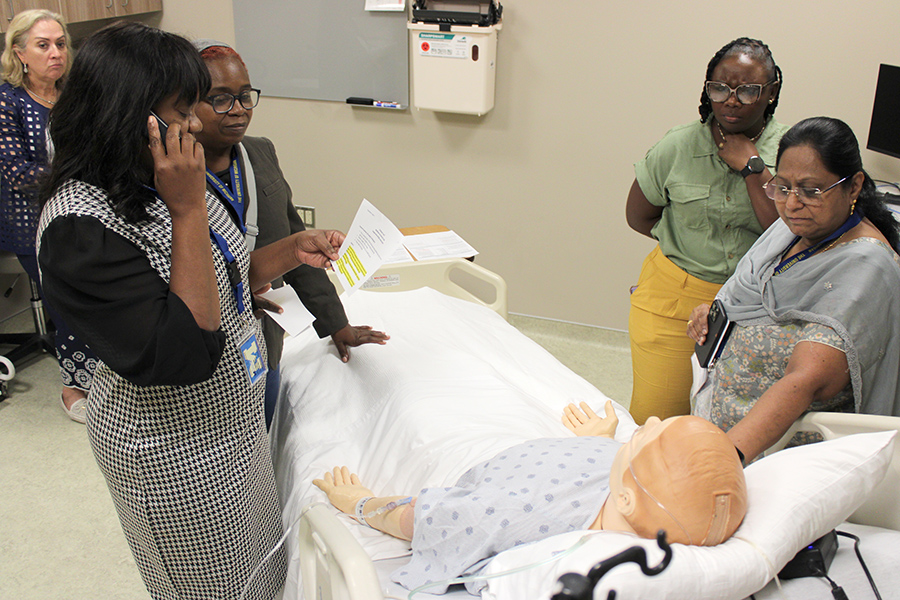
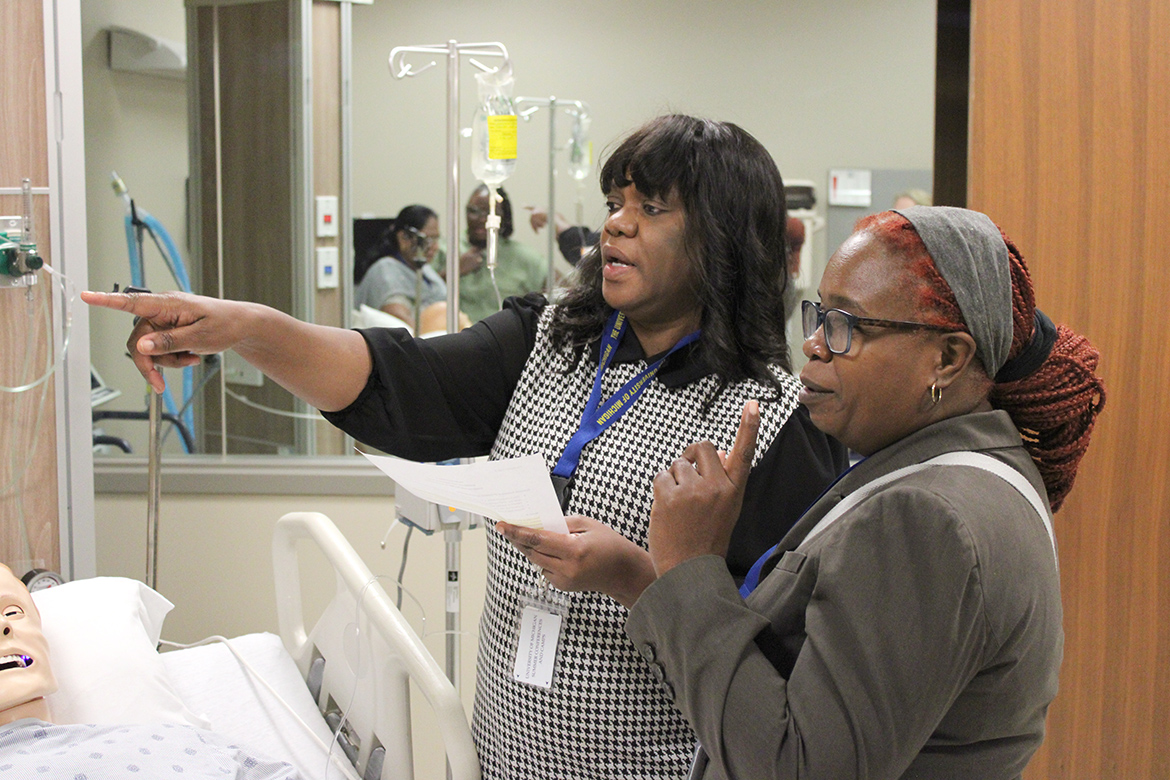
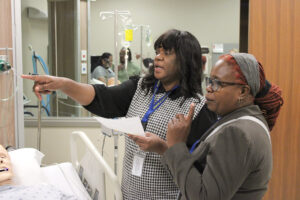
During the first week, participants from across the Caribbean took part in simulation exercises at UMSN’s state-of-the-art center. 

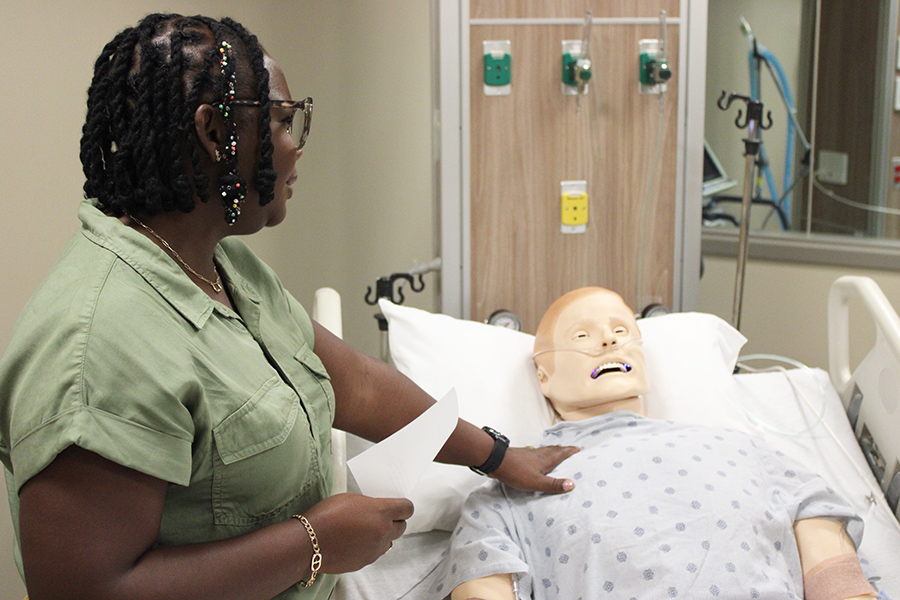
They rotated through roles as clinicians, family members, and control room staff, managing high-fidelity mannequins in lifelike scenarios that simulated hospital challenges such as changes in vital signs, coughing, and shifting patient conditions. These activities reinforced teamwork, crisis management, and clinical autonomy—skills participants can take home to train fellow educators.

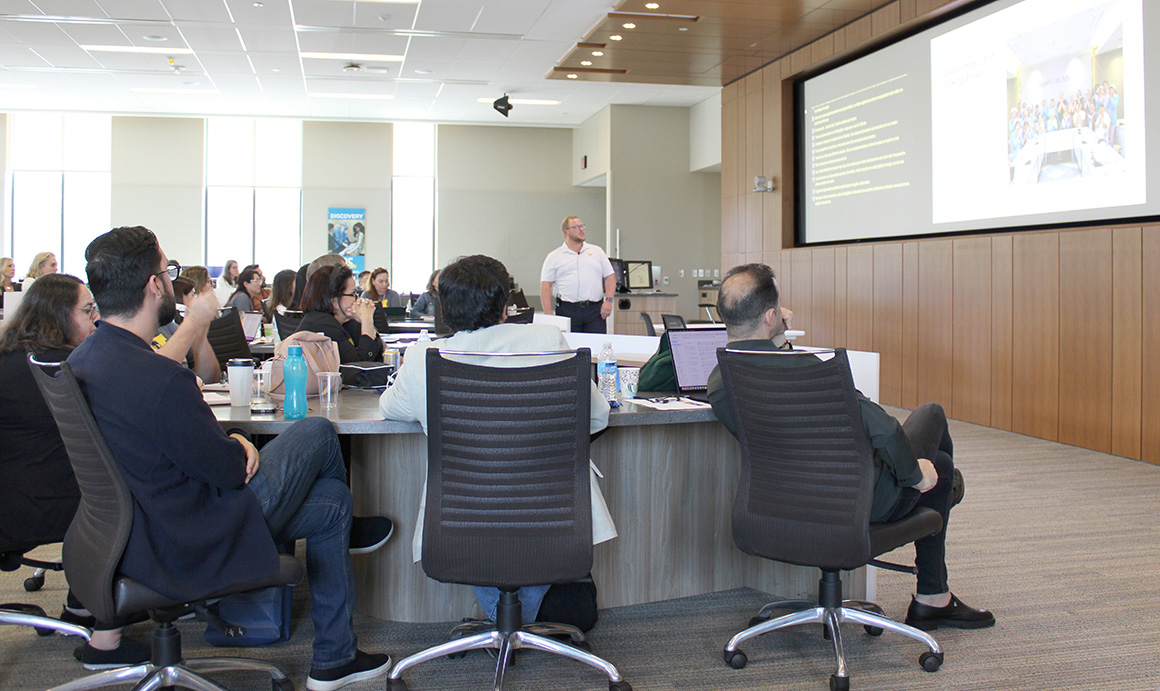
The week also included presentations and discussions about nursing education, giving participants a chance to consider how U.S. approaches might be adapted for their own countries.

“There are plans to enhance simulation in teaching, so I want to be prepared to go back and teach others,” said Cynthia Pitter, senior lecturer and head of the School of Nursing at the University of the West Indies Mona in Jamaica.

Natalie Watson, an instructor at Barbados Community College, said, “Simulation is the way forward. We want to make sure that our students are placed in a secure environment and can practice before they get to the bedside with real patients.”

“One of my hopes is that we all take to heart and take home how—with skillful faculty—it is not the technology that matters quite as much as how we are using the technology. There is a lot we can do with less technology than we think, as long as we use it carefully and skillfully,” said Megan Eagle, U-M clinical assistant professor of nursing. 
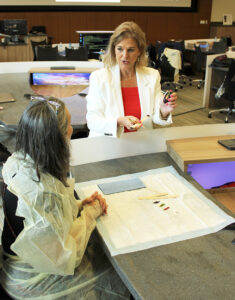
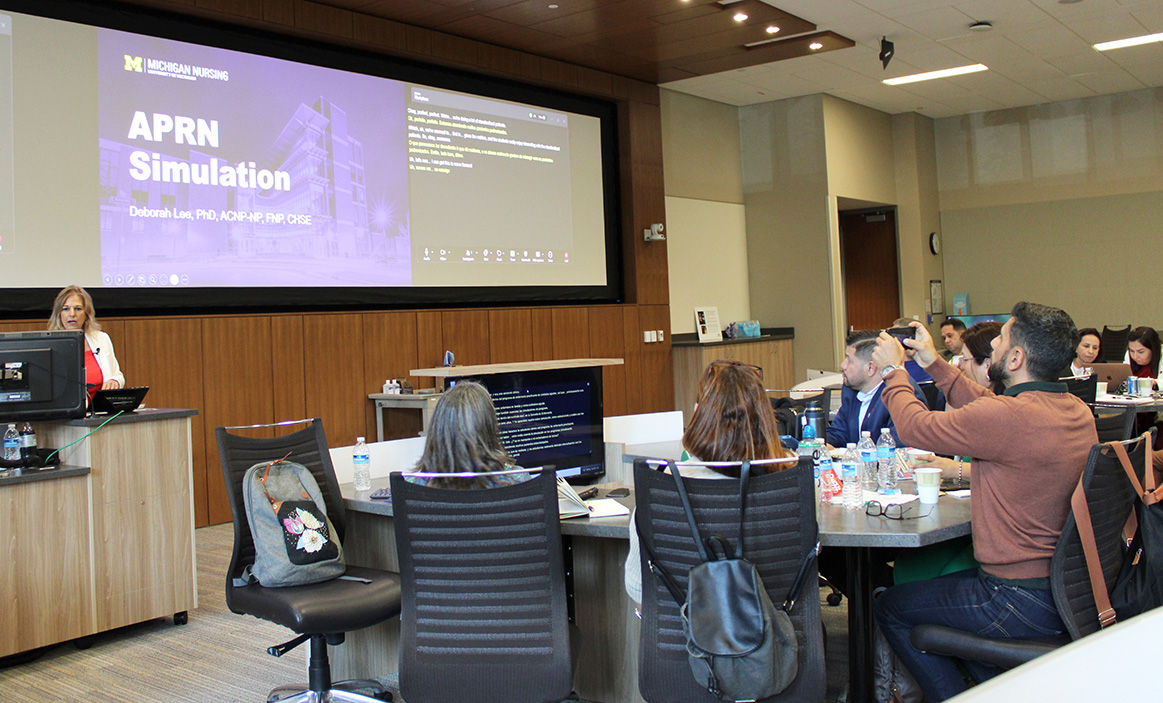
Professor Deborah Lee is preparing materials for the hands-on activity at the participants’ table.

Exploring the advanced practice nurse education and roles

In week two, Latin American nurses, faculty, and administrators explored nurse practitioner education and roles, as well as their impact in U.S. health care settings, through presentations and discussions with U-M faculty, students and members of nursing organizations. They also visited U-M Health and community sites to gain further insights into nurse practitioner roles in the U.S. context, with particular emphasis on how these roles contribute to eliminating health disparities.

For their hands-on activity, participants wore protective hospital garments and used readily available materials to create the different layers of a simulated puncture wound on their own hands—an exercise that highlighted both practical and creative approaches to clinical simulation education.

“This seminar is focused on implementing the nurse practitioner education in Latin America, which allows us to see how the role is implemented and consider strategies we can apply in our own countries, approaches that could improve health care access and coverage,” said Francisca Márquez-Doren, director of graduate studies at the School of Nursing at the Pontifical Catholic University of Chile. 

“It’s interesting to see how this North American model can bring us together. We need to culturally adapt this experience, among others, to make it work in our own countries. In some places, it works exactly as it does here.”

Aurturo Ferreira, professor and director of the Department of Wellbeing and Health at the Catholic University of Uruguay, said he is eager to focus on forming strategic alliances—both with hospitals in other countries and with universities in the region—recognizing that such partnerships are essential to developing the nurse practitioner roles.

For many, the formation of networks and leadership capacity was important. 

“A nurse is a nurse anywhere in the world, but what sets nurse practitioners apart is that they are not generalists—they are experts in a particular area, with extensive knowledge and experience, able to act independently in specific situations,” said Viviana de los Angeles Galarza, professor at the School of Nursing at the National University of Misiones in Argentina.

U-M students and presenters also shared how the experience provided a valuable global perspective.

“It’s important in today’s world to maintain global relationships. For me, learning from other cultures can shape my practice and help me better educate the next generation of midwives,” said Renee Sokolowski, certified nurse-midwife student at U-M.
Nursing leaders from the Caribbean participate in simulation exercises at the University of Michigan School of Nursing, rotating through clinical roles and practicing real-life scenarios.

Jimmy Johnston, a doctor of nursing practice student in Adult-Gerontology Acute Care, agreed. He pointed out that nurses are crucial to the health system and said the program gives them the tools to lead change, advance their expertise, and apply evidence-based solutions wherever they work.

“We might be on different sides of the world, but we experience many of the same health disparities. It’s up to us to find unique ways to address these challenges together,” he said.

Stacciarini said the two global programs offer tremendous value to our international partners while providing enriching learning experiences for U-M faculty, students and community nurse practitioners. 

“Together, we are building a more interconnected, informed and impactful global nursing community,” she said.

Juan Ochoa is the Spanish communication representative for Michigan News at the University of Michigan. This story was provided to El CENTRAL Newspaper by Michigan News.

La escuela de enfermería de la U-M fortalece los lazos de educación en salud con América Latina y el Caribe

ANN ARBOR—La Escuela de Enfermería de la Universidad de Michigan recibió recientemente a líderes de enfermería de todo el Caribe y América Latina para capacitaciones inmersivas, prácticas e intercambios enfocados en mejorar la educación en salud en la región.

La Oficina de Asuntos Globales de la Escuela de Enfermería, en colaboración con la Organización Panamericana de la Salud/Organización Mundial de la Salud (OPS/OMS), recibió a un grupo de formadores en enfermería de Barbados, Jamaica, Trinidad y Tobago como parte de la iniciativa de simulación “Train the Trainer” del Caribe. Este esfuerzo se enmarca dentro de su designación, desde hace 27 años, como Centro Colaborador de la OPS/OMS.
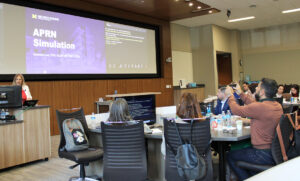
La profesora Deborah Lee presenta a la cohorte latinoamericana.

Además, la Escuela de Enfermería dio la bienvenida a socios de enfermería de Argentina, Brasil, Chile, Paraguay, Uruguay y México para apoyar el desarrollo de Enfermeros Especialistas en América Latina.

Ambos programas reflejan el compromiso de décadas de la escuela para avanzar la educación en enfermería y partería, empoderar a las enfermeras, cultivar liderazgo y fomentar el intercambio de conocimientos. Según Jeanne-Marie Stacciarini, decana asociada de asuntos globales y codirectora del Centro Colaborador OPS/OMS en la Escuela de Enfermería de la Universidad de Michigan, estos esfuerzos están impulsados por una visión orientada a promover el liderazgo global en salud, apoyar a regiones de ingresos bajos y medios, y fortalecer la capacidad educativa para abordar las disparidades en salud.

Cerrando la brecha entre el conocimiento y la práctica en el Caribe

Durante la primera semana, participantes de todo el Caribe participaron en ejercicios de simulación en las modernas instalaciones de la Escuela de Enfermería de la U-M.

Rotaron en roles como personal clínico, familiares y miembros del área de control, manejando maniquíes de alta fidelidad en escenarios realistas que simulaban desafíos hospitalarios, como cambios en signos vitales, tos y variación en las condiciones de los pacientes. Estas actividades reforzaron el trabajo en equipo, la gestión de crisis y la autonomía clínica, habilidades que los participantes podrán aplicar en la formación de otros educadores al regresar a sus países.

La semana también incluyó presentaciones y debates sobre la educación en enfermería, brindando a los participantes la oportunidad de considerar cómo los enfoques utilizados en EE. UU. podrían adaptarse a sus propios contextos.

“Hay planes para fortalecer la simulación en la enseñanza, así que quiero estar preparada para regresar y capacitar a otros”, comentó Cynthia Pitter, profesora principal y directora de la Escuela de Enfermería de la Universidad de las Indias Occidentales Mona en Jamaica.

Natalie Watson, instructora en el Barbados Community College, afirmó que la simulación es el futuro. “Queremos asegurarnos de que nuestros estudiantes estén en un entorno seguro y puedan practicar antes de atender a pacientes reales”.

“Una de mis esperanzas es que todos valoremos y apliquemos lo aprendido. Con docentes capacitados, lo más importante no es la tecnología en sí, sino cómo la utilizamos. Se puede lograr mucho con menos tecnología de lo que pensamos, siempre que la usemos con cuidado y destreza”, dijo Megan Eagle, profesora clínica asistente de enfermería en la U-M.
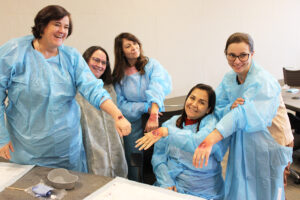
Los participantes muestran sus heridas simuladas.

Explorando la educación y los roles de la enfermería de práctica avanzada

En la segunda semana, enfermeras/os, docentes y administradores de América Latina analizaron la formación y los roles de las enfermeras/os especialistas, así como su impacto en los entornos de atención médica en EE. UU., a través de presentaciones y debates con profesores, estudiantes y miembros de organizaciones de enfermería de la U-M. También visitaron centros de salud de la U-M y sitios comunitarios para conocer más a fondo el papel de las enfermeras especialistas en el contexto estadounidense, con énfasis en cómo estos roles contribuyen a eliminar las desigualdades en salud.

En la actividad práctica, los participantes se pusieron ropa hospitalaria de protección y utilizaron materiales de uso común para crear en sus propias manos las diferentes capas de una herida punzante simulada, un ejercicio que resaltó tanto los enfoques prácticos como los creativos en la educación en simulación clínica.

“Este seminario está enfocado en la implementación de la formación de enfermeros especialistas en América Latina, lo que nos permite ver cómo se desarrolla el rol e identificar estrategias que podríamos aplicar en nuestros propios países, enfoques que podrían mejorar el acceso y la cobertura en salud”, expresó Francisca Márquez-Doren, directora de estudios de posgrado en la Escuela de Enfermería de la Pontificia Universidad Católica de Chile.

“Es interesante ver cómo este modelo norteamericano puede unirnos. Necesitamos adaptar culturalmente esta experiencia, entre otras, para que funcione en nuestros países. En algunos lugares, funciona exactamente igual que aquí”.

Arturo Ferreira, profesor y director del Departamento de Bienestar y Salud de la Universidad Católica del Uruguay, señaló que está entusiasmado por enfocarse en formar alianzas estratégicas, tanto con hospitales en otros países como con universidades de la región, reconociendo que estas asociaciones son esenciales para el desarrollo de los roles de enfermeros especialistas.

Para muchos, la formación de redes y la capacidad de liderazgo fueron fundamentales.

“Un enfermero es un enfermero en cualquier parte del mundo, pero lo que distingue a los enfermeros de práctica avanzada es que no son generalistas, son expertos en una área específica, con amplios conocimientos y experiencia, y pueden actuar de manera autónoma en situaciones determinadas”, dijo Viviana de los Ángeles Galarza, profesora de la Escuela de Enfermería de la Universidad Nacional de Misiones en Argentina.

Los estudiantes y presentadores de la U-M también compartieron cómo esta experiencia les brindó una valiosa perspectiva global.

“Es importante, en el mundo actual, mantener relaciones globales. Para mí, aprender de otras culturas puede moldear mi práctica y ayudarme a educar mejor a la próxima generación de parteras”, dijo Renee Sokolowski, estudiante de enfermería certificada en partería en la U-M.
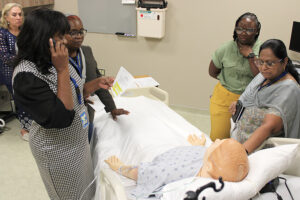
Líderes de enfermería del Caribe participan en ejer- cicios de simulación en la Escuela de Enfermería de la Universidad de Michigan, rotando a través de roles clínicos y practicando escenarios de la vida real.

Jimmy Johnston, estudiante del doctorado en práctica de enfermería en atención aguda para adultos y geriatría, estuvo de acuerdo. Señaló que las enfermeras y los enfermeros son fundamentales para el sistema de salud y dijo que el programa les brinda las herramientas para liderar el cambio, avanzar en su especialización y aplicar soluciones basadas en evidencia en cualquier lugar donde trabajen.

“Puede que estemos en diferentes partes del mundo, pero experimentamos muchas de las mismas desigualdades en salud. Nos corresponde a nosotros encontrar formas únicas de abordar juntos estos desafíos”, dijo.

Stacciarini dijo que los dos programas globales ofrecen un valor tremendo a los socios internacionales, al mismo tiempo que proporcionan experiencias de aprendizaje enriquecedoras para la facultad y los estudiantes de la U-M, así como para los profesionales de enfermería comunitaria.

“Juntos, estamos construyendo una comunidad global de enfermería más interconectada, informada y con mayor impacto”, afirmó.

Juan Ochoa es el representante de comunicación en español de Michigan News en la Universidad de Michigan. Este artículo fue proporcionado a El CENtral Newspaper por Michigan News.
Tags: latin america
Previous Post

Postal Total Expands Shipping and Business Services in Southwest Detroit

Next Post

Introducing Season Fair, Detroit’s First Contemporary Art Fair

Juan Ochoa

Juan Ochoa

Juan Ochoa is a Detroit-based freelance writer and the Spanish Communication Representative for Michigan News at the University of Michigan. With deep roots in communication, his experience spans from the Southwest Detroit Community Justice Center and WXYZ-TV to international organizations like UNESCO and the World Association of Newspapers. Juan holds a master’s degree in Global Communication from The American University of Paris and a bachelor’s in Media Communication from Lawrence Technological University. When he isn't writing, he enjoys traveling and exploring nature with family and friends.

Related Posts

Motorized tricycle taxis carrying passengers pass each other on a wide Havana street lined with weathered colonial-style buildings.
Community

Cubans Raise Their Voices Amidst the Darkness of Sanctions

by EL CENTRAL
July 7, 2026
0

Cuba humanitarian crisis deepens as blackouts, shortages and sanctions reshape daily life. Hear firsthand voices from Cubans living through it

Read moreDetails
Frank Venegas and Ideal Steel Employee Francisco Orozco
Community

For 30 years, Frank Venegas Jr. has demonstrated that business success and community investment can grow together

by EL CENTRAL
July 7, 2026
0

Frank Venegas Jr. transformed Ideal Group into a force for Southwest Detroit through jobs, education and community investment

Read moreDetails
Community

Assembly for Hope Ratifies Statewide Policy Platform to Support Immigrants

by EL CENTRAL
July 5, 2026
0

Welcoming Michigan takes shape as immigrant leaders ratify a statewide policy platform to protect families, expand rights, and inspire action

Read moreDetails
Community

Houston Welcomes the World 

by David Levine
July 5, 2026
0

World Cup Houston comes alive through one fan's unforgettable trip, from Cristiano Ronaldo's goals to the electric host-city atmosphere

Read moreDetails
Community

Detroit Health Department Releases Community Health Roadmap Informed by 6,000+ Detroiters 

by EL CENTRAL
June 30, 2026
0

Detroit community health assessment reveals key health challenges, resident priorities, and plans to improve care, food access, and equity

Read moreDetails
Community

“With Heavy Hearts”: Venezuelans Living in Michigan React to the Earthquakes That Devastated Their Homeland

by Erick Díaz Veliz
July 2, 2026
0

Venezuela earthquake leaves thousands dead, missing and displaced as Michigan families anxiously await news and organize relief efforts

Read moreDetails
Next Post

LFSA Welcome Back Reception Celebrated Latino/a Impact and Growth at Wayne State University

ADVERTISEMENT
  • Trending
  • Comments
  • Latest

Volunteers Needed for Refugee Resettlement in Michigan

February 14, 2024

Why We Celebrate “CINCO DE MAYO, THE 5TH OF MAY”

May 2, 2024
Steve Nagi Vanessa and Joanna Velazquez

Infamous Highwaymen Motorcycle Club Leader Pursues a Second Chance at Life

February 1, 2024

MSHDA Opens $60 Million MI Neighborhood Applications

April 4, 2024

Community and RuboFest 2022 

0

“Vemos a México como un socio igualitario”

0

Ford Hispanic and Latino Network Beautifies Clark Park

0

Editorial Opinion “The Fifth, I take the Fifth”

0
Motorized tricycle taxis carrying passengers pass each other on a wide Havana street lined with weathered colonial-style buildings.

Cubans Raise Their Voices Amidst the Darkness of Sanctions

July 7, 2026

Southwest Detroit Business Association Honors Community Investment Leaders 

July 7, 2026
Frank Venegas and Ideal Steel Employee Francisco Orozco

For 30 years, Frank Venegas Jr. has demonstrated that business success and community investment can grow together

July 7, 2026

Assembly for Hope Ratifies Statewide Policy Platform to Support Immigrants

July 5, 2026
ADVERTISEMENT
Motorized tricycle taxis carrying passengers pass each other on a wide Havana street lined with weathered colonial-style buildings.

Cubans Raise Their Voices Amidst the Darkness of Sanctions

July 7, 2026

Southwest Detroit Business Association Honors Community Investment Leaders 

July 7, 2026
Frank Venegas and Ideal Steel Employee Francisco Orozco

For 30 years, Frank Venegas Jr. has demonstrated that business success and community investment can grow together

July 7, 2026

Assembly for Hope Ratifies Statewide Policy Platform to Support Immigrants

July 5, 2026

The Morning After Graduation: What do 1,000 graduates mean for the future of Southwest Detroit?  

July 5, 2026

Born in the U.S.A. : The Supreme Court did the right thing, but four are dangerously off their rockers

July 5, 2026
ADVERTISEMENT
ADVERTISEMENT
EL CENTRAL Hispanic News

Michigans #1. Oldest. Largest & Only
Bilingual Hispanic News for 33 Years.

Follow Us

Browse by Category

  • Business
  • Classifieds
  • Community
  • Culture & Arts
  • Education
  • Entrepreneurs
  • Español
  • Events
  • Featured
  • Finance
  • Food
  • Latest News
  • Local News
  • Local Small Business
  • Music
  • National News
  • Opinion
  • Others
  • People
  • Politics
  • Resources
  • Restaurants
  • Sports
  • Throwbacks
  • World
  • World Cultures

Recent News

Motorized tricycle taxis carrying passengers pass each other on a wide Havana street lined with weathered colonial-style buildings.

Cubans Raise Their Voices Amidst the Darkness of Sanctions

July 7, 2026

Southwest Detroit Business Association Honors Community Investment Leaders 

July 7, 2026
  • Latest Issue
  • Newsletter
  • Advertise
  • About
  • Contact
  • Privacy Policy
  • Terms
  • MHCC Member
  • Created with EyeBreatheDesign

© 2026 EL CENTRAL HISPANIC NEWS

No Result
View All Result
  • Home
  • Sections
    • Featured
    • Local News
    • Community
    • Culture & Arts
    • Español
    • Music
    • Sports
  • Events
  • Latest Issue
  • Past Issues
  • Contact
  • Advertise
  • Privacy & Cookie Policy
  • Terms of Service

© 2026 EL CENTRAL HISPANIC NEWS