
















Growing up in the Springwells neighborhood of Southwest Detroit, Esther Guerrero can see the freeway from her backyard. She hears train whistles from nearby railroads mixed with boat horns from the shipping docks. Factory smoke from the Marathon plant and Zug Island hang in the air she breathes every day.
“We’re neighbored by factories,” Guerrero said of her childhood home, where she still lives. “I didn’t really understand the impact of that environment until I started studying public health.”
Now, as she prepares to graduate with her Master of Public Health degree in Health Behavior & Health Equity from the University of Michigan School of Public Health, Guerrero has transformed her lived experience into fuel for change. She’s also earning a certificate in Maternal and Child Nutrition with a focus on health communications—skills she’s already putting to work in Detroit.
Guerrero’s path to public health began long before she knew what the field was called. As a high school student, she joined the Latinx Youth Council at Congress of Communities, helping create a program called Nuestro Futuro (Our Future), with a special focus on self-care.
“Health was always at the root of the work I did,” she said. “I just didn’t know I was doing public health work.”
She started college at Wayne State University as a Biology major, wanting to understand health from the ground up. A friend heard her talking about her interests and suggested she look into public health.
“I fell in love with it,” said Guerrero, who earned a bachelor’s degree from Wayne State. “It was just perfect for me.”
She kept her Biology minor to understand the body’s physical mechanisms while adding a minor in Latin American Studies. After graduation, she joined Michigan’s Future Public Health Leaders Program (FPHLP), which changed everything.
Guerrero, who said she wasn’t quite ready yet for graduate school, spent two and a half years leading youth programming at Congress of Communities in Detroit, the same organization where she had once been a youth council member. Working with young people showed her where she could make the biggest impact.
“I became really passionate about nutrition because when you work with young folks, you see where the needs are,” she said. “But I knew I needed more education to assess what I wanted to assess.”
I think we all know the hype of the University of Michigan, and the hype really is true. But now, I get to be part of that community of people doing life-changing work and bring it back to Detroit.” — Esther Guerrero
The daily commute as practice
Every school day, Guerrero’s parents drop her at the bus station in Detroit. She takes the D2A2 bus to Blake Transit Center in Ann Arbor, then either catches another bus or walks about a mile to the School of Public Health.
“I usually like to walk to put into practice some of those health behaviors,” she said. “It’s a little funny because it’s what I study, but I try to really live what I practice.”
As a first-generation college student and child of immigrants, Guerrero has faced financial challenges throughout her education. She works two part-time jobs—one at the School of Public Health’s Careers Office and another at Ford Field.
“Commuting is definitely a challenge,” she said. “Waking up earlier than everyone else to get to my 9 a.m. class, doing late nights at the library and then coming home via the bus. But at the end of the day, I’m grateful for the opportunity.”
That gratitude extends to the scholarships that have supported Guerrero’s journey, including the Michigan Public Health Internship Transition Fund, the Reproductive and Women’s Health Summer Internship, and the Zavela Family Scholarship Fund.
“The support has been life-changing,” she said.
The challenges have shaped her character.
“I’m proud of myself for being able to overcome things that might have knocked me down early on,” Guerrero said.
Bringing science to the community
During an internship at Henry Ford Health, Guerrero created communication materials for the Triple Crown Program, which focuses on maternal and child health. Her main project involved designing information about syphilis testing for pregnant mothers.
“I had to put it into plain language so the target audience could understand without scientific jargon,” she said. “But also reassuring them that this is completely normal, just part of their prenatal care.”
Guerrero created a card for mothers and a training presentation for community health workers—materials that Henry Ford Health now uses regularly.
This work reflects Guerrero’s broader passion of translating complex science into messages everyone can understand. She’s currently producing a documentary called “Detroit is Genius: A Day in the Life of a Detroit Genius,” featuring two seniors from Cass Technical High School. Screenings are planned for March or April.
“I’m technically a senior too,” she said about being in the final year of grad school. “It’s going to be really great to graduate and close off this journey with a film about two students showing that genius comes from Detroit.”
Building community through La Salud
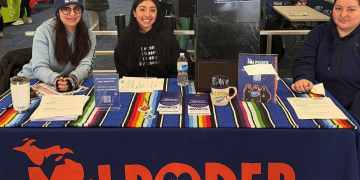
As co-president of La Salud, a student organization focused on Latine health issues, Guerrero has created spaces for cultural celebration and difficult conversations. Last fall, the group held a Día de los Muertos event where students created small magazines called zines honoring loved ones who had died.
“We had really beautiful creations focusing on their grandmother, incorporating flowers, quotes they might have said, signing letters so they can read them on their journey,” Guerrero said.
The group also hosts a Week of Cultural Resistance, bringing in community speakers. With recent Immigration and Customs Enforcement (ICE) activity targeting immigrant communities, these conversations have become even more important.
“We’re creating a safe space where we can speak about these things openly,” she said. “Where we can come and support each other during tough times.”
The power of connection
Her favorite part of the Health Behavior & Health Equity program is the people: “the peace and love folks” who can see humanity in data and numbers. Chair Darrell Hudson, Guerrero said, has opened his home to host dinners with students. Amy Schulz, professor, taught her about community-based participatory research, while Alison Miller, professor, guided her understanding of child development.
“The faculty is so welcoming, so warm,” Guerrero said. “They’re really good examples of where we could be, where we’re headed.”
“Esther’s story is remarkable and underscores the need to support students who have lived experience and bring a unique perspective to the work we do, both in Health Behavior & Health Equity and in the School of Public Health,” Hudson said. “Esther’s voice is critical to making changes necessary to strive toward health equity.
“While I am no genius myself, I am a native Detroiter and Esther truly represents the genius of Detroit. She is a delight in our department and while we will miss her, we are looking forward to her contributions to the field.”
Guerrero also credits staff members like Hallie Williams, program coordinator, who keeps a drawer stocked with snacks and personal care items for anyone who needs them.
“They really embody what public health means,” she said.
After graduation, Guerrero hopes to work in health communications, possibly starting her own business to help people in southwest Detroit and beyond meet their nutritional needs through education.
“I’m good at translating scientific ideas into something you can understand and digest,” she said. “I hope to do that at a bigger scale, through consulting or with a company that aligns with my values.”
For Guerrero, public health is a calling that has brought her back to where she started.
“I think we all know the hype of the University of Michigan, and the hype really is true,” she said. “But now, I get to be part of that community of people doing life-changing work and bring it back to Detroit.”
Esther’s story is remarkable and underscores the need to support students who have lived experience and bring a unique perspective to the work we do, both in Health Behavior & Health Equity and in the School of Public Health. Esther’s voice is critical to making changes necessary to strive toward health equity.”
— Darrell Hudson, chair of the Department of Health Behavior & Health Equity