
















The State of Michigan Historical Marker for Dr. Lucile Gajec has arrived at La Joya Gardens! This marker is among the first in Michigan to highlight LatinX history and to feature a Spanish/English translation.
In Southwest Detroit, near the corner of W. Vernor & Hubbard St, this marker will soon stand as a permanent testament to a woman who dedicated her life to ensuring that the stories of Mexican-Americans in Detroit and Indiohispanic peoples would never be forgotten. The State of Michigan Historical Commission approved the installation of a Michigan Historical Marker honoring the life and legacy of Dr. Lucile Cruz Gajec—educator, historian, founder of Museo Indigenista, and the woman long known as “the community historian of Southwest Detroit.”
A public dedication ceremony is being planned for Sunday June 28, 2026 from 1-3pm at La Joya Gardens, 4000 W Vernor Hwy, Detroit, MI 48209. The event is hosted by Detroit VOCES Collective (DVC) in partnership with Southwest Detroit Business Association’s La Joya Gardens.
The marker placement was chosen because it is the former site of Museo Indigenista. “It is an honor for La Joya Gardens to be the host for the marker that remembers and commemorates Dr. Gajec and her work in this community on this site. We are stewards of this land. We want to make this a space for the community of Southwest to celebrate, and further her legacy”, said Greg Mangan, Real Estate Advocate at SDBA.
Born March 4, 1926, in Harlingen, Texas, Dr. Gajec was a third-generation American of Mexican descent, the daughter of a U.S. citizen father and an Indigenous mother. She grew up in Texas public schools under the harsh English immersion ideology of the era — a system designed to make children forget their native languages. That early experience of cultural erasure would fuel a lifelong mission: To preserve, teach, and celebrate the Indo-Hispanic roots of Mexican people.
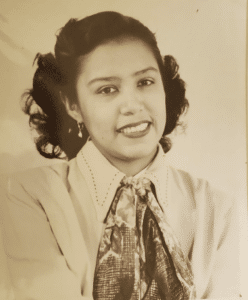
Dr. Gajec arrived in Detroit in 1959 and quickly became a force across multiple sectors. For thirty years, she worked at the Michigan Employment Security Commission as the Latin American Community liaison, but her evenings and weekends belonged to the community of southwest.
Dr. Gajec’s service on boards and committees spanned from 1968 to 2002, including roles with the LA SED (Latin Americans for Social & Economic Development), Circulo Mutualista Mexicano, National Association of Folklore Groups, Mexican Patriotic Committee, Detroit Ethnic Festivals Committee, Most Holy Trinity, Corktown College Folk Dance Group, and LULAC (League of United Latin American Citizens) among many more. She received recognitions from organizations in the City of Detroit, across Michigan, and internationally—honored as a guardian of Mexican culture and a preserver of a people’s history.
“I cried,” said Elena Herrada. “Not because I was sad. Because finally, the state is recognizing what we always knew. Luci was our walking archive. She was the abuela who never forgot to tell us where we came from.”
Dr. Gajec’s academic achievements were equally remarkable. She earned an Associate of Arts from Wayne County Community College (1970), a Bachelor of Social Sciences from Shaw College at Detroit (1974), a Master of Public Administration from the University of Michigan-Flint (1987), and a Doctor of Education in Curriculum and Instruction from Wayne State University (1993).
However, it was her work outside formal institutions that may have left the deepest imprint. In 1991, Dr. Gajec founded and directed Museo Indigenista—a museum dedicated to preserving Indo-Hispanic cultures. What began as an informal personal collection of Mexican cultural artifacts grew, through her curation and passion, into a community treasure. She never sought external funding, relying instead on her own resources and donations from community members who believed in her mission. Through the museum, she educated Detroit Public School students and visitors on the Indigenous roots of Mexican people — reaffirming cultural practices that run deep in the history of Mexico and North America.
“She made sure the children knew where they came from,” said Rachel Harness. “Now Michigan will make sure nobody forgets her.”
What made Dr. Gajec unique was her insistence on the Indigenous part of the story. She didn’t just teach Mexican pride. She taught that Mexican identity is Indigenous identity. That was radical. And it was true.
“Dr. Gajec was unequivocally the community historian of Southwest Detroit and Detroit Latinos broadly,” says Elena Herrada.
From 1996 to 2002, she served as a feature writer for EL CENTRAL Hispanic News. Her articles explored the historical origins of Mexican cultural practices, customs, current events, and Indo-Hispanic history. Dolores Sanchez, founder of EL CENTRAL, recalled that Dr. Gajec’s articles were “an extension of her museum and research,” making the knowledge of El Museo Indigenista publicly accessible to all.
Dr. Lucile “Luci” Cruz Gajec passed away on April 29, 2008, in Detroit, but her work has never left the neighborhoods she served. The new Michigan Historical Marker will ensure that future generations walking the streets of Southwest Detroit will see her name and know that one woman, born to migrant workers in Texas, can build a museum, shape a community’s memory, and change history.
The Michigan Historical Marker Program typically honors sites, structures, and individuals of statewide significance. Irma Maribel Andrade Guzman served as the lead researcher for the marker process. Dr. Gajec’s application was supported by documents from the Walter P. Reuther Library, Archives of Labor and Urban Affairs, University of Michigan Bentley Historical Library, Museo Indigenista archives (housed at Ideal Group), and private photographs and documents shared by Rachel Harness (Dr. Gajec’s daughter). This marker was made possible by the Michigan History Center through the generous support of the William G. Pomeroy Foundation.
El Marcador Histórico del Estado de Michigan en honor a la Dra. Lucile Gajec ya llegó a La Joya Gardens! Este marcador es uno de los primeros en Michigan en destacar la historia LatinX y en incluir texto bilingüe en español e inglés.
Ubicado en Southwest Detroit, cerca de la esquina de W. Vernor y Hubbard St., este marcador pronto se convertirá en un testimonio permanente de una mujer que dedicó su vida a garantizar que las historias de los mexicoamericanos de Detroit y de los pueblos indohispanos nunca fueran olvidadas. La Michigan Historical Commission aprobó la instalación de un Michigan Historical Marker para honrar la vida y el legado de la Dra. Lucile Cruz Gajec: educadora, historiadora, fundadora del Museo Indigenista y la mujer conocida durante muchos años como “la historiadora de la comunidad de Southwest Detroit”.
Se está organizando una ceremonia pública de dedicación para el domingo 28 de junio de 2026, de 1:00 p.m. a 3:00 p.m., en La Joya Gardens, ubicado en 4000 W Vernor Hwy, Detroit, MI 48209. El evento es organizado por Detroit VOCES Collective (DVC) en colaboración con La Joya Gardens de Southwest Detroit Business Association (SDBA).
La ubicación del marcador fue elegida porque allí se encontraba anteriormente el Museo Indigenista. “Es un honor para La Joya Gardens ser el hogar de este marcador que recuerda y conmemora a la Dra. Gajec y su trabajo en esta comunidad, precisamente en este lugar. Somos guardianes de esta tierra. Queremos que este sea un espacio donde la comunidad de Southwest pueda celebrar y continuar su legado”, dijo Greg Mangan, defensor de bienes raíces de SDBA.
Nacida el 4 de marzo de 1926 en Harlingen, Texas, la Dra. Gajec era una estadounidense de tercera generación de ascendencia mexicana, hija de un padre ciudadano estadounidense y una madre indígena. Creció en las escuelas públicas de Texas bajo la estricta ideología de inmersión en inglés de aquella época, un sistema diseñado para que los niños olvidaran sus lenguas maternas. Esa experiencia temprana de borrado cultural alimentó una misión que la acompañó toda la vida: preservar, enseñar y celebrar las raíces indohispanas del pueblo mexicano.
La Dra. Gajec llegó a Detroit en 1959 y rápidamente se convirtió en una figura influyente en distintos sectores. Durante treinta años trabajó en la Michigan Employment Security Commission como enlace con la comunidad latinoamericana, pero sus noches y fines de semana pertenecían a la comunidad de Southwest Detroit.
Su servicio en juntas directivas y comités se extendió de 1968 a 2002, incluyendo funciones en LA SED (Latin Americans for Social & Economic Development), Circulo Mutualista Mexicano, National Association of Folklore Groups, Mexican Patriotic Committee, Detroit Ethnic Festivals Committee, Most Holy Trinity, Corktown College Folk Dance Group y LULAC (League of United Latin American Citizens), entre muchas otras organizaciones. Recibió reconocimientos de instituciones de la Ciudad de Detroit, de todo Michigan y también a nivel internacional, siendo honrada como guardiana de la cultura mexicana y preservadora de la historia de su pueblo.
“Lloré”, dijo Elena Herrada. “No porque estuviera triste. Sino porque, por fin, el estado está reconociendo lo que siempre supimos. Luci era nuestro archivo viviente. Era la abuela que nunca olvidaba contarnos de dónde veníamos”.
Los logros académicos de la Dra. Gajec también fueron extraordinarios. Obtuvo un Associate of Arts de Wayne County Community College (1970), una licenciatura en Ciencias Sociales de Shaw College at Detroit (1974), una maestría en Administración Pública de la University of Michigan-Flint (1987) y un Doctorado en Educación con especialización en Currículo e Instrucción de Wayne State University (1993).
Sin embargo, quizás fue su trabajo fuera de las instituciones formales el que dejó la huella más profunda. En 1991, la Dra. Gajec fundó y dirigió el Museo Indigenista, un museo dedicado a preservar las culturas indohispanas. Lo que comenzó como una colección personal e informal de objetos culturales mexicanos se transformó, gracias a su dedicación y pasión, en un tesoro comunitario. Nunca buscó financiamiento externo; dependió de sus propios recursos y de donaciones de miembros de la comunidad que creían en su misión. A través del museo, educó a estudiantes de Detroit Public Schools y a visitantes sobre las raíces indígenas del pueblo mexicano, reafirmando prácticas culturales profundamente arraigadas en la historia de México y Norteamérica.
“Ella se aseguró de que los niños supieran de dónde venían”, dijo Rachel Harness. “Ahora Michigan se asegurará de que nadie la olvide”.
Lo que hacía única a la Dra. Gajec era su insistencia en destacar la parte indígena de la historia. No solo enseñaba orgullo mexicano. Enseñaba que la identidad mexicana también es una identidad indígena. Eso era algo radical. Y era verdad.
“La Dra. Gajec fue, sin lugar a dudas, la historiadora de la comunidad de Southwest Detroit y de la comunidad latina de Detroit en general”, afirmó Elena Herrada.
De 1996 a 2002, colaboró como escritora de artículos especiales para EL CENTRAL Hispanic News. Sus textos exploraban los orígenes históricos de las prácticas culturales mexicanas, las costumbres, los acontecimientos actuales y la historia indohispana. Dolores Sánchez, fundadora de EL CENTRAL, recordó que los artículos de la Dra. Gajec eran “una extensión de su museo y de su investigación”, haciendo que el conocimiento del Museo Indigenista estuviera disponible para toda la comunidad.
La Dra. Lucile “Luci” Cruz Gajec falleció el 29 de abril de 2008 en Detroit, pero su trabajo nunca abandonó los barrios a los que dedicó su vida. El nuevo Michigan Historical Marker garantizará que las futuras generaciones que caminen por las calles de Southwest Detroit vean su nombre y sepan que una mujer, nacida de trabajadores migrantes en Texas, pudo construir un museo, moldear la memoria de una comunidad y cambiar la historia.
El Programa de Marcadores Históricos de Michigan generalmente reconoce sitios, estructuras y personas de importancia estatal. Irma Maribel Andrade Guzmán fungió como investigadora principal del proceso de solicitud del marcador. La nominación de la Dra. Gajec fue respaldada por documentos del Walter P. Reuther Library, Archives of Labor and Urban Affairs, University of Michigan Bentley Historical Library, los archivos del Museo Indigenista (resguardados en Ideal Group) y fotografías y documentos privados compartidos por Rachel Harness, hija de la Dra. Gajec. Este marcador fue posible gracias al Michigan History Center y al generoso apoyo de la William G. Pomeroy Foundation.