

















The Wixárikas or Wixáricas, known in the rest of Mexico as Huichol, are an ethnic group located in the states of Nayarit, Jalisco, San Luís Potosí, Durango and Zacatecas. They live in the central west of the country, in the Sierra Madre Occidental. They call themselves Wixárika (the people) in their language, which belongs to the Uto-Aztec family of languages and which they call Wixaritari Waniuki.
The ethnonym Wixarika comes from the adaptation to the Nahuatl language of the autonomous Wixarika, due to the fact that in the Wixarika language the a can be heard as or; ryl are allophones, and the pronunciation of x, which was sibilant, was interpreted as affricate, tz, between the seventeenth and eighteenth centuries (when the loan of the word could have occurred), but the loss of the -ka syllable gave as Huitzol result in Nahuatl, and its Castilianization,Wirraricas.
The Wixárikas speak a language of the Wixarika group that is closely related to the language of the Nahua-Aztecoidgroup. In addition, they have received Mesoamerican influences, which is reflected in the fact that Huichol has typical features of the Mesoamerican linguistic area.
His traditional spirituality includes the collection and consumption of peyote (Lophophora williamsii), a cactus that has hallucinogenic effects due to its psychoactive alkaloids, including mescaline. They are internationally recognized for their artistic creations and crafts, for the projection of their mythologies, the search for the grandfather, the white deer, the peyote.
Drink Nawa – Tejuino
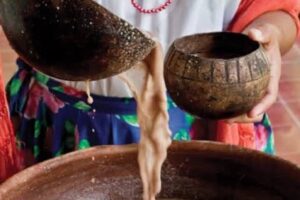
The nawa or tejuino is a drink prepared with corn whose use among the Wixaritari covers a whole world of meanings. In this text its use among the inhabitants of a Wixárikacommunity is exposed, whose actions and knowledge show the different paths that the yeiyari (tradition) takes tocontinue on the path of the ancestors.
The preparation of the tejuino puts the corn to germinate under a layer of sand that is moistened and, once the corn has the first sprouts, it is washed and ground in a metate or mill. Water is boiled and the corn is poured into it; boil for many hours. Once the mixture of water and corn is boiled, it is emptied into containers in which it is left to rest for at least two days to ferment; the more time passes, the greater the fermentation.
Preparing the nawa is a delicate process that falls on women, who must observe several prohibitions: not be menstruating; not having sexual intercourse days before and during theperiod in which the tejuino is made; do not eat sugar or sweet foods, for example, oranges, because all work is spoiled and the drink will turn out to be sweet; very different from the desired flavor. To this we must add the sleeplessness of the women, who must be supervising during the hours of the day and night that the intensity of the fire is correct so that the drink is good as it should. Men, for their part, must stay away from the place where the tejuino is made so as not to spoil it with their presence.
The tejuino, due to the material it is made of, represents to a certain extent the Wixárika family and the cooperation that exists in different areas among all its members: the man, the women, girls and boys who sow, take care of the sacred plant of corn and harvest it. Likewise, in preparation, the opposite or rather complementary poles, masculine-feminine, are always present and in constant relationship; the man who carries firewood and the woman who prepares the drink; Tejuino comes from dry corn (male), but which has germinated (female) and has been ground to be cooked in pots with water (female) slowly over the fire (male). It is served in jícaras or other containers (feminine) that represent the world, the totality of the human settlements.
Music: El venado Azul Band
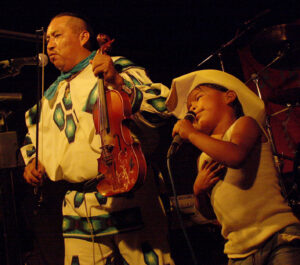
The Venado Azul band, from the Sierra Madre Occidental de Jalisco, in Mexico. Founded 18 years ago, in a region that had few houses, many elderly people and everything was different. Today everything has been changing, and the music of this band has crossed borders. The Venado Azul band became known when it participated in the documentary Made in Mexico, which deals with Mexican culture.
The name, Venado Azul, arose on a pilgrimage to Wirikuta, San Luis Potosí, a sacred territory in conflict over tenders to foreign mining companies. In Wirikuta ceremonies are held for deities. Jícuri (peyote) is collected.
Venado Azul is a sacred symbol for the Wixárika- Huichol community, which is why they chose this name, which represents the infinite and the guide.
Music is the mantra, magic, socialization, the combination to be able to talk with someone from heart to heart, from thought to thought. Music comesthrough culture, tradition, which awakens and is installed in the spirit to continue with traditional music, which is not composed by the human being, but listened to.
Myth of the birth god of Fire: Tate’warí-Tai
Before, long before, in the Middle World, which is locatedunder the sky and above the underworld, there was no fire, no moon, no sun, and no people. There were animals but they were all nocturnal because there was no light. Nobody knew anybody because nobody could see anything. Everyone collided with each other, some fought, others devoured each other. Animals lived in caves, in crevices, under stones. They all lived: the bat, the water lion, the owl, the owl, the badger, the rat, the wild cat, the opossum, the snakes and the scorpions. Everybody.
Then, one fine day, in the midst of the darkness, in hersubterranean abode, Tate ’Yuliana’ka, Mother Earth, moved five times, trying to rise up.
In the first attempt to get up, everyone could see on thehorizon something like the fire of a cigarette about to go out. On the second try, she managed to get a little higher and everyone saw something like a dark sun, like an eclipse sun. On the third attempt there was a strong shaking and something cleared, as if it were the beginning of a sunrise. The animals looked at each other in amazement, not knowing what it was. There was a fourth attempt that brought greater clarity and greater wonder.
Finally, when Mother Earth shook for the fifth time, there appeared, luxurious and warm, Tate’warí, the God of Fire who is also given the affectionate name of Tai. He appeared in the center of the world, in Teakata. Tai was a fire never seen before. The animals were ecstatic.
Los wixárikas o wixáricas, conocidos en el resto México como huichol, son un grupo étnico ubicado en los estados Nayarit, Jalisco, San Luís Potosí, Durango y Zacatecas.
Habitan en el oeste central del país, en la Sierra Madre Occidental. Se autodenominan wixárika (la gente) en su lengua, que pertenece a la familia de las lenguas utoaztecas y a la que llaman Wixaritari waniuki.
El etnónimo wixarika proviene de la adaptación al idioma náhuatl del autónimo wixarika, debido a que en idioma wixarika la a puede llegar a oírse como o; r y l son alófonos, y la pronunciación de x, que era sibilante, se interpretó como africada, tz, entre los siglos XVII y XVIII (época en que pudo ocurrir el préstamo de la palabra), pero la pérdida de la sílaba -ka dio como resultado huitzol en náhuatl, y su castellanización, wirraricas.
Los wixárikas hablan una lengua del grupo wixarika que está cercanamente emparentada con la lengua del grupo nahua-aztecoide. Además, han recibido influencias mesoamericanas, lo cual se refleja en el hecho de que el huichol tiene rasgos típicos del área lingüística mesoamericana.
Su espiritualidad tradicional incluye la recolección y el consumo del peyote (Lophophora williamsii), un cactus que posee efectos alucinógenos debido a sus alcaloides psicoactivos, entre ellos la mescalina.
Son reconocidos internacionalmente por sus creaciones artísticas y artesanías, por la proyección de sus mitologías, la búsqueda del abuelo, el venado blanco, el peyote.
Bebida Nawa – Tejuino
El nawa o tejuino es una bebida preparada con maíz cuyo uso entre los wixaritari reviste todo un mundo de significaciones. En el presente texto se expone su uso entre los habitantes de una comunidad wixárika, cuyos haceres y saberes muestran los diferentes caminos que el yeiyari (la tradición) toma para continuar en el camino de los ancestros.
La preparación del tejuino pone a germinar el maíz bajo una capa de arena que es humedecida y, una vez que el maíz tiene los primeros brotes, se lava y se muele en metate o en molino. Se pone a hervir agua y se echa el maíz en ella; se deja hervir durante muchas horas. Una vez hervida la mezcla de agua y maíz, se vacía en recipientes en los que se deja reposar por al menos dos días para que fermente; entre más tiempo pase, mayor es la fermentación. Preparar el nawa es un proceso delicado que recae en las mujeres, quienes deben observar varias prohibiciones: no estar menstruando; no tener relaciones sexuales días antes y durante el lapso en que se elabora el tejuino; no comer azúcar ni alimentos dulces, por ejemplo, naranjas, porque todo el trabajo se echa a perder y la bebida resultará dulce; muy distinta al sabor deseado. A lo anterior hay que sumar los desvelos de las mujeres, quienes deben estar supervisando durante las horas de día y noche que la intensidad del fuego sea la correcta para que la bebida quede bien como es debido. Los hombres, por su parte, deben permanecer alejados del lugar donde se elabora el tejuino para no echarlo a perder con su presencia.
El tejuino, por la materia de que está hecho, representa en cierta medida a la familia wixárika y la cooperación que existe en los diferentes ámbitos entre todos sus miembros: el hombre, las mujeres, niñas y niños que siembran, cuidan de la planta sagrada del maíz y lo cosechan.
Asimismo, en la preparación, los polos opuestos o más bien complementarios, masculino-femenino, siempre están presentes y en constante relación; el hombre que acarrea leña y la mujer que prepara la bebida; el tejuino proviene del maíz seco (masculino), pero que ha germinado (femenino) y ha sido molido para ser cocido en ollas con agua (femenino) lentamente en el fuego (masculino).
Se sirve en jícaras u otros recipientes redondos que representan al mundo, a la totalidad de las rancheríashumanas.
Mito del fuego, el nacimiento del Tate’warí-Tai, el dios del Fuego
Antes, mucho antes, en el Medio Mundo, que se ubica bajo el cielo y por encima del inframundo, no había fuego, ni luna, ni sol, ni gente. Había animales, pero eran todos nocturnos porque no había luz. Nadie conocía a nadie porque nadie podía ver nada. Todos chocaban entre sí, algunos se peleaban, otros se devoraban. Los animales vivían en las cavernas, en las grietas, bajo las piedras. Vivían todos: el murciélago, el león de agua, el búho, la lechuza, el tejón, la rata, el gato montés, el tlacuache, las serpientes y los escorpiones. Todos.
Entonces, un buen día, en medio de las tinieblas, en su morada subterránea, se movió cinco veces Tate’ Yuliana’ka, la Madre Tierra, tratando de alzarse.
En el primer intento por levantarse, todos pudieron ver en el horizonte algo así como la lumbre de un cigarro a punto de apagarse. En el segundo intento, logró alzarse un poco más y todos vieron algo así como un sol oscuro, como un sol de eclipse. En el tercer intento ocurrió una fuerte sacudida y algo aclaró, como si fuera el principio de un amanecer. Los animales se miraban asombrados, sin saber qué cosa era aquello. Hubo un cuarto intento que trajo mayor claridad y mayor asombro.
Finalmente, cuando la Madre Tierra se sacudió por quinta vez apareció, lujoso y cálido, Tate’warí, el Dios del Fuego a quien también se da el nombre cariñoso de Tai. Apareció en el centro del mundo, en Teakata. Tai era una lumbre nunca antes vista. Los animales estaban extasiados.
Canción Cumbia Wixárika Cusinela, del Venado Azul
Cusi acusi cusinela tedenekiete kusinela ¡yaju!
ay kusinela kui kuitamai kuitamalele pamu yama
techale papa, te baricare te ma kuitale si ra ya pomeme
memechimao ni achou, nitze pa nou cuasi ya te ni ba ita
ma atima catacu uti se le pemutei neya onemele la me chi
taou nel e cusinel chita chita, chita pili pili pili me tu pine
nia comermela meche tao eh cusinela ¡jeitzhee!
¡Salud cusinela pampa dios yaju!
(Coro 2) cusinela cusinela cuitamai cuitamai cuitamai
cusinela, cusinela cusinela cuitamai cuitamai cuitamai
cusinela, cusinela cusinela cuitamai cuitamai cuitamai
cusinela, cusinela cusinela cuitamai cuitamai cuitamai
cusinela, cusinela cusinela cuitamai cuitamai cuitamai
cusinela, ¡acusi acusi cusinela!
ay kusinela kui kuitamai kuitamalele pamu yama
techale papa, te baricare te ma kuitale si ra ya pomeme
memechimao ni achou nitze pa nou cuasi ya te ni ba ita
ma atima catacu uti china, le pemutei ne ya comermela
me chi taou ne le cusinela ekuchi, meposelka tikitikitini tusi
tusi tusi me tu pili e cusinela ¡eitzhe!
cusinela pampa dios salu cusinela pampa dios… […]
La banda musical Venado Azul
La banda Venado Azul, de la Sierra Madre Occidental de Jalisco, en México. Fundada hace 18 años, en una región que había pocas casas, muchos ancianos y todo era diferente. Hoy todo ha ido cambiando, y la música de esta banda ha traspasado fronteras. La banda Venado Azul se dio a conocer cuando participó en el documental Hecho en México, que trata de la cultura mexicana.
El nombre, Venado Azul, surgió en una peregrinación a Wirikuta, San Luis Potosí, un territorio sagrado en conflicto por licitaciones a empresas mineras extranjeras. En Wirikuta se llevan a cabo ceremonias para las deidades. Se recolecta jícuri (peyote).
Venado Azul es un símbolo sagrado para la comunidad Wixárika-huichol, por ello escogieron este nombre, que representa el infinito y el guía.
La música es el mantra, la magia, la socialización, la combinación para poder platicar con alguien de corazón a corazón, de pensamiento a pensamiento. La música llega por la cultura, la tradición, la cual despierta y se instala en el espíritu para seguir con la música tradicional, que no es compuesta por el ser humano, sino escuchada.
Venado Azul está integrado por José López Robles, vocalista, violín y director musical; Esteban García Vergara, tololoche; Albino de la Cruz Díaz, vihuela; Alma Delia Torres, segunda voz, y Manuel Ávila, mánager.