



















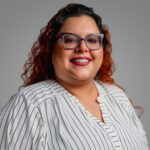
Alycia Meriweather’s lifelong work has gained her one of the Skillman Foundation’s 2026 Visionary Awards.
Long before Meriweather was Deputy Superintendent of Detroit Public Schools Community District (DPSCD), or a recipient of the Skillman Foundation Visionary Award, she was teaching her stuffed animals.
“I always knew I wanted to be a teacher,” said Meriweather.
From the time she was eight years old, she’d imagine herself in front of a classroom. The dream became a goal as she babysat neighborhood children, led youth groups, became a science teacher, and eventually held professional development trainings for teachers.
Teaching simply ran in her family. Her father was a science teacher. The family spent a year overseas in Liberia, West Africa where her father taught school and he taught her seventh grade science class that year.
With the exception of that year overseas, Meriweather has attended Detroit schools from head start through college.She has lived in Southwest Detroit for over 30 years, giving her a deep understanding and connection of the neighborhood’s specific needs.
“You have to work to change larger systems,” Meriweather said, referring to district, state, and federal policies, “but at the same time, you can’t neglect who’s right in front of you.”
The balance is a challenge but challenges and gaps are what make the work worth it, she says, remembering the 14 months in which she serves as interim superintendent of DPSCD after the district transitioned from emergency management back to local control.
Whether confronting longstanding inequity or responding to an immediate need, Meriweather believes lasting progress requires long-term vision and practical action.
That mindset has earned her the respect and admiration from colleagues.
“You could tell that when she spoke about instruction or curriculum, that it came from the heart as a teacher, which I think gave her a very powerful lens,” said Angel Garcia, principal of Western International High School. Garcia met Meriweather over a decade ago.
Over the years, Garcia acknowledges that she is a constant in an ever changing educational landscape.
“She’s withstood a lot of change because I think that she’s just a person who’s got a lot of integrity and obviously works very hard at what she does,” Garcia said.
An example of Meriweather’s approach is the creation of DPSCD Health Hubs, an initiative designed to address the underlying causes of chronic absenteeism. Rather than treating absenteeism as a behavioral problem, she views it as a symptom of barriers that the district’s families face, such as transportation issues, health care access, food insecurity, and access to basic hygiene necessities.
The Health Hubs are physically located in local high schools, such as Western. They serve to connect students and their families with wraparound resources including clothing, legal aid, and community organizations.
Garcia remembers how difficult it used to be to connect families to those services.
“In Southwest Detroit, finding resources, nonprofits, and necessary programs was really difficult years ago when I first became principal,” Garcia said. According to Garcia, Meriweather’s efforts to bridge these resources and fill the need gaps is what makes her so collaborative. “Collaborating with all these different partners and then coordinating and creating this thing that I’ve never seen exist before really is a testament to her ability to just create structures and systems that benefit communities.”
And you can measure the data. She has tackled absenteeism in such a way that district-wide absenteeism fell from 79% during the 2021-2022 school year to 66% by 2023-2024.
But it’s not all about numbers. Ashley Aidenbaum, Director of Strategic Initiatives at the Skillman Foundation, believes it is Meriweather’s commitment to addressing the root barriers that exist beyond the classroom.
“She uses data to understand problems and assess solutions, but she also talks to students, families, and educators to really understand the story behind the numbers so that her solutions can be really rooted in community,” said Aidenbaum.
Meriweather thinks deeply about the way schools are funded.She believes funding should directly correlate with the needs of the student, versus the traditional model which allocates the same financial support to every child, regardless of need.
“The bigger question is, how are we funding students?” Meriweather said.
She argues that students growing up in poverty or affected by trauma need additional resources to reach the same opportunities as their peers. The DPSCD Health Hubs served 8,000 students last year. However, most of the resources allocated to the Health Hubs rely on philanthropic support, rather than stable public funding.
Nonetheless, Meriweather remains optimistic about the future.
”When you walk in purpose, you don’t lose hope,” Meriweather said.
Community schools, in her opinion, should be the standard, not the exception. This model would assess the needs of the individual student to move them toward academic growth.
Because she has lived in Detroit for most of her life, the vision she has for the local education system is built on personal experience and deep understanding creating a more sustainable, equitable future for students.
”I always knew I wanted to be a teacher, and I knew I wanted to teach in Detroit,” Meriweather said. “I want to see the next generation come from the city and teach in the city as a continual evolution.”
La Visión de Equidad Educativa de la Vicepresidenta Superintendente Alycia Meriweather
El trabajo de toda la vida de Alycia Meriweather le ha ganado uno de los Skillman Foundation Visionary Awards 2026.
Mucho antes de que Meriweather fuera Vicepresidenta Superintendente del Detroit Public Schools Community District (DPSCD), o receptora del Skillman Foundation Visionary Award, estaba enseñando a sus animales de peluche.
“Siempre supe que quería ser maestra,” dijo Meriweather.
Desde los ocho años de edad, se imaginaba a sí misma enfrente de una aula. El sueño se convirtió en una meta mientras cuidaba niños del barrio, lideraba grupos de juventud, se convirtió en maestra de ciencias, e eventualmente realizó entrenamientos de desarrollo profesional para maestros.
La enseñanza simplemente corría en su familia. Su padre era un maestro de ciencias. La familia pasó un año en el extranjero en Liberia, África Occidental donde su padre enseñaba escuela y enseñó su clase de ciencias de séptimo grado ese año.
Con la excepción de ese año en el extranjero, Meriweather ha asistido a escuelas de Detroit desde head start hasta la universidad. Ha vivido en Southwest Detroit durante más de 30 años, dándole una comprensión profunda y conexión de las necesidades específicas del barrio.
“Tienes que trabajar para cambiar sistemas más grandes,” dijo Meriweather, refiriéndose a políticas de distrito, estado, y federal, “pero al mismo tiempo, no puedes descuidar a quién está directamente enfrente de ti.”
El equilibrio es un desafío pero los desafíos y brechas son lo que hace el trabajo valioso, dice, recordando los 14 meses en los cuales sirvió como superintendente interina de DPSCD después de que el distrito hizo la transición de manejo de emergencia a control local.
Ya sea confrontando inequidad histórica o respondiendo a una necesidad inmediata, Meriweather cree que el progreso duradero requiere visión a largo plazo y acción práctica.
Esa mentalidad le ha ganado respeto y admiración de colegas.
“Podías decir que cuando ella hablaba sobre instrucción o currículo, que venía del corazón como maestra, que creo le dio un lente muy poderoso,” dijo Angel Garcia, directora de Western International High School. Garcia conoció a Meriweather hace más de una década.
A lo largo de los años, Garcia reconoce que es una constante en un paisaje educativo siempre cambiante.
“Ha resistido mucho cambio porque creo que es solo una persona que tiene mucha integridad y obvio trabaja muy duro en lo que hace,” dijo Garcia.
Un ejemplo del enfoque de Meriweather es la creación de DPSCD Health Hubs, una iniciativa diseñada para abordar las causas subyacentes del ausentismo crónico. En lugar de tratar el ausentismo como un problema de comportamiento, lo ve como un síntoma de barreras que enfrentan las familias del distrito, como problemas de transporte, acceso a atención médica, inseguridad alimentaria, y acceso a necesidades básicas de higiene.
Los Health Hubs están ubicados físicamente en escuelas preparatorias locales, como Western. Sirven para conectar estudiantes y sus familias con recursos comprehensivos incluyendo ropa, asistencia legal, y organizaciones comunitarias.
Garcia recuerda lo difícil que solía ser conectar familias a esos servicios.
“En Southwest Detroit, encontrar recursos, organizaciones sin fines de lucro, y programas necesarios era realmente difícil años atrás cuando primero me convertí en directora,” dijo Garcia. De acuerdo a Garcia, los esfuerzos de Meriweather para cerrar la brecha de estos recursos y llenar las brechas de necesidad es lo que la hace tan colaborativa. “Colaborar con todos estos diferentes socios y luego coordinar y crear esta cosa que nunca he visto existir antes realmente es un testimonio de su capacidad de solo crear estructuras y sistemas que benefician comunidades.”
Y puedes medir los datos. Ha abordado el ausentismo de tal manera que el ausentismo a nivel de distrito cayó de 79 por ciento durante el año escolar 2021-2022 a 66 por ciento para 2023-2024.
Pero no se trata solo de números. Ashley Aidenbaum, Directora de Strategic Initiatives en la Skillman Foundation, cree que es el compromiso de Meriweather de abordar las barreras raíz que existen más allá del aula.
“Usa datos para entender problemas y evaluar soluciones, pero también habla con estudiantes, familias, y educadores para realmente entender la historia detrás de los números para que sus soluciones puedan estar realmente arraigadas en la comunidad,” dijo Aidenbaum.
Meriweather piensa profundamente sobre la manera en que las escuelas están financiadas. Cree que el financiamiento debe correlacionar directamente con las necesidades del estudiante, versus el modelo tradicional que asigna el mismo apoyo financiero a cada niño, sin importar la necesidad.
“La pregunta más grande es, ¿cómo estamos financiando estudiantes?” dijo Meriweather.
Ella argumenta que estudiantes creciendo en pobreza o afectados por trauma necesitan recursos adicionales para alcanzar las mismas oportunidades como sus pares. Los DPSCD Health Hubs sirvieron a 8,000 estudiantes el año pasado. Sin embargo, la mayoría de recursos asignados a los Health Hubs se basan en apoyo filantrópico, en lugar de financiamiento público estable.
Sin embargo, Meriweather permanece optimista sobre el futuro.
“Cuando caminas en propósito, no pierdes esperanza,” dijo Meriweather.
Las escuelas comunitarias, en su opinión, deberían ser el estándar, no la excepción. Este modelo evaluaría las necesidades del estudiante individual para moverlos hacia crecimiento académico.
Porque ha vivido en Detroit durante la mayoría de su vida, la visión que tiene para el sistema educativo local está construida sobre experiencia personal y comprensión profunda creando un futuro más sostenible y equitativo para estudiantes.
“Siempre supe que quería ser maestra, y supe que quería enseñar en Detroit,” dijo Meriweather. “Quiero ver la próxima generación venir de la ciudad y enseñar en la ciudad como una evolución continua.”